
Agar Armor: The Biopolymer Plant Shield
Ajeet Toor, Harvinder Chouhan
Gobind Sarvar School Guru Nanak Gate Campus
Grade 11
Presentation
No video provided
Hypothesis
If seeds are grown in a biopolymer suspension containing agar-agar and microplastics (PE, PP, and PET), then seed germination, root development, and early plant growth will be less negatively affected than in seeds exposed to microplastics alone. This is because microplastics can interfere with water absorption, nutrient availability, and root penetration, which can reduce germination rates, slow growth, and impair overall plant health. The agar-agar in the suspension is expected to temporarily improve soil moisture, create a more stable growth environment, and partially reduce the physical barriers and chemical disruptions caused by microplastics. As a result, seeds exposed to the agar-agar microplastic suspension may germinate more successfully, develop stronger roots, and exhibit greater overall growth than seeds exposed to microplastics without the biopolymer. This experiment models a potential way natural biopolymers could help reduce the environmental impacts of plastic pollution on agriculture and ecosystems.
Research
MICROPLASTICS: What are Microplastics? Microplastics are tiny pieces of plastic smaller than 5 millimetres (about the size of a pencil eraser). They can have many different shapes, such as tiny fragments, beads, fibres, films, foams, or pellets, and they are made from many common plastics (polyethylene, polypropylene, polystyrene, polyvinyl chloride, etc.). When plastics break down in the environment, they form secondary microplastics. When plastics are manufactured small on purpose (for example, some beads or resin pellets), they are called primary microplastics. Even smaller particles, below one micrometre, are often referred to as nanoplastics.
How do Microplastics Enter the Environment? Microplastics come from a wide range of everyday sources: Wear and Tear: Tire dust from roads, worn fishing ropes, and damaged plastic equipment release small fragments and fibres. Textiles: Synthetic clothes shed tiny plastic fibres when washed, which then enter wastewater systems. Single-Use Plastics: Items such as packaging, bottles, bags, and cigarette butts break down over time into smaller plastic particles. Cosmetics and Industrial Pellets: Some personal care products previously contained microbeads, and Plastic resin pellets used in manufacturing can leak into the environment. Recent Sources: The increased use and disposal of PPE (Personal Protective Equipment), such as face masks during the COVID-19 pandemic have added more plastic waste and microplastics particles. From land, microplastics are carried into rivers and oceans through litter, stormwater runoff, wastewater discharge, and sewer overflows. They are now found on beaches, in water, deep-sea sediments, soil, and even in the air.
What Happens to Microplastics in Soil? When microplastics enter soil through sources such as wastewater irrigation, sewage sludge, plastic mulches, litter, or air deposition, they can affect the soil in several ways: Physical Effects:
- Change Soil Structure and Porosity:
Particles can alter pore size distribution, affecting how water moves and is stored in soil.
- Change Soil Density and Air Flow:
Depending on the type and concentration, plastics may change compaction and oxygen availability.
- Interfere with Root Growth:
Sharp fragments or a layer of high-fibre content could physically block or redirect roots. Chemical Effects:
- Absorption of Nutrients and Pollutants:
Microplastic surfaces can attract and hold onto dissolved ions, organic pollutants (such as pesticides or PAHs [Polycyclic Aromatic Hydrocarbons - Chemical pollutants made up of multiple connected carbon rings]), and heavy metals. That can lower the free concentration of those substances in soil solution or concentrate pollutants on the plastic surface (?).
- Leaching of Additives:
Many plastics contain chemical additives (plasticizers such as phthalates, bisphenol A, flame retardants, dyes). These additives can leach into soil water and potentially alter nutrient dynamics or become toxic to organisms.
- Carrier of Microbes and Chemicals:
Microplastics can transport microorganisms, including antibiotic-resistant bacteria, and concentrate other contaminants on their surfaces, changing the chemical and biological micro-environment near roots. Biological Effects:
- Change Microbial Communities:
Microplastics may favour or reduce certain soil microbes, which in turn affects decomposition and nutrient cycling.
- Influence Nutrient Availability:
By absorbing nutrients or changing microbial processing, microplastics can alter how much nitrogen, phosphorus, and other key nutrients are available to plants.
Effects on Plants and Animals: Research is still developing, but studies have observed effects such as:
- Reduced germination rates and slower early growth in some plant species when grown in soils contaminated with microplastics.
- Changes to root structure (shorter roots or different branching patterns) in response to certain plastic types or concentrations.
- Changed plant biomass and, in some cases, lower nutrient content in plant tissues.
- In animals, swallowing microplastics can cause physical blockages, reduced feeding, inflammation, and the buildup of chemicals associated with plastics in tissues. Microplastics have been detected in marine animals throughout the food web and are increasingly being found in terrestrial organisms as well.
- Smaller particles (nanoplastics) might be able to cross cell walls and enter tissues. This is an active area of research with important implications.
Human Health Concerns and Broader Implications: Microplastics have been found in drinking water, seafood, table salt, and even in human tissues. Although scientists are still figuring out the full effects on human health, laboratory and animal research states possible impacts such as inflammation, oxidative stress, and interference with normal biological functions, partly because plastics can carry toxic additives and absorb pollutants. Since microplastics may also affect soil processes and crop quality, contamination of agricultural soils could have long-term consequences for food security and increase human exposure over time.
Gap and Challenges in Microplastic Research: Standardization: Scientists are still improving how microplastics are sampled and measured, which makes it hard to directly compare results from studies. Particle Diversity: Microplastics come in many shapes, sizes, and chemical types, and they don’t all behave the same way. Due to that, it is difficult to make broad, one-size-fits-all conclusions. Low-Concentration Effects: In many environments, microplastics exist at low but constant levels. Figuring out how these long-term, low-level exposures affect living organisms is challenging. Nanoplastics: The tiniest particles are especially hard to detect and study, but they may be very important for understanding potential risks and impacts.
AGAR AGAR POWDER: (We used GEL) What is Agar Agar Powder? Agar-agar (often shortened to “agar”) is a vegetable/plant gelatin extracted from certain red algae (seaweed). It is a mixture of polysaccharides (mainly agarose and agaropectin) that form a jelly when dissolved in hot water and cooled. It is sold commercially as powder, flakes, bars, or strands. The powder form dissolves fastest and is commonly used in recipes.
| Agarose | Agaropectin |
|---|---|
| Gel Strength | Gel Flexibility |
| Neutral | Charged |
| Strong | Weak |
| Very Consistent | Variable |
| Labs and Research | Food and Crude Agar |
| Structure and Precision | Chemical Interaction |
Difference Between Agar-Agar Powder and Agar Gel:
- Powder: It is finely ground and dissolves quickly when boiled into a liquid. It is easiest to measure and substitute.
- Flakes/ Bars/ Strands: They are more whole forms produced when seaweed is processed, and they take longer to hydrate/ dissolve and are often ground or soaked first.
- Gel: The prepared (already dissolved + cooled) jelly is formed after cooking agar into a liquid and letting it sit. Gel is the result of using powder or flakes, not a different raw material. (Powder→boil→cool→gel)
What is Agar Used For?
-
Culinary:
-
Vegan substitute for gelatin in jellies
- Puddings
- Custards
- Gummy candies
- Ice cream stabilizer
- Japanese desserts (Kanten/Anmitsu)
-
It sets firmer than gelatin and can stay stable at higher temperatures.
-
Non-Culinary:
-
Clarifying factor in brewing
- Filler in paper/ fabric sizing
- Scientific uses (not many microbiology agar plates
Positive and Negative Effects of Agar?
Positives:
|
Negatives:
|
|---|---|
Why Can/ Can Not Agar be Used in Normal Plastics? Agar HAS properties that make it useful in biodegradable or experimental plastics, especially in research:
-
Biopolymer:
-
Agar is a natural polymer, so it can form films and solid structures, similar to plastic.
-
Renewable and Biodegradable:
-
Unlike petroleum-based plastics, agar can break down naturally over time due to its biodegradable nature.
-
Acts as a Binder or Filler:
-
When mixed with other materials (such as starch or glycerol), agar can help hold a composite material together.
-
Useful for Prototyping Eco-Plastics:
-
It is often used in lab-scale “bioplastics” to test sustainability ideas.
“Normal Plastics” (such as polyethylene, polypropylene, PET) are designed for very specific industrial properties that Agar CAN NOT meet:
-
Not Heat-Resistant Enough:
-
Agar softens and breaks down at temperatures where conventional plastics are manufactured.
-
Industrial plastics are melted and shaped at very high temperatures, which would destroy agar.
-
Highly Water-Sensitive:
-
Agar absorbs water easily and can swell or dissolve.
-
Most everyday plastics are water-resistant, while agar is not.
-
Too Brittle on its Own:
-
Pure agar-based materials crack and break easily.
-
Conventional plastics are flexible and durable.
-
Short Lifespan:
-
Agar biodegrades relatively quickly.
-
“Normal plastics” are designed to last for years without breaking down.
-
Incompatible Chemistry:
-
Agar is hydrophilic (like/ attract water).
- Most conventional plastics are hydrophobic (repel water), so they don't mix well at a molecular level.
Agar Agar is better suited for biodegradable plastic alternatives or composites, not for replacing traditional plastics directly. That is why it is researched as an additive or experimental bioplastic, not a drop-in replacement.
Effect of Agar Agar on Plants and Animals:
| PLANTS | ANIMALS |
|---|---|
Positive Effects:
|
Positive Effects:
|
Negative Effects:
|
Negative Effects:
|
Environmental Perspective:
- Biodegradable: Breaks down naturally over time.
- Low environmental risk compared to synthetic plastics.
- Short-term impact rather than long-term accumulation.
- Agar is generally safe and non-toxic for plants and animals, but in high concentrations, it can restrict growth, movement, or digestion due to its strong water-absorbing and gelling properties.
What Happens to Agar in Soil?
-
Absorbs Water:
-
Agar is hydrophilic, meaning it attracts and holds water.
-
In soil, it can temporarily increase moisture retention, which can help seeds or roots stay hydrated.
-
Forms a Gel:
-
When mixed with water and soil, agar can create a jelly-like layer.
-
This can limit root penetration if too concentrated, which is why agar is usually kept warm or used at lower concentrations to prevent it from forming a firm gel.
-
Slows Nutrient Movement:
-
Agar gel can act as a barrier, making it harder for water-soluble nutrients to move freely to the roots.
-
Breaks Down Over Time:
-
Agar is biodegradable, so microbes in the soil gradually digest and decompose it.
-
This means it does NOT persist long-term, unlike synthetic plastics.
-
Effect on Soil Structure:
-
Small amounts may slightly soften dry soil.
-
Large amounts can make soil compacted and jelly-like, which can suffocate roots.
-
No Toxic Residue:
-
Agar does NOT release harmful chemicals, so it is considered safe for plants and soil organisms.
Agar in soil mostly retains water and forms a gel, temporarily affecting root growth and nutrient flow, but it biodegrades naturally without leaving toxins.
Where and How Can Agar be Used? (temperature, environment, product types)
-
In Plant Science/ Gardening:
-
Where: Seed germination, tissue culture labs, and hydroponics experiments.
-
How:
-
Dissolve agar powder in water or nutrient solution by heating (usually near boiling) until fully dissolved.
-
Cool slightly to room temperature to create a gel medium.
-
Temperature Considerations:
-
Agar liquefies when heated and solidifies around 32-40°C.
-
Roots can grow through softer gels, but too firm of a gel can resist growth.
-
Products: Lab growth media, plant culture gels, experimental hydroponic gels.
-
In Microbiology/ Science Labs:
-
Where: Petri dishes for bacteria, fungi, and other microorganisms.
- How: Agar is mixed with nutrient broth, sterilized, poured into plates, and cooled to form a gel.
- Temperature: Agar remains stable up to \~85°C before melting. It forms a gel at \~32-40°C.
-
Products: Agar plates, nutrient gels, microbial culture media.
-
In the Food Industry:
-
Where: Desserts, jellies, ice cream stabilizers, and dairy products.
- How: Agar powder is dissolved in hot liquids and then cooled to form a gel.
-
Temperature:
-
Dissolves at \~90-100°C (boiling), then cools to room temperature to set.
-
Stable at room temperature and in warm climates, unlike gelatin, which melts easily.
-
Products: Jellies, puddings, vegan desserts, gummy candies, dairy stabilizers.
-
In Biodegradable Materials/ Bioplastics:
-
Where: Experimental bioplastics or soil additives.
-
How:
-
Agar is mixed with other natural polymers (such as starch and glycerol) and water.
-
Heated to dissolve, then cooled to form a solid film.
-
Temperature: Heat needed to dissolve (\~90-100°C), avoiding temperatures that degrade natural additives.
- Products: Biodegradable films, soil stabilizers, and experimental eco-friendly plastics.
How Can Agar be Used in Traditional/ Conventional Plastics to Reduce Plastic Pollution? Short Answer: Agar can NOT replace conventional plastics, but it can be used as a biodegradable phase or filler inside plastic composites to increase fragmentation and biodegradation while maintaining usable mechanical properties.
-
The ONLY realistic way agar can be used in “normal plastics”
-
Agar can NOT be melted and processed, unlike plastics such as polyethylene or polypropylene.
- So instead, scientists use agar in composite plastics, meaning:
- A petroleum plastic matrix + agar-based biodegradable domains ↳ These are called biopolymer-synthetic polymer composites.
-
How agar is actually incorporated (mechanism):
-
Agar is plasticized (usually with glycerol or sorbitol).
- It is dispersed as a solid or gel phase inside another polymer.
- The synthetic plastic provides strength.
-
Agar provides biodegradability and microbial access.
-
When agar degrades:
-
It creates voids
- Increases surface area
- Accelerates fragmentation
-
Reduces the persistence of microplastics
-
EXACT AMOUNTS of Agar used in plastic:
-
As previously researched, too much agar can ruin the plastic.
- Typical agar/ polysaccharide loading ranges:
| Agar Content (by weight percentages) | Reactions/ Products: |
|---|---|
| <5 wt% | Minimal biodegradation effect. |
| 5-15 wt% | Best Balance: Plastic still performs well, and biodegradation increases. |
| 15-30 wt% | Significant loss of strength and high water sensitivity. |
| >30 wt% | Material behaves like bioplastic, not normal plastic. |
-
Sweet Spot: Most studies state \~10-20 wt% agar-based material functions best like conventional plastics.
-
This allows the tensile strength to still be usable, partial biodegradation, and reduced microplastic persistence.
-
Can this plastic still “perform like traditional plastic”?
-
Yes, though this partially depends on the use:
| Property | Result |
|---|---|
| Tensile Strength: | Reduced, but still usable. |
| Flexibility: | Lower, unless plasticized. |
| Heat Resistance: | Lower |
| Water Resistance: | Worse |
| Environmental Breakdown: | Much better |
-
With this, we can conclude it is NOT suitable for:
-
Bottles, electronics, and high-heat uses.
-
Though it IS suitable for:
-
Agricultural films, mulch plastics, packaging, and short-life consumer items.
-
Does this mixture biodegrade at the same rate as agar alone?
-
No, it does NOT, and this is important.
-
What really happens is:
-
Agar domains degrade first.
- Plastic matrix fragments faster.
-
Overall degradation is FASTER than conventional plastics, but slower than pure agar.
-
Why does this mixture help plastic pollution?
-
Using agar:
-
Introduces microbial weak points.
- Prevents the formation of long-lasting microplastics.
- Reduces the persistence time.
-
Improves the soil and compost breakdown.
-
This does NOT eliminate plastic pollution, but it reduces the severity and duration of it.
CONCLUSION: Agar alone can NOT replace conventional plastics, but when used at around 10-20 wt% in composite materials, it creates biodegradable regions that accelerate fragmentation and reduce microplastic persistence with environmental benefit, and is currently the most realistic way agar could help reduce plastic pollution.
CONVENTIONAL PLASTICS: What Are Conventional Plastics?
- Conventional plastics are synthetic polymers made from petroleum or natural gas.
-
Common types of plastics include:
-
Polyethylene (PE): shopping bags and bottles
- Polypropylene (PP): packaging and automotive parts
- Polyvinyl Chloride (PVC): pipes and flooring
- Polystyrene (PS): foam cups and insulation
- Polyethylene Terephthalate (PET): soda bottles and food containers
How are These Plastics Made?
- Petrochemical Feedstocks (such as ethylene or propylene) are polymerized into long chians.
-
Often, additives are added for:
-
Flexibility (plasticizers)
- Color (dyes)
- Flame Resistance
- Durability
What are Their Properties?
| PROPERTY: | DESCRIPTION: |
|---|---|
| Strength and Durability: | Very strong and long-lasting. |
| Water Resistance: | Usually hydrophobic, and do NOT absorb water. |
| Heat Resistance: | Usually Varies: Some melt at low temperatures (PE), while others resist heat (PVC). |
| Flexibility: | Can be flexible or rigid depending on the additives. |
| Lifespan: | Can last hundreds of years in the environment. |
Environmental Concerns:
- Non-biodegradable → stay in the environment for decades to centuries.
- Break into Microplastics → tiny pieces of plastic that contaminate soil, water, and food chains.
- Additives can leach → some are toxic (such as BPA or phthalates).
- Global plastic pollution → over 300 million tons of plastic are produced yearly
- \~8 million tons enter oceans.
Why They are Difficult to Replace:
- Very cheap and easy to produce. (Similar to today's fast-fashion)
-
Very versatile:
-
Used in packaging, construction, electronics, and automotive industries.
-
Can withstand heat, UV light, and chemicals better than natural biopolymers such as agar or scratch.
| Basic Words & Sentences: |
|---|
| Tensile Strength: Tensile strength is the maximum stress a material can endure while being stretched or pulled before it breaks or fractures. |
| Reduced Microplastic Persistence: A decrease in the length of time that plastic particles (less than 5mm) remain in the environment or within living organisms before breaking down into harmless, non-plastic components. |
| Petrochemical Feedstocks: The raw materials, mainly derived from oil and natural gas, that are used to create the building blocks for thousands of everyday products. |
| Germination: The process by which a plant grows from a seed into a seedling. |
| Biomass: Organic material that comes from plants and animals (microorganisms) and is used as a renewable source of energy. |
| Difficult Sentences: |
|---|
| That can lower the free concentration of those substances in soil solution or concentrate pollutants on the plastic surface (?). |
| ↳Simplest form: "It can reduce harmful substances in the soil water or cause pollutants to build up on the plastic surface." |
Wt %: wt → weight
|
Variables
Variables: Independent: Treatment type:
- Control (water only)
- Microplastics suspended in water (PE, PP, PET)
-
Microplastics suspended in agar-agar gel (PE, PP, PET)
-
Microplastic concentration (example levels: low/ medium/ high, define exact mg/g soil or % w/w in protocol)
- Microplastic polymer type: polyethylene (PE), polypropylene (PP), polyethylene terephthalate (PET)
- Application timing: incorporation at Day 0 and re-application at Day 15
- Plant species (if being compared as separate treatments): marigold, cosmos, kale, radish, peace lily, pothos
Dependent:
-
Seed germination:
-
How many seeds sprout
-
How fast the seeds sprout
-
Plant growth:
-
Plant height (cm)
-
Number of leaves
-
Leaves:
-
Leaf size
-
Leaf count
-
Plant color / health:
-
How green the leaves are (shows how healthy the plant is)
-
Roots:
-
Root length
-
How strong and spread out the roots are
-
Plant mass:
-
Weight of the plant after it is dried at the end of the experiment
-
Soil condition:
-
Soil pH (how acidic or basic the soil is)
-
Overall plant health:
-
Signs like wilting, yellow leaves, or weak growth
-
Photos:
-
Pictures taken every few days to compare growth over time
Controlling:
- Same soil type and amount in all pots
- Same pot size
- Same type and number of seeds/plants per pot
- Same water source (tap water)
- Same amount of water each time
- Same watering schedule
- Same light exposure (sunlight)
- Same temperature
- Same length of experiment
- Same method of applying solutions
Procedure
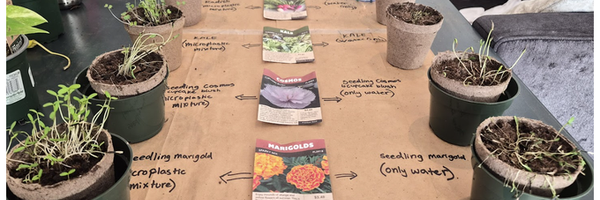
Experimental materials and process: We will be using multiple plants in this experiment. We will be experimenting with seedlings and the effects of microplastics- agar agar powder solution and water over the span of a month. Additionally, we are also testing with grown plants aswell. We will have a control group that will just grow with normal water and no microplastics. Plants with no previous growth (seeds):
- Marigold
- Cosmos
- Kale
- radish
Plants that are already grown:
- We will be using the Peace Lily (Spathiphyllum), as they require plenty of water and will show significant results.
- Pothos (non- variegated money plant) nodes with at least 3 leaves will be introduced to the microplastic solution and water.
Microplastic solution that will be used on plants: We will be testing and understanding this substance on plants, searching for potential benefits. Also, since microplastics do not dissolve in water, we will create a suspension of this solution and use it not only to spray the plants, but also to incorporate it into the soil for the seeds to grow in, by kneading and mixing the solution into the soil. The solution will consist of :
- Water
- Polyethylene (PE), Polypropylene (PP), and Polyethylene terephthalate (PET): these are some of the most common microplastics that affect plants and nature in general. For (PE) & (PP), we may rely on the common Ziploc sandwich bags.
- Plastic Bottles: we will be grinding and making them into smaller particles by cutting in to smaller pieces and blending them in a common blender. We will also rely on this for the (PET) content.
- Agar Agar powder: to create a solution medium, in this case, a suspension. This natural powder will determine the beneficial effects of the addition of these microplastics.
*We could possibly have used a hydroponic medium, but not all plants grow under such a medium, so we will only water with a solution and incorporate it into the soil on the first day and on the 15th. * The water used will be Calgary city-treated potable water/ tap water * sunlight will be an independent variable
Testing and observing: We will be testing and observing many different components of plant growth & performance. In this case, we will be testing:
- Plant height
- Leaf size/ surface area
- Pigment/chlorophyll content
- Soil PH
- Dry mass (on the last day of observation) will include one whole seedling sample and will be added to the observation folder
- Root systems (on the first and last day of observation)
*All plants, controls, grown, and seedlings will be tested using all these factors, and will have the same light and temperature conditions. Pictures of the plants will be taken at intervals of every 4th day and on specific interesting days of observation. All images will be printed and placed in the observation folder.
Watering cycles: All plants have different watering cycles depending on their conditional needs. According to their species, we water them accordingly. The common denominator is that we will be watering 2 - 3 times every week according to plant data.
Observations
Observations: Day 1 (January 15)
| Plant type: | Plant height | Leaf size | Soil PH | Dry mass
(Day 15) | Root system
(Day 15) |
| ----------- | ------------ | --------- | ------- | ---------------- | -------------------- |
| Marigold (Mix) | 0 | 0 | 5 |
|
|
| Marigold | 0 | 0 | 5.5 |
|
|
| Cosmos (Mix) | 0 | 0 | 5 |
|
|
| Cosmos | 0 | 0 | 5.5 |
|
|
| Kale (Mix) | 0 | 0 | 5 |
|
|
| Kale | 0 | 0 | 5.5 |
|
|
| Radish (Mix) | 0 | 0 | 5 |
|
|
| Radish | 0 | 0 | 5.5 |
|
|
| Pothos (Mix) | 11.5 cm | 5 cm | N/A |
|
|
| Pothos | 11.5 cm | 5.4 cm | N/A |
|
|
| Peace lily (Mix) | 18.4 cm | 14 cm | 7 |
|
|
| Peace lily | 24 cm | 19 cm | 7.5 |
|
|
Specific details on day 1:
- All of the pothos (aquatics) were cut to the nodes at exactly a full length of 11.5 cm on each.
- The peace lilies were taken from a larger plant and were re-potted in separate planters
- Every pot with the mixture was given exactly 3 tablespoons of the mixture
- The pots that will take just water were given 1 tablespoon and 2 teaspoons of microplastics alone
Observations: Day 7 (January 22)
| Plant type: | Plant height | Leaf size | Soil PH | Dry mass
(Day 15) | Root system
(Day 15) |
| ----------- | ------------ | --------- | ------- | ---------------- | -------------------- |
| Marigold (Mix) | 3.5 cm | 0.5 cm | 5 |
|
|
| Marigold | 2.7 cm | 2 mm | 5.5 |
|
|
| Cosmos (Mix) | 2 cm | 4 mm | 5 |
|
|
| Cosmos | 1.2 cm | 3mm | 5.5 |
|
|
| Kale (Mix) | 1 cm | 0 cm | 5 |
|
|
| Kale | 0 cm | 0 cm | 5.5 |
|
|
| Radish (Mix) | 0.5 cm | 0 cm | 5 |
|
|
| Radish | 0 cm | 0 cm | 5.5 |
|
|
| Pothos (Mix) | 11.5 cm | 6 cm | N/A |
|
|
| Pothos | 11.5 cm | 7 cm | N/A |
|
|
| Peace lily (Mix) | 19 cm | 14 cm | 7 |
|
|
| Peace lily | 24 cm | 19 cm | 7.5 |
|
|
Observation details:
- There is no growth in the kale and radish on the only water side.
- The leaves on the peace lilies seem a little more droopy
- First growth of the majority of plants (plants first sprouted)
- PH has remained the same as before
- The leaves of the pothos have grown by a few centimetres
Observations: Day 12 (January 27)
| Plant type: | Plant height | Leaf size | Soil PH | Dry mass
(Day 15) | Root system
(Day 15) |
| ----------- | ------------ | --------- | ------- | ---------------- | -------------------- |
| Marigold (Mix) | 7 cm | 1 cm | 5 |
|
|
| Marigold | 5 cm | 1 cm | 5.5 |
|
|
| Cosmos (Mix) | 7.6 cm | 7 mm | 5 |
|
|
| Cosmos | 7.3 cm | 6 mm | 5.5 |
|
|
| Kale (Mix) | 4 cm | 0.5 cm | 5 |
|
|
| Kale | 1 cm | 0 cm | 5.5 |
|
|
| Radish (Mix) | 0.8 | 0 cm | 5 |
|
|
| Radish | 0 cm | 0 cm | 5.5 |
|
|
| Pothos (Mix) | 15 cm | 8 cm | N/A |
|
|
| Pothos | 15.2 cm | 7.3 cm | N/A |
|
|
| Peace lily (Mix) | 14 cm | 14 cm | 7 |
|
|
| Peace lily | 8 cm | 19 cm | 7.5 |
|
|
Observation details:
- There is still no visible growth in the radish with only water
- The Kale with only water has dried significantly and looks visibly shrivelled, even though they have the same watering cycles as the contrary
- The plant mixture is showing significant growth.
- Both peace lilies have collapsed, though the mixture peace lily is still holding up; the only watered peace lily has fallen over completely
- The pothos on both sides experience some type of verigation, which could be a mutation caused by the microplastics
Observations: Day 15 (January 30)
| Plant type: | Plant height | Leaf size | Soil PH | Dry mass
(Day 15) | Root system
(Day 15) |
| ----------- | ------------ | --------- | ------- | ---------------- | -------------------- |
| Marigold (Mix) | 9 cm | 1.4 cm | 5 | 0.5 g | Fibrous root |
| Marigold | 4 cm | 1 cm | 5.5 | 0.2 g | Fibrous root (developed root rot) |
| Cosmos (Mix) | 8.8 cm | 1 cm | 5 | 0.45 g | Fibrous root (pale in colour) |
| Cosmos | 6 cm | 7 mm | 5.5 | 0.3 g | Underdeveloped fibrous root |
| Kale (Mix) | 6 cm | 9 mm | 5 | 0.3 g | Fibrous root (large in number) |
| Kale | 0 cm | 0 cm | 5.5 | <0.1 g | Minimal development, small, little-tailed fibrous root |
| Radish (Mix) | 1 cm | 4 mm | 5 | 0.1 g | Tiny taproot, slightly swollen, with fine, small fibres attached |
| Radish | 0 cm | 0 cm | 5.5 | <0.1 g | Not germinated properly (no root system) |
| Pothos (Mix) | 15.6 cm | 8.2 cm | N/A | 3.0 g | Adventitious root from the node (small, with a very few fibres) |
| Pothos | 15. 2 cm | 7.3 cm | N/A | 2.8 g | Adventitious root, not that much different from the mix ( small, with a very few fibres) |
| Peace lily (Mix) | 14 cm | 14 cm | 7 | 4.0 g | Fibrous root ball (minimal damage) |
| Peace lily | 6 cm | 19 cm | 7.5 | 3.5 g | Fibrous root system (root rot) |
Final observations/ thoughts:
- The Dry mass procedure was done through baking a sample of each plant, and seeing the mass with all water evaporated - the results show a lot of the intricacies and problems with microplastic affect on roots, and plant weight.
- The peace lilies had a lot of problems, and the one with only watrer delevloped root rot quite quickly in the experiment, though the mix one had held up quite well, even surviving till the end of the experiment
- The radish that only got water did not grow properly at all, with slowly developing nodes, but no higher growth.
- The watered-only marigolds were doing well during the majority of the experiment, though they suddenly developed root rot and lost a lot of growth
- Kale on the only watered side also lost plenty of growth, and even died; the drymass showed that significantly
- Both pothos grafts performed quite well, one even experiencing verigation
- The marigold mix did amazing the whole experiment, experiencing significant growth every day since germination
- The Ph did not change whatsoever throughout the experiment, though it is noticed that the agar mixture made the soil more neutral.
Analysis
Observations: Day 1 (January 15)
| Plant type: | Plant height | Leaf size | Soil PH | Dry mass
(Day 15) | Root system
(Day 15) |
| ----------- | ------------ | --------- | ------- | ---------------- | -------------------- |
| Marigold (Mix) | 0 | 0 | 5 |
|
|
| Marigold | 0 | 0 | 5.5 |
|
|
| Cosmos (Mix) | 0 | 0 | 5 |
|
|
| Cosmos | 0 | 0 | 5.5 |
|
|
| Kale (Mix) | 0 | 0 | 5 |
|
|
| Kale | 0 | 0 | 5.5 |
|
|
| Radish (Mix) | 0 | 0 | 5 |
|
|
| Radish | 0 | 0 | 5.5 |
|
|
| Pothos (Mix) | 11.5 cm | 5 cm | N/A |
|
|
| Pothos | 11.5 cm | 5.4 cm | N/A |
|
|
| Peace lily (Mix) | 18.4 cm | 14 cm | 7 |
|
|
| Peace lily | 24 cm | 19 cm | 7.5 |
|
|
Specific details on day 1:
- All of the pothos (aquatics) were cut to the nodes at exactly a full length of 11.5 cm on each.
- The peace lilies were taken from a larger plant and were re-potted in separate planters
- Every pot with the mixture was given exactly 3 tablespoons of the mixture
- The pots that will take just water were given 1 tablespoon and 2 teaspoons of microplastics alone
Observations: Day 7 (January 22)
| Plant type: | Plant height | Leaf size | Soil PH | Dry mass
(Day 15) | Root system
(Day 15) |
| ----------- | ------------ | --------- | ------- | ---------------- | -------------------- |
| Marigold (Mix) | 3.5 cm | 0.5 cm | 5 |
|
|
| Marigold | 2.7 cm | 2 mm | 5.5 |
|
|
| Cosmos (Mix) | 2 cm | 4 mm | 5 |
|
|
| Cosmos | 1.2 cm | 3mm | 5.5 |
|
|
| Kale (Mix) | 1 cm | 0 cm | 5 |
|
|
| Kale | 0 cm | 0 cm | 5.5 |
|
|
| Radish (Mix) | 0.5 cm | 0 cm | 5 |
|
|
| Radish | 0 cm | 0 cm | 5.5 |
|
|
| Pothos (Mix) | 11.5 cm | 6 cm | N/A |
|
|
| Pothos | 11.5 cm | 7 cm | N/A |
|
|
| Peace lily (Mix) | 19 cm | 14 cm | 7 |
|
|
| Peace lily | 24 cm | 19 cm | 7.5 |
|
|
Observation details:
- There is no growth in the kale and radish on the only water side.
- The leaves on the peace lilies seem a little more droopy
- First growth of the majority of plants (plants first sprouted)
- PH has remained the same as before
- The leaves of the pothos have grown by a few centimetres
Observations: Day 12 (January 27)
| Plant type: | Plant height | Leaf size | Soil PH | Dry mass
(Day 15) | Root system
(Day 15) |
| ----------- | ------------ | --------- | ------- | ---------------- | -------------------- |
| Marigold (Mix) | 7 cm | 1 cm | 5 |
|
|
| Marigold | 5 cm | 1 cm | 5.5 |
|
|
| Cosmos (Mix) | 7.6 cm | 7 mm | 5 |
|
|
| Cosmos | 7.3 cm | 6 mm | 5.5 |
|
|
| Kale (Mix) | 4 cm | 0.5 cm | 5 |
|
|
| Kale | 1 cm | 0 cm | 5.5 |
|
|
| Radish (Mix) | 0.8 | 0 cm | 5 |
|
|
| Radish | 0 cm | 0 cm | 5.5 |
|
|
| Pothos (Mix) | 15 cm | 8 cm | N/A |
|
|
| Pothos | 15.2 cm | 7.3 cm | N/A |
|
|
| Peace lily (Mix) | 14 cm | 14 cm | 7 |
|
|
| Peace lily | 8 cm | 19 cm | 7.5 |
|
|
Observation details:
- There is still no visible growth in the radish with only water
- The Kale with only water has dried significantly and looks visibly shrivelled, even though they have the same watering cycles as the contrary
- The plant mixture is showing significant growth.
- Both peace lilies have collapsed, though the mixture peace lily is still holding up; the only watered peace lily has fallen over completely
- The pothos on both sides experience some type of verigation, which could be a mutation caused by the microplastics
Observations: Day 15 (January 30)
| Plant type: | Plant height | Leaf size | Soil PH | Dry mass
(Day 15) | Root system
(Day 15) |
| ----------- | ------------ | --------- | ------- | ---------------- | -------------------- |
| Marigold (Mix) | 9 cm | 1.4 cm | 5 | 0.5 g | Fibrous root |
| Marigold | 4 cm | 1 cm | 5.5 | 0.2 g | Fibrous root (developed root rot) |
| Cosmos (Mix) | 8.8 cm | 1 cm | 5 | 0.45 g | Fibrous root (pale in colour) |
| Cosmos | 6 cm | 7 mm | 5.5 | 0.3 g | Underdeveloped fibrous root |
| Kale (Mix) | 6 cm | 9 mm | 5 | 0.3 g | Fibrous root (large in number) |
| Kale | 0 cm | 0 cm | 5.5 | <0.1 g | Minimal development, small, little-tailed fibrous root |
| Radish (Mix) | 1 cm | 4 mm | 5 | 0.1 g | Tiny taproot, slightly swollen, with fine, small fibres attached |
| Radish | 0 cm | 0 cm | 5.5 | <0.1 g | Not germinated properly (no root system) |
| Pothos (Mix) | 15.6 cm | 8.2 cm | N/A | 3.0 g | Adventitious root from the node (small, with a very few fibres) |
| Pothos | 15. 2 cm | 7.3 cm | N/A | 2.8 g | Adventitious root, not that much different from the mix ( small, with a very few fibres) |
| Peace lily (Mix) | 14 cm | 14 cm | 7 | 4.0 g | Fibrous root ball (minimal damage) |
| Peace lily | 6 cm | 19 cm | 7.5 | 3.5 g | Fibrous root system (root rot) |
Final observations/ thoughts:
- The Dry mass procedure was done through baking a sample of each plant, and seeing the mass with all water evaporated - the results show a lot of the intricacies and problems with microplastic affect on roots, and plant weight.
- The peace lilies had a lot of problems, and the one with only watrer delevloped root rot quite quickly in the experiment, though the mix one had held up quite well, even surviving till the end of the experiment
- The radish that only got water did not grow properly at all, with slowly developing nodes, but no higher growth.
- The watered-only marigolds were doing well during the majority of the experiment, though they suddenly developed root rot and lost a lot of growth
- Kale on the only watered side also lost plenty of growth, and even died; the drymass showed that significantly
- Both pothos grafts performed quite well, one even experiencing verigation
- The marigold mix did amazing the whole experiment, experiencing significant growth every day since germination
- The Ph did not change whatsoever throughout the experiment, though it is noticed that the agar mixture made the soil more neutral.
Conclusion
Microplastics such as polyethylene, polypropylene, and polyethylene terephthalate are expected to negatively affect plant germination and early growth by altering soil structure, restricting water and nutrient movement, and interfering with root development. The inclusion of agar-agar as a biopolymer suspension is expected to partially stabilize soil moisture and reduce some physical stress caused by microplastics, leading to improved germination and growth compared to microplastics alone. However, agar-agar cannot eliminate all microplastic impacts and may restrict root growth if used at high concentrations. Overall, the study highlights the potential of natural biopolymers to reduce, but not fully remove, the environmental impacts of microplastic pollution, emphasizing the importance of both material innovation and plastic reduction strategies for protecting ecosystems and agricultural productivity.
Application
The results of this study can support improved understanding of how microplastics influence seed germination and early plant growth in contaminated soils. Evidence that agar-agar biopolymer suspensions can partially reduce the negative physical effects of microplastics may help guide the development of biodegradable soil amendments, seed coatings, or growth media designed for polluted environments. Findings may also inform agricultural practices by highlighting risks associated with plastic-contaminated soils and encouraging the reduction of plastic inputs such as synthetic mulches and improperly treated compost. In addition, this research may contribute to bioplastic development by demonstrating how natural biopolymers interact with conventional plastics, supporting composite designs that reduce long-term microplastic persistence in soils.
Sources Of Error
Variations of Microplastic Particle Size. The microplastics in this experiment were made through cutting and blending plastic products including bags and bottles using hands. This would have probably led to the size and shape of particles being uneven. This inconsistency could have influenced the outcome of plant growth because various sizes of microplastics could have different impacts on soil structure\, water movement\, and root interaction. Disproportional Microplastic Soil and Water Distribution. Microplastics are insoluble in water\, and are likely to float or stick together. Although it was mixed before it was applied\, microplastics might not have been distributed evenly in soil or water bodies. This might have led to the exposure of some of the plants to more concentrations than others. Agar-Agar Gel Consistency variation. The solidification strength of agar-agar can vary according to temperature\, concentration and rate of solidification. Minor variations in the firmness of the gel could have varied root penetration\, oxygen\, and movement of nutrients across the pots causing differences in the growth of the plant. Seed Viability differences. The rate of germination and the viability of any seed are not necessarily the same\, even when the seed is of the same package. There is a possibility that some of the seeds were damaged\, immature or less viable\, which might be the reason of slow or no germination in some plants (like radish and kale). Light Variability of the environment. Despite laying plants in the same general location\, the amount of sunlight and the sunlight angle might have differed slightly as a result of the position of the windows\, the time of day\, or vegetation that blocked the sunlight. As sunlight was a variable independent variable\, this might have affected the rate of growth and leaf development. Hydrologic and Moisture variations. Against a regular watering schedule\, the soil water content could have been varying because of the variations in the soil absorption\, water retention in the agar and drainage. Excessive watering or condensed moisture could have caused the root rot in a few plants\, particularly peace lily and marigolds. Limited Sample Size The amount of plants used on each treatment group was small. The sample size could be more efficient as it would minimize the impact of outliers and enhance the validity of the outcome. The weak number of replicates that were used might have increased the impact of individual plant variation. Human Measurement Error The height of the plant\, the size of the leaf\, the length of the root\, and the dry mass are the measurements that were carried out manually. The fact that some tools for measuring\, positioning or observing were inaccurate in by a small margin may also have contributed to the slight errors in the recorded data. Limitations of dry mass measurements We cannot measure a large mass so dry that its effect is negligible\, or so dry that it appears moveable in rapid motions near the limit of observation accessible to us.<|human|>Limitations of Dry-Mass Measurements We cannot measure a large mass so dry that its action is negligible\, nor so dry that it seems to be moving in rapid motions near to the limit of observation to which we can reach. Baking of plant samples was done to determine dry mass. Irregular drying period or temperature could have resulted in an incomplete process or partial tissue burning\, and it can influence final mass values. Tension during Growing of Plants. The transplantation or pruning of peace lilies and pothos was done prior to the commencement of the experiment. Their early development and the quality of their root may have been influenced by transplant shock or cutting shock\, regardless of agar or microplastic.
Citations
MICROPLASTICS: https://magazine.hms.harvard.edu/articles/microplastics-everywhere https://oceanservice.noaa.gov/facts/microplastics.html https://www.dfo-mpo.gc.ca/science/environmental-environnement/microplastics-microplastiques/index-eng.html https://www.unep.org/news-and-stories/story/everything-you-should-know-about-microplastics https://education.nationalgeographic.org/resource/microplastics/ https://pmc.ncbi.nlm.nih.gov/articles/PMC9920460/ AGAR AGAR POWDER: https://www.youtube.com/watch?v=fVDwzZJQIfI https://www.thespruceeats.com/what-is-agar-agar-p2-1000960 https://www.vegetariantimes.com/guides/what-is-agar-agar/ https://www.bulkbarn.ca/en/Products/All/AGAR-AGAR-POWDER-3687 https://draxe.com/nutrition/agar-agar/ https://www.webmd.com/vitamins/ai/ingredientmono-80/agar https://oldfashionfoods.com/product/agar-agar-powder/ USAGE OF AGAR AGAR AND CONVENTIONAL PLASTICS: Hernández-Izquierdo, V. M., & Krochta, J. M. Journal of Food Science. Thermal and mechanical properties of agar-based films, 2008 ↳https://ift.onlinelibrary.wiley.com/doi/10.1111/j.1750-3841.2008.00739.x https://ijsrbs.isroset.org/index.php/j/article/download/662/669/1329 https://pubmed.ncbi.nlm.nih.gov/35683252/ https://www.fherreralab.com/assets/papers/2022%20Agar%20Biopolymer%20Films%20for%20Biodegradable%20Packaging%20A%20Reference%20Dataset%20for%20Exploring%20the%20Limits%20of%20Mechanical%20Performance.pdf? https://pubmed.ncbi.nlm.nih.gov/32442572/ https://pubmed.ncbi.nlm.nih.gov/24507339/ CONVENTIONAL PLASTICS: Andrady, A. L., & Neal, M. A. (2009). Applications and societal benefits of plastics. Philosophical Transactions of the Royal Society B: Biological Sciences. ↳https://doi.org/10.1098/rstb.2008.0304 Geyer, R., Jambeck, J. R., & Law, K. L. (2017). Production, use, and fate of all plastics ever made. Science Advances. ↳https://doi.org/10.1126/sciadv.1700782 Thompson, R. C., et al. (2009). Plastics, the environment and human health: current consensus and future trends. Philosophical Transactions of the Royal Society B: Biological Sciences. ↳https://doi.org/10.1098/rstb.2009.0053
Acknowledgement
- Harrang Kaur - She was a lab nurse/ worker. She is a principal at Gobind Sarvar in Edmonton. She helped us with analyzing diagrams and understanding different types of solutions.
- Mrs. Manjula - She is our Bio-20 teacher, and she helped in various ways, including researching our topic.