
Rolling Rivals: A Golf Ball Showdown
Kai Oakley
R. T. Alderman School
Grade 7
Presentation
No video provided
Hypothesis
Hypothesis: If a golf ball has more dimples, then it will travel further, because there will be less friction between the ball and the ground to slow it down.
Research
In my science experiment, I’m going to test how far four different Titleist golf balls can travel on a green: the Titleist Pro V1, the Titleist Pro V1x, the Titleist Tru Feel and the Titleist Tour Soft. Each of these balls has a different number of dimples, as follows: Titleist Pro V1 has 388, the Titleist Pro V1x has 348 (Titleist Newsroom, 2023), the Titleist Tru Feel has 376 (Zach, R., 2024) and the Titleist Tour Soft has 346 (Covey, T., 2026). I want to see if the amount of dimples a ball has affects the distance they roll on the ground. Additionally, I will be breaking the golf balls into 2 different categories: High End balls (Pro V1 and Pro V1X) and Budget balls (Tru Feel and Tour Soft). Titleist makes high end golf balls for advanced golfers and budget golf balls for amateurs. To make it a fair test, I will not be comparing these balls against each other since the internal core of the budget balls are different than the core of the high end balls.
Dimples on a golf ball might look like nothing but tiny craters, but they are very important for flight distance and rolling distance. Dimples on a golf ball create a thin layer of air that clings to the ball's surface, reducing drag. A dimpled ball has about half the drag of a smooth ball. The dimples reduce drag rate, the enemy of distance. A dimpled golf ball has 50% less drag compared to a smooth one, letting it fly farther (Scientific American, 2005). When objects are in motion, a contact force called friction slows them down because it resists motion by converting some of an object’s kinetic energy into heat as it scrapes against a surface (Britannica, 2025). This idea connects directly to my experiment because since dimples help create less drag in the air while flying, ideally they should also do the same while rolling on the ground; making less contact with the ground, therefore creating less friction and drag.
| Golf Ball Type | # of Dimples/Ball |
|---|---|
| Titleist Pro V1 | 388 |
| Titleist Pro V1X | 348 |
| Titleist Tru Feel | 376 |
| Titleist Tour Soft | 346 |
Variables
Manipulated Type of Titleist golf ball
Responding Distance the golf ball travels in centimeters
Controlled
- Ramp
- Tape measurer
- Starting point on the ramp
- Turf (rolling surface)
- Force applied to ball (none)
Procedure
Procedure:
- Place a ramp with a 25 degree angle slope on a flat turf covered surface (ensure the turf is at least 3 meters long)
- Open 1 pack of the 4 types of golf balls and make sure none of the balls have visible external flaws. Remove any that do.
- Choose 1 ball from the first pack to begin, all balls in the pack will be used in the trials to create a fair test in case of non-visible inconsistencies
- Hold the ball steady on the starting point marked with an X at the top of the ramp
- Release the ball allowing it to roll down the ramp and onto the turf
- Measure the distance the golf ball travels from the bottom edge of the ramp to the front tip of the ball with a tape measure in cm
- Record the distance the golf ball travels in cm in a table
- Repeat steps 3 through 7 ten times for each golf ball type for a total of 40 trials
Observations
| Trial # | Pro V1 (Distance travelled in cm) | Pro V1X (Distance travelled in cm) | Tru Feel (Distance travelled in cm) | Tour Soft (Distance travelled in cm) |
|---|---|---|---|---|
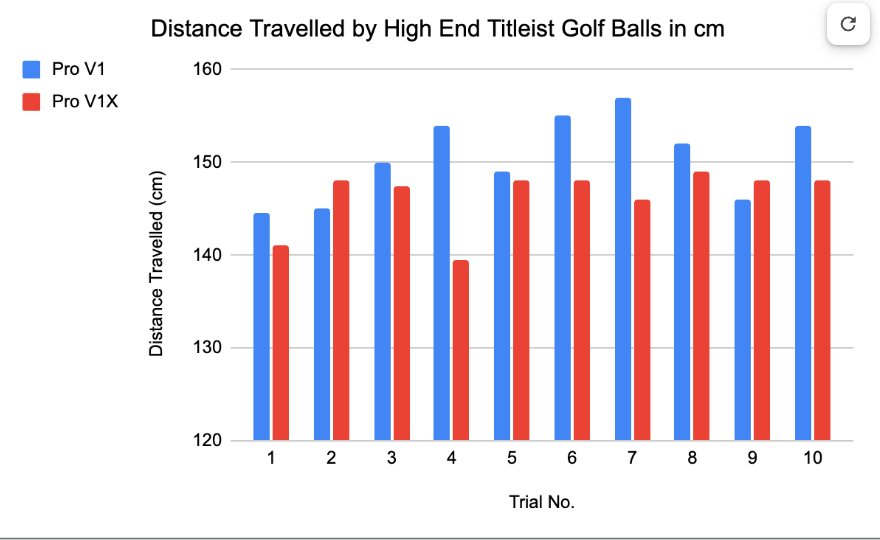
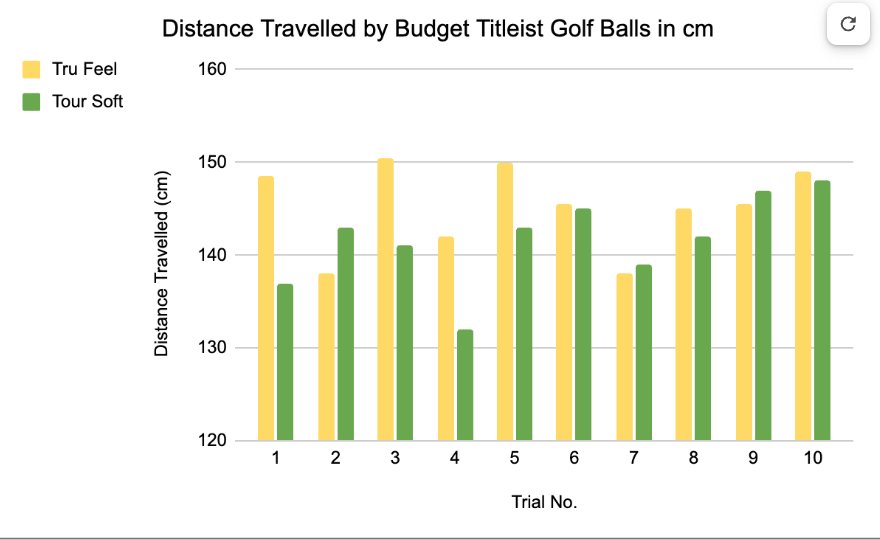
| 1 | 144.5 | 141 | 148.5 | 137 |
| 2 | 145 | 148 | 138 | 143 |
| 3 | 150 | 147.5 | 150.5 | 141 |
| 4 | 154 | 139.5 | 142 | 132 |
| 5 | 149 | 148 | 150 | 143 |
| 6 | 155 | 148 | 145.5 | 145 |
| 7 | 157 | 146 | 138 | 139 |
| 8 | 152 | 149 | 145 | 142 |
| 9 | 146 | 148 | 145.5 | 147 |
| 10 | 154 | 148 | 149 | 148 |
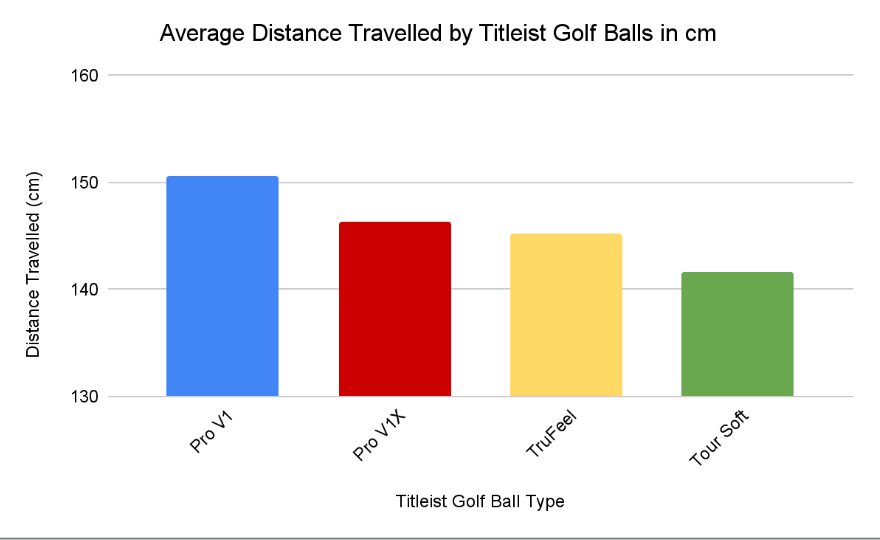
| Average | 150.65 | 146.30 | 145.20 | 141.70 |
Analysis
Conclusion
Conclusion:
By performing this experiment I found my hypothesis to be correct. If a golf ball has more dimples then it will travel further while rolling on a surface. The data that was collected for the high end Titleist golf balls shows that Pro V1 golf balls with 388 dimples travelled an average of 150.65 cm while the Pro V1x golf balls with 348 dimples travelled an average of 146.30 cm. In the trials for the budget balls, the Tru Feel golf ball with 376 dimples travelled an average of 145.20 cm while the Tour Soft with 346 dimples travelled an average of 141.70 cm. Based on the evidence, I can conclude that if a golf ball has more dimples it will travel further on the surface because my trial results showed that the high end Pro V1 and the budget Tru Feel both travelled further on average than the Pro V1x and Tour Soft golf balls which have a lower dimple count than their opponents.
Application
Real World Application:
This experiment could be very important to golfers, especially those who need to practice their putting game. With this knowledge, golfers will be able to pick the golf ball that rolls further on the green to improve their putting accuracy and power for further putts.
Sources Of Error
Sources Of Error:
Some things that might have affected my results are:
- The ramp was not perfectly smooth which could affect the distance travelled
- There could have been inconsistencies on the turf I rolled it on which could affect the golf balls roll
- I might have not placed the golf ball on the exact same spot which could have affected the speed the golf ball travelled at
- There could have been inconsistencies on the ball which will affect the the way the golf ball rolled
Citations
Bibliography:
Britannica Editors. "friction". Encyclopedia Britannica, 10 Jan. 2026, https://www.britannica.com/science/friction.
How do dimples in golf balls affect their flight? (2024, February 20). Scientific American. www.scientificamerican.com/article/how-do-dimples-in-golf-ba/
Titleist introduces new Pro V1 and Pro V1X Golf Balls. (2023, February 1). Titleist Newsroom. https://mediacenter.titleist.com/en-US/221575-titleist-introduces-new-pro-v1-and-pro-v1x-golf-balls/
Covey, T. (2026, January 1). Titleist Tour Soft Golf Balls: More ‘Tour’ Than ‘Soft’. [online] MyGolfSpy. https://mygolfspy.com/news-opinion/titleist-tour-soft-golf-balls-more-tour-than-soft/
Zach, R. Team Titleist Staff. (2024, January 10). Titleist Introduces New TruFeel – The Softest Titleist Golf Ball. www.titleist.ca/teamtitleist/ca/b/weblog/posts/titleist-introduces-new-trufeel-the-softest-titleist-golf-ball?srsltid=AfmBOoqBs_JMe2w58z-yTyY-3H78nd7KQyQvAfbTpiQfl9Rul0Wkv4En
Acknowledgement
I would like to thank the following people:
- My Mom for helping me and encouraging me
- My teacher Mr. Barenec for supporting me
- My Dad for letting me use his brand new golf balls