
The Effect of Peak Acceleration and Resonance on Lunar Regolith Removal from a Model Planetary Surface Panel
Anirudh Vijayan, Jaden Lee
STEM Innovation Academy High School
Grade 10
Presentation
No video provided
Hypothesis
Introduction
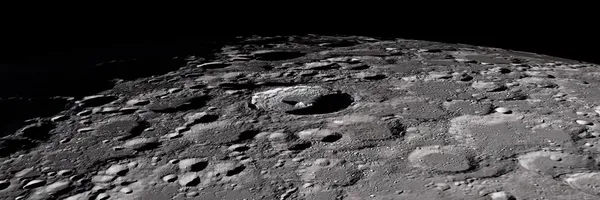
Lunar dust is usually an overlooked problem that is growing dramatically. It’s made of tiny, sharp, electrostatically charged particles that are formed by billions of years of meteor impacts, when there isn’t an atmosphere to smooth them.
- Average particle size: 20–50 micrometers (about the width of a human hair)
- Made up of silicon, iron, calcium, and aluminum
- The particles are jagged and abrasive, so they easily scratch glass, seals, and mechanical joints
- This is due to the lack of natural erosion on the moon’s surface and the constant bombardment of asteroids on the moon's surface because of a lack of gravity
- During Apollo missions, dust clogged equipment, damaged visors, and even caused suit leaks
- Astronauts reported “Moon dust smell” inside the lander and respiratory irritation after exposure to lunar dust
This affects future moon missions because the moon’s lack of atmosphere means the dust seems to stick to surfaces, causing further irritation to people. The build-up on solar panels and sensors is also a big issue because it can drastically reduce their efficiency, resulting in many problems. According to NASA, lunar dust can cause a 40% power loss in solar panels within just a few days if not treated. Also, the dust covers thermal radiators, which can cause overheating and interference with various optical machinery. During Apollo missions, astronauts had to manually brush the dust off, which, first of all, was inefficient, and second of all, caused scratching and damage to the more delicate surfaces.
Some existing approaches for dust removal
- Mechanical cleaning using brushes and blowers: This was inefficient and left scratches and permanent damage to delicate areas; it also required human work.
- Electrostatic repulsion: Applying high voltage, which alternates the fields to push off the charged lunar dust, but a drawback is that very high voltage is required, and it could damage circuits
- Gas jets/ Air pulses: This method uses compressed gas to push off the lunar dust, but a drawback is that it is heavy, and can get wasteful in a vacuum
Vibration-based cleaning
Uses mechanical and ultrasonic energy to make the surface vibrate, hence removing the lunar dust without air. When a surface vibrates with an acceleration that is more than the gravitational or adhesion acceleration on a particle, it will lift off. By tuning the frequency of the vibration, dust can be effectively removed without the need for manual work. Piezoelectric actuators are very useful for this because they are light and thin, can vibrate at very high frequencies, and don't require a high amount of power.
Question
What peak acceleration is required to overcome adhesion and electrostatic forces and remove lunar regolith from a vibrating surface?
Hypothesis
If amplitude is held constant and the vibration frequency is increased, thereby increasing peak acceleration according to aₚ = (2πf)²A, then lunar regolith will detach once the peak acceleration generates an inertial force (F = ma) greater than the combined gravitational, electrostatic, and mechanical adhesion forces acting on the particles. Therefore, there will be a threshold peak acceleration that maximizes energy efficiency and effectiveness.
Research
Ethics-based research
Should dust removal systems prioritize efficiency, durability, or astronaut safety, and why?
Dust removal systems used on the Moon should prioritize astronaut safety, as the health and well-being of astronauts are of the utmost importance. Our design aims to mitigate the dangers posed by lunar regolith, which can significantly threaten future Moon missions. Lunar regolith is extremely sharp, chemically reactive, and easily inhaled, making it hazardous to human health. When inhaled, its abrasive particles can damage delicate lung tissue and the respiratory system. Additionally, lunar dust contains silicates, which are also found near volcanic regions on Earth. Workers exposed to high concentrations of silicates, such as miners, often develop silicosis—a serious lung disease that causes inflammation, breathing difficulties, and permanent lung scarring. Scientists believe that prolonged exposure to lunar regolith, especially during long-term lunar missions, could lead to similar health complications for astronauts.
Beyond its impact on human health, lunar regolith can also severely damage equipment and instruments. During the Apollo missions, astronauts reported that lunar dust clung to spacesuits, clogged joints, scratched visors, and interfered with mechanical systems. These issues increased wear on equipment and made basic operations more difficult. As future missions plan for longer stays on the Moon, an effective dust mitigation system is essential to protect both astronauts and mission-critical technology.
What risks might vibrations pose to sensitive instruments or scientific measurements?
Vibrations can pose serious risks to sensitive instruments and scientific measurements, especially in environments like the Moon, where extremely precise measurements are critical. Even small or low-frequency vibrations can cause instruments to shift, tilt, or lose alignment, which can lead to inaccurate or inconsistent data. For example, high-resolution cameras and telescopes require extreme stability; vibrations can blur images or distort observations, making it difficult to study lunar surface features or distant celestial objects accurately. Scientific instruments such as spectrometers and chemical analyzers are also highly sensitive to motion. Vibrations can introduce electrical or mechanical noise into their readings, which may be misinterpreted as real data. This can compromise experiments that analyze the composition of lunar soil or detect trace elements. Similarly, seismometers, which are designed to measure very small ground movements, can mistakenly record vibrations from nearby machinery or astronaut activity as moonquakes, interfering with the accuracy of seismic data.
Over long periods, repeated vibrations can loosen bolts, connectors, or wiring inside instruments, gradually reducing precision and causing calibration drift. For instance, robotic arms or drilling equipment used near scientific stations may generate continuous vibrations that accelerate wear on nearby sensors. In harsh lunar conditions, repair opportunities are limited, so vibration-induced damage could permanently disable important instruments. For these reasons, minimizing vibrations is essential to ensure reliable scientific measurements and the long-term success of lunar missions.
Could vibration-based dust removal be scaled up for large lunar bases or long-term missions?
Yes, vibration-based dust removal could be scaled up for large lunar bases and long-term missions, but it would need to be designed carefully. For bigger lunar bases, vibration systems could be built into areas like airlocks, spacesuit cleaning stations, landing pads, and the outside of buildings. These systems could use gentle vibrations to shake lunar dust off surfaces before it spreads inside the base.
For long-term missions, this type of system would be helpful because it can be reused many times and doesn’t need a lot of replacement materials. It could also work automatically, which would save time for astronauts. The vibrations could be limited to specific areas, such as where astronauts enter or where equipment is stored, so dust is removed without affecting the entire base.
However, there are some challenges. If the vibrations are too strong, they could disturb sensitive scientific instruments or loosen parts of equipment. They could also be uncomfortable for astronauts if not properly controlled. To prevent this, engineers would need to carefully control how strong the vibrations are and use materials that absorb or reduce vibration. Overall, with the right design and safety measures, vibration-based dust removal could be a practical solution for large lunar bases and long-term missions.
Surface-Science research
How does surface texture or coating change how effective vibrations are at removing dust?
The surface texture and coating drastically change how effective vibrations can be at removing lunar regolith. Surface texture can affect how effective vibrations are for multiple reasons. A rough surface has a greater surface area compared to a smooth surface, meaning rougher surfaces collect a greater amount of lunar regolith compared to smoother surfaces. A rougher surface also has an increased amount of grooves, ridges, and edges for regolith to get trapped. When vibration is applied to a rough surface, the dust particle has less room to move around and dislodge due to limited space, leading to vibrations being less efficient compared to a smooth surface, where dust can easily slide or lift off much quicker. Surface coatings can reduce how strongly the lunar dust sticks to the surface in the first place. Some coatings are designed to be dust-repellent or anti-static, which lowers the electrical attraction between the dust and the surface. Lunar dust becomes electrically charged, so if a coating reduces this charge, vibrations don’t need to be as strong to remove the dust. Other coatings are harder and more durable, which prevents dust from embedding into the surface over time.
Overall, smooth surfaces and dust-resistant coatings make vibration-based dust removal much more effective because they reduce adhesion between the lunar dust and equipment. This allows vibrations to safely remove dust with less energy, while also lowering the risk of damage to instruments or structures.
Would vibrations work better on rigid surfaces or smooth surfaces?
Vibrations would generally work better on rigid surfaces, like solar panels, than on flexible surfaces, like spacesuit fabric. Rigid surfaces respond to vibrations in a more predictable way. When a solid surface vibrates, the motion is transferred evenly across the material, which helps shake loose lunar dust particles. Solar panels are smooth and stiff, so dust has fewer places to get trapped. When vibrations are applied, the dust can break free more easily and fall or be shaken off. Flexible surfaces, such as spacesuit fabric, absorb vibrations instead of transmitting them effectively. The fabric bends and flexes, which reduces how much energy reaches the dust particles. Lunar dust can also become embedded in the tiny fibers of the fabric, making it much harder to remove using vibrations alone. Because of this, vibrations are less effective at cleaning flexible materials.
Overall, vibrations are more effective on rigid, smooth surfaces because they efficiently transfer energy to the dust particles, while flexible surfaces tend to absorb the vibrations and trap dust more easily.
How does repeated vibration affect long-term material fatigue on lunar equipment?
Repeated vibration can cause long-term material fatigue in lunar equipment, which means materials slowly wear out over time. Even if the vibrations are small, they can still stress the material again and again. This repeated stress can cause tiny cracks to form inside the material.
Over time, these small cracks can grow bigger and weaken the equipment. Eventually, parts could break or fail, which is a big problem on the Moon because equipment is very hard to repair. For example, bolts and screws could slowly loosen, joints might start to crack, and electronic parts could shift or become damaged from constant shaking.
The Moon already has extreme temperature changes between day and night, which puts extra stress on materials. When vibration is added on top of that, the damage can happen faster. Because of this, engineers need to control how much vibration equipment experiences and use strong materials that can handle repeated movement. This helps lunar equipment last longer and stay safe to use.
Physics-based research
Is there a resonant frequency at which lunar regolith detaches most efficiently from a surface?
Well, there probably is such a resonant frequency as to remove the lunar regolith most effectively, but this is not something constant for the whole universe. On the contrary, the most effective frequency would depend on the type of lunar dust itself, on the type of surface material, etc.
Mechanical resonance is the tendency of a mechanical system to respond to a higher amplitude when the frequency of the oscillations matches the natural vibration frequency more than any other frequency. The formula for the natural frequency is this:
 F is the natural frequency, k is the spring constant, which is the stiffness of the surface, and m is the mass of the surface. The spring constant tells you how much force is needed to cause a certain amount of movement. Factors like how it bends and compression affect the measurement; for example, a thin, flexible surface has a low spring constant, while a stiff metal plate has a high spring constant. It can be measured by k=(2πf)2m, which is an equation to measure it using vibrations; it is derived from Hooke’s law.
The particles detach when the vibration produces enough acceleration to overcome gravity and adhesion forces. It is represented in this formula:
aₚ = (2πf)²A
Where “a” is the peak acceleration, “A” is the vibration amplitude. Looking at the equation, we can see that when the vibration amplitude increases, the acceleration increases significantly. Since it is squared, small changes in the frequency will make the biggest difference in dust removal. Amplitude is the maximum distance the surface will move from its equilibrium position. This formula calculates the peak acceleration of an object that is undergoing a harmonic motion. In our project it measures the displacement amplitude by calculating the peak to peak displacement (distance the plate is going up and down), this number changes when the frequency varies.
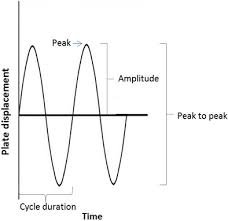
When the vibration speed equals the natural frequency of either the surface, the dust layer, or the interface between surface and dust, the phenomenon of resonance takes place. In that situation, even minute vibrations can generate large motions. In lunar regolith, efficient removal can be facilitated by vibrations that can cause the dust particles to momentarily lift away from the surface by overcoming friction, cohesion, and electrostatic forces. Thin layers of fine dust might be more effectively removed by high-frequency vibrations, potentially ultrasonic, while larger layers might be more readily stripped at lower frequencies with larger amplitudes. Furthermore, it may occur that the surface itself has its resonant frequency. If a solar panel, plate, and membrane vibrate at their resonant frequency, it enhances surface vibrations that can efficiently remove dust with less energy input. Nevertheless, it may occur that conditions on the lunar surface can alter these effects due to low gravity, a vacuum, and pronounced electrostatic charging. It is anticipated that frequency tuning will emerge as the most effective method by experimenting with and tuning different vibration frequencies to optimize dust removal.
How do vibrations overcome electrostatic forces compared to mechanical adhesion forces?
Electrostatic forces and mechanical adhesion forces are two major reasons why small particles, like dust, adhere or stick to surfaces. Electrostatic forces relate to electric charge. When two objects have opposite electric charge, they attract each other, a fact described by Coulomb’s Law. Mechanical adhesion forces result from the physical contact of surfaces. Even the smoothest surface has microscopic roughness. When a dust particle comes into physical contact with a surface, there are several microscopic "points of contact." At these points of contact, intermolecular forces, which are Van der Waals forces, act between molecules.
The dust particles are attracted to the surface because of two main forces: mechanical adhesion and electrostatic forces. The mechanical adhesion consists of van der Waals forces and microscopic surface interlocking, which occurs because of the roughness of the surface. The forces are effective at very short distances and are determined by the closeness of the dust particle to the surface. Electrostatic forces, on the other hand, are relevant in dry conditions, such as on the surface of the Moon. The electrostatic forces are effective at slightly longer distances and are usually greater than the mechanical adhesion. If the surface on which the dust particle rests is vibrating, it means that the surface is accelerating. The inertial force on the dust particle on the surface is given by:
Fvibration=ma
Where “m” is mass and “a” is the acceleration of the vibrations.
Vibrations can break the mechanical adhesion because they cause the surface on which the dust particle rests to move up and down very fast. The dust particle, however, resists the movement because of inertia. When the inertia becomes larger than the adhesive force, the microscopic points of contact are broken. The repeated action of the surface moving up and down breaks the adhesive forces, causing the dust particle to be detached from the surface. The adhesive forces are generally weaker, and that is why they are the first to be broken.
Electrostatic forces are slightly more difficult to remove, but are done when the mass and acceleration overpower the vibration.
Threshold Acceleration
If a surface is in vibration and there are particles stuck to it, as with dust on a plate, the threshold acceleration is the minimum vibration acceleration required to dislodge the particles. The resisting forces in this case are not friction, but electrostatic and mechanical adhesion forces that keep the particles stuck to the surface. If a particle has mass, and the plate is in vibration vertically with acceleration, the inertial force is given by Newton’s Second Law, F=ma. The particles will detach when the total force going into the particles is equal to or greater than the forces used to keep the particles stick to the surface (adhesion forces).
The smaller the particle, the higher the threshold acceleration because adhesion force varies as surface area, but the particle’s mass varies as volume. So, for example, lunar regolith requires a rather high acceleration to overcome the adhesion force. In a vibrating system, the surface acceleration is often related to frequency and amplitude.
(2πf)²A≥Fadhesion/m
Overall this is the lowest peak acceleration that is required to detach the dust from the surface.
Variables
Independent Variable:
- The peak acceleration, changed by varying frequencies from the function generator
Dependent Variable:
- The threshold acceleration (Peak acceleration Vs. Percentage of dust removal)
Controlled Variable's:
- Amplitude of the Piezoelectric disk
- Aluminum plate
- Mass of dust (0.8g of Cocoa powder)
- Thin layer of dust applied on plate
- test duration
- angle of the plate
Procedure
Materials
- 50mm Piezoelectric disc
- 15cmX12cmX0.5mm flat surface plate (aluminum)
- FG-200 DDS Function generator
- Fenugreek powder
- Jigsaw
- Wood glue
- Electric sander
- Tape
- BNC to alligator wire
- 61cmX21cmX2cm wooden plank
- Soldering iron
- Solder wire
- Weight scale
- Pencil
- Protractor
- Ruler
- Spring clamps
- Safety glasses
- 15cmX11cmX1mm flat plastic plate
- Styrofoam
- Thin double sided tape
- Wire stripper
- Small metal plates
- White sheet of paper
Building Procedure
- Assemble all materials required for building the demonstration, and wear safety goggles
- Take 61cmX21cmX2cm wooden plank and use a pencil to draw a piece with a 12cm base, and on each side going up by 3cm, then inward again by 4.5 cm. For the 3cm gap in the middle, draw two 7cm lines going upward, then connect them at the top. This is the main side piece. It should look like this:
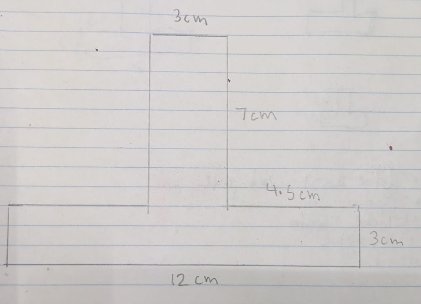
- Repeat this process on another portion of the wooden plank
- Now we need to draw the piece for the aluminum plate to rest on. This is just a simple rectangle shape that will later be glued onto the previously made shape. The rectangle is 12cmX3cm, draw two of them
- To connect the 2 pieces, draw a rectangle piece that is 18cmX3cm onto the same wooden plank
- To create a slope for the dust to glide off, there need to be two triangular-shaped pieces on the surface where the aluminum plate would rest, so the plate rests on the slope. It is a right triangle with a base of 12cm and a height of 4cm; the angle degree is 15 degrees, which is enough for the dust to glide off, but also ensures that gravity doesn't have a large role in the actual detachment of the dust
- Once all of these pieces are drawn out on the wooden plank, use a jigsaw to cut the pieces out, ensuring that the cuts are right outside of the lines drawn
- With all the cut-out pieces, use an electric sander to ensure the lines are straight and accurate.
- To assemble the structure, use wood glue, and the center of the rest piece should be glued 3cm from the top of the main side piece, with the 2cm thick side being glued directly onto it. Do this for the other side plate as well
- Glue the triangular piece on top of the rest of the piece, each one facing the same direction
- Glue the back connection piece to the bottom of both the side pieces, connecting them
- Use spring clamps to hold pieces in place during drying process
- Now that the stand is complete, take the plastic piece and place it between both triangle pieces
- Take the flat aluminum plate, and using thin double-sided tape, attach the 50mm piezoelectric disks side by side in the middle area of the aluminum plate
- Place the aluminum plate on the slope, and place a piece of Styrofoam between the back of the plate and the plastic piece. This is to ensure that the sound is more contained
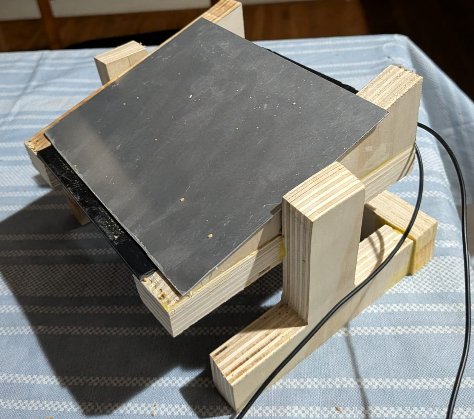
- The model is done, it should look like this:
Experiment Procedure
- Connect FG-200 DDS Function generator to a power outlet, and using the BNC to alligator clips wire, connect it to the piezoelectric disks that are on the aluminum plate, red alligator clips go on the two red wires of the two piezoelectric disks, black clip goes on the two black wires (If needed use wire strippers, and if wire falls off piezo solder it back).
- Prepare three metal plates, each with 5g of fenugreek powder
- Take one of the 5g plates and evenly spread the powder across the aluminum plate, then put a white sheet of paper underneath where the dust would fall, so it will catch it
- Start the function generator at 500htz, but don't start yet, have a timer with you and set it to 30 seconds
- Click "Run" on the function generator and start the timer at the same exact time, this ensures that for each test the duration is the same
- As soon as the timer ends stop the function generator
- Without dropping any pieces of dust, take the white piece of paper, put the dust back in the metal plate, the metal plate should be on the weight scale and zeroed out. This is to isolate the weight of the dust removed
- Record the weight in grams of the amount removed, and then divide that number by five, and multiply by a hundred to get the percentage of dust removed
- In order to find the percentage of dust removed vs. the peak acceleration, we need to find the peak acceleration when the function generator is set at 500htz, and the displacement amplitude. The displacement amplitude is very difficult to find without proper equipment such as an accelerometer, which we didn't have access to. So as an alternative for our project, we gave an AI chatbot a detailed description of measurements, environment, and specific placements in out model to accurately get a peak to peak amplitude. Using the formula aₚ = (2πf)²A, we could determine the peak acceleration. To find the displacement amplitude from the peak to peak, we first need to divide it by two to find the displacement amplitude in millimeters, then to convert it to meters divide it again by 1000. Plot the numbers into the formula to find the peak acceleration.
- Repeat these steps with the same frequency with the other two plates of 5g of Fenugreek powder
- Repeat all of these steps for different frequencies, going up by 500htz increments and ending at 3500htz
Observations
Test set 1
For this set of tests, the function generator was set to 500 Hz and had a peak acceleration of 740.2203301 m/s^2. In the first test, the vibrations removed 0.3 grams of dust from the 5 grams evenly spread across the plate; this is 6% dust removal compared to a 740.22 m/s^2 peak acceleration. This result was expected because the frequency was too low for any real dust detachment. The second test removed 0.2 grams, or 4.8%, which is slightly less than the previous one. And the last test removed 0.3 grams, just like the first one. We noticed that the dust that did end up falling off the plate was mainly just the bottom layer, and this was because the slight movement from the top layer allowed the dust to slide down the 15-degree angle and force the bottom layer off the plate. The vibration was mainly steady with no sudden spikes or jumps, and there was a low humming noise from the piezoelectric disks throughout the thirty-second cycle. We noticed that there was local bending and coupling efficiency, as the most movement occurred right above the placement of the piezoelectric disks, meaning that the placement may affect the result. Overall, we can conclude that this peak acceleration and frequency did not meet the threshold requirement, and is not near resonance.
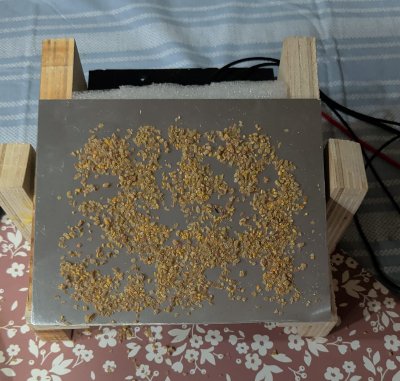
Test set 2
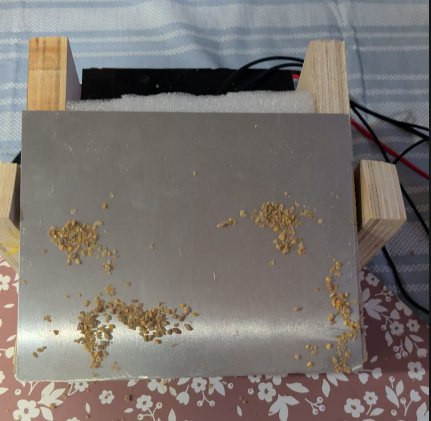
At 1000htz, the peak acceleration was 986.9604401 m/s^2. The vibration on this acceleration performed exceptionally well, almost removing all of the dust in every test. In the first test, it managed to remove 4.9 grams of dust, or 98% of all the dust on the plate. In the second test, it removed just under 5 grams, since the scale that was used for measuring only goes to the nearest tenth, the change of dust wasn't large enough to make a change, so the scale presented 5 grams of dust removal. This obviously wasn't true because a small amount of dust remained on the plate, so instead we estimated around 4.97 grams of dust removal, which is 99.4%. And the last test mimicked the first, with 4.9 grams of dust removed. As shown in the picture, not only was the bottom layer affected, as in the previous test, but also the top and middle layers suffered from the vibration. The humming noise was much louder and high-pitched, and the noise remained steady throughout the duration. The particles presented a small lift from the surface, but only in a few areas. Other than that, the vibration didn't produce enough inertial force to make the particles jump against the force of gravity; they still did produce enough inertial force to overpower the adhesion forces, which make the particle stick to the surface. This is the main objective, not to make the particles jump. Overall, this indicates that this frequency and peak acceleration are very close to resonance.
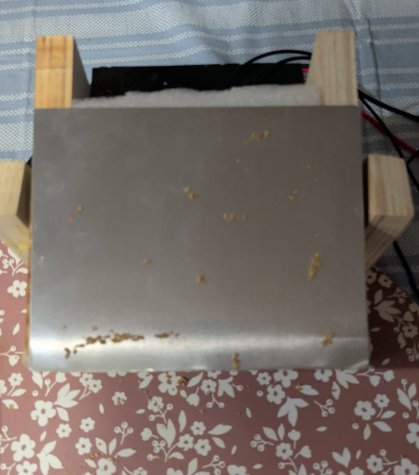
Test set 3
At 1500htz, and a peak acceleration of 888.2643961 m/s^2, the results were different from expected. On the first test, the vibrations managed to remove 0.9 grams of dust, or 18%. On the second test, it removed 1 gram of dust, or 20%. And for the last test, it removed 0.9 grams just like the first, with 18% dust removal. These results show that the vibration power was much less than the 989.96 m/s^2 test. Although the frequency increased from before, the peak acceleration actually decreased, which suggests an inconsistency in amplitude when frequency is raised steadily. Not only was the dust detachment and fall much slower and less, but the sound produced by the piezoelectric disks was also a lot quieter than the previous test, indicating a correlation between sound and performance. Unlike last time, the particles did not jump at all from the surface, just simply gliding after adhesion forces were broken, like the first set of tests. This test was likely between the resonance and another strong vibration frequency, which would explain why the force of vibrations was drastically decreased even after increasing frequency.
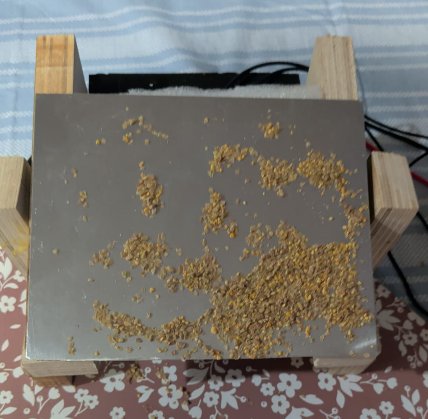
Test set 4
For our fourth set of tests, the frequency went up again by 500htz, meaning that the frequency is now 2000htz, and the peak acceleration is 789.57 m/s^2. For the first test, 2.6g of dust fell off the plate, or 52%, the second test, 2.4g of dust fell off, or 48%; for the last test, 2.7g of dust fell off, which is 54% of the dust removed. These results are interesting because even though in the previous test the power dropped, it came back up again. This proves the existence of vibration patterns and that the vibration structure is non-linear rather than evenly distributed. The vibration does not just move up and down; it moves in a certain pattern that can emphasize certain parts of the plate, and also has spots where it won't vibrate as much because of the existence of nodes (certain spots where vibration decreases). For this particular test, the overall peak acceleration was decreased, but the spots where the vibration was emphasized are better suited for dust removal. Knowing this information, it is now easier to identify that the dust that remained on the plate is in random positions for each varying frequency and peak acceleration; these are where the nodes are located in each test. We observed that the humming noise also increased from the last time, which further supports that there is a correlation between the sound and the effectiveness.
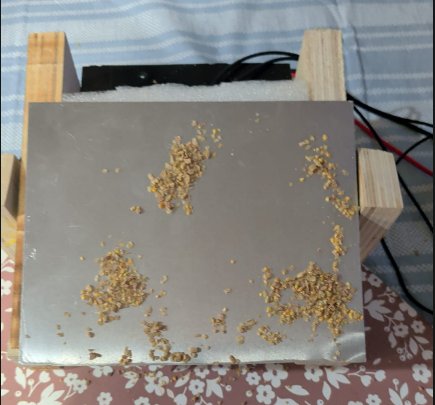
Test set 5
At 2500Htz, the peak acceleration was 863.5903851 m/s^2. Here are the results. On the first test, it removed 4g out of 5g in the 30-second test duration, 80% of the dust was removed. In the second test, it removed 4.2g of dust, which is 84%. For the last test, it removed 3.9g of dust, which is 78%. The peak acceleration began to increase again after it decreased with the previous few tests, showing how inconsistent it is in terms of displacement and amplitude. So far, this is closest to the 989.96 m/s^2 test (1000Htz), but that one still performed better, and that test is much nearer to resonance because of both performance and amplitude, because resonance is characterized by a maximum amplitude response. The 1000Htz test had a larger maximum amplitude. The sound remained steady throughout the cycle and was relatively high-pitched. And the few patches of dust that remained on the plate are the nodal lines, which form the unique vibration pattern of this test.
Test set 6
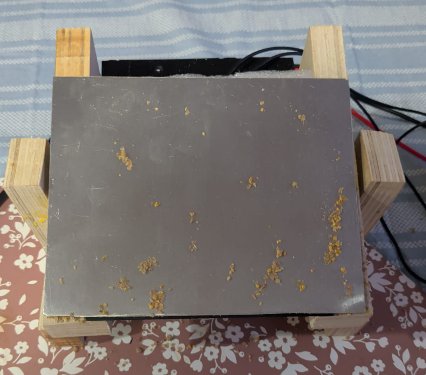
Again up another 500Htz, the set of tests is at 3000Htz and has a peak acceleration of 888.2643961 m/s^2. On the first test, it removed 4.8g of dust, which is 96% of the dust removed. On the second test, it removed 4.6g, which is 92%. And on the last test, it removed 4.9g, which is 98%. This test performed really well and was really close to the 1000Htz test. What was really interesting is that the peak acceleration for this is the same as the peak acceleration of the 1500Htz test. This is because the amplitude at 1500Htz is four times larger than at 3000Htz. This test performed better because when the frequency increased, the contact time of the particles decreased, which means the adhesion bonds are disrupted more frequently. There are still some nodes visible at places where dust clumps and doesn't detach. The sound of the humming is very high-pitched and slightly unsteady compared to other tests. Since the vibration power and pattern were effective in removing dust, there were small jumps in the dust particles.
Test set 7
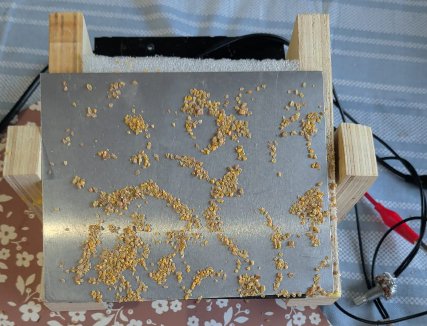
This is the last test that we conducted, the frequency is 3500Htz and the peak acceleration is 725.4159235 m/s^2. On the first test, it removed 3.5g of dust, which is 75%. On the second test, it removed 3.6g, which is 72%, and on the last test, it also removed 3.6g. The peak acceleration decreased again, but there was a good amount of dust fall because of the vibration pattern and non-linear structure. The pattern left on the plate is the most unique and random out of all of them, as there are clumps all over the board that didn't move. The sound was the highest-pitched so far, and we observed that the higher the frequency, the higher pitched sound.
Graph
Analysis
Test result analysis
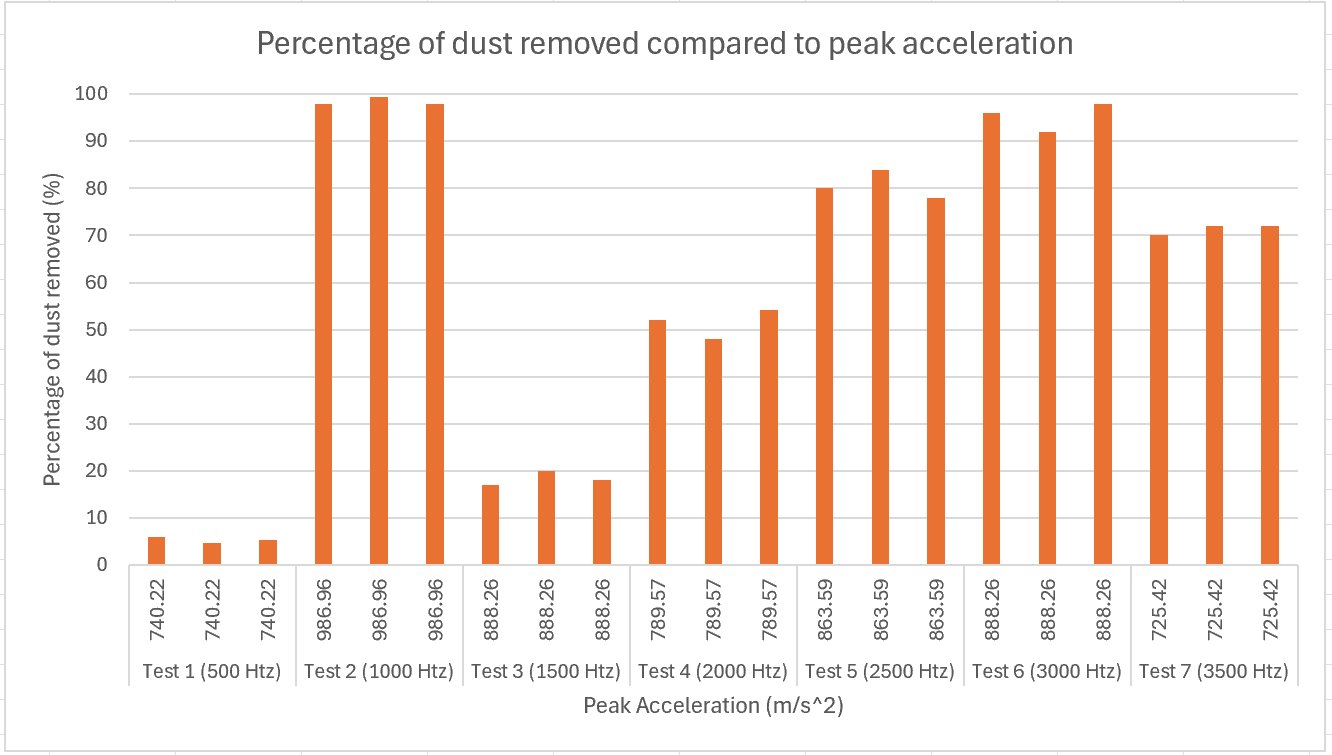
For our experiment, we conducted 21 total test, each in sets of three in which the three tests are all at the same frequency. In our experiment, we changed our peak acceleration, and tested to see what percentage of dust was removed. Our first set of tests started at 500 Hz and a peak acceleration of 740.22 m/s^2, which removed and average of 5.3% of the dust. For our second set of tests, we changed the amplitude to 1000 Htz with a peak acceleration of 986.96 m/s^2, and an average of 98.4% of dust was removed. Test three was 1500 Htz with a peak acceleration of 888.26 m/s^2, and roughly 18.7% of the dust was removed. For test 4, we put the amplitude at 2000 Htz while peak acceleration was 789.57 m/s^2, and an average of 51.3% of the dust was removed. Test five was at 2500 Htz and a peak acceleration of 863.59 m/s^2, and 80.7% of the dust was removed. Test 6 had an amplitude of 3000 Htz with the peak acceleration being 888.26 m/s^2, and roughly 95.3% of the dust was removed. The final test was conducted at 3500 Htz with a peak acceleration of 725.42 m/s^2, and 71.3% of the dust was removed. Based on the results from these sets of tests, the order of amplitude with the highest success rate is:
- 1000Htz
- 3000Htz
- 2500Htz
- 3500Htz
- 2000Htz
- 1500Htz
- 500Htz
The results of the first test were expected, as the frequency was too low for any of the dust to detach. For the second test, almost all of the dust was removed, meaning that the frequency and peak acceleration are very close to the natural resonance. For test 3, the results varied from what we originally thought. The results dropped drastically, showing the inconsistency in amplitude when the frequency is raised steadily. For test 4, the results increased from test three, even though the frequency was increased. This shows that the existence of vibrations is non-linear, not evenly distributed. The vibration does not just move up and down; it moves in a certain pattern that can emphasize certain parts of the plate, and also has spots where it won't vibrate as much because of the existence of nodes (certain spots where vibration decreases). For the fifth test, the results increased yet again, highlighting the non-linear relation between vibrations and displacement. Test 6 results were extremely close to test two at 1500 Htz. What was really interesting is that the peak acceleration for this is the same as the peak acceleration of the 1500Htz test. This is because the amplitude at 1500Htz is four times larger than at 3000Htz. This test performed better because when the frequency increased, the contact time of the particles decreased, which means the adhesion bonds are disrupted more frequently. The last test, test 7, showed a decrease in the amount of dust removed, highlighting the uneven pattern of vibrations. Overall, our testing shows promising results and highlights the non-linear pattern between vibrations and displacement.
Extension:
Despite the hard work we've put in over the course of our science fair project, there are still a couple of items we would like to do leading up to the in-person fair. We still need to complete our logbook, as we did not prioritize this as high compared to the actual testing. We would also like to include a better simulant rather than Fenugreek powder, as there are other substances we can use that better simulate lunar regolith. Lastly, we would like to conduct more tests that don't stop at 3500Htz to get more results.
Conclusion
This project aimed at finding the impact that the vibration frequency has on the efficiency of dust removal from a model planetary panel, with a hypothesis that as the frequency increases, with a constant amplitude, the acceleration increases according to the formula, and that there is a point where the inertial force will be greater than the gravitational, electrostatic, and adhesive forces that are binding the simulated particles on the surface of the moon, and that there is an optimal acceleration where the particles are detached from the surface in a very efficient way.
The experimental results have partially supported this hypothesis. In general, the increase in the frequency was beneficial for the dust removal performance. However, from our testing, we learnt that the increase in the removal efficiency and frequency did not necessarily increase the peak acceleration. In some cases, the higher frequencies with lower calculated peak acceleration were more efficient in the removal of the dust particles than the lower frequencies with higher acceleration. This implies that the removal of the particles is not only related to the peak acceleration but also depends on the mode of vibration, resonance, and the distribution of the acceleration over the surface of the plate. The frequencies that are close to the resonance are more efficient in the removal of the particles, which was proved correct when the 1000Htz test with a peak acceleration of 986.96 m/s^2. This test was the closest to resonance as it was the most effective acceleration with the largest maximum amplitude.
This implies that there is indeed a threshold acceleration for the detachment of the regolith, but it is largely dependent on the structural dynamics instead of the frequency. The most energy-efficient method of dust removal occurs when the structure is tuned to resonate at the modes that allow the greatest vibration amplitudes and acceleration distribution to the dust particles, thus requiring the least amount of energy to be wasted in the dust removal process.
In summary, the effectiveness of the work that we did in this project proves that the removal of regolith is dependent on the optimization of peak acceleration as well as resonance behavior, thus the importance of the dynamic analysis of systems in the field of aerospace surface engineering.
Application
Moon dust, called regolith, causes trouble for missions heading there. Unlike Earth's fine particles, the stuff on the Moon feels more like broken glass. Without wind or water to wear down edges, each speck stays harsh. Countless asteroid strikes over millions of years keep breaking rock into sharper fragments. Roughness sticks around when nothing softens it. A single speck of dust measures just like a strand of human hair across. Making matters stickier, these particles cling due to an effect known as static charge. Long ago, while exploring the Moon on Apollo flights, space travelers noticed something sharp in the air dust. It scoured face shields, damaged suit joints, disrupted tools, and also slipped into capsules where breathing became tough. With Artemis aiming to return people there soon, handling that fine gray grit matters more than ever, for it stays much longer this time around.
What drives our work is understanding just how hard you have to push to shake dust loose. Gravity holds it down, while static cling and tiny physical hooks resist removal. A calculation guides us, balancing those clinging factors against the effort needed. Vibration frequency plays a role, but so does energy cost. Finding one without wasting the other matters most. What makes our study helpful is how it might shield solar gear placed on the Moon. Since these panels tend to be lightweight and efficient, they’re likely the go-to power source there. Yet dust on the surface sticks fast, often piling up before long. That buildup? It cuts their output sharply, even cutting effectiveness by half at times. When that happens, communication systems may falter along with scientific instruments relying on steady juice. Finding the right shake to loosen dust means panels might wipe themselves clear. With a small tremor here and there, cleaning could happen using less power.
Looking into ways to shield astronaut suits along with gear mechanisms. Sharp lunar dust poses real problems. It damages seals, joints, and maybe even motors. Apollo saw gear degrade fast thanks to the grit. Longer stays mean more moonwalks. That raises risks for critical systems failing. Starting with how things shake might lead to tools that clear dust using motion, placed right at entry zones or cleanup spots. Because of this, floating particles stay outside living areas, cutting risks for space travelers.
Heat management sits high on our list of concerns. With no atmosphere on the Moon, cooling relies entirely on radiators, machines that release warmth into space. Dust gathering on these surfaces weakens their ability to function. When covered, overheating becomes a real risk. A possible fix? Making radiators shake slightly so dust falls away naturally. Shaking parts might clear grime while drawing little power. Such designs could protect both computers and gear, keeping astronauts alive.
Machines will handle much of what happens on the Moon, including construction, scouting, and tasks far from Earth. Cameras might blur when dust sticks. Sensors could slow down if grit sneaks inside. Moving pieces may jam without warning. Fixing gear there takes too long, so durability matters more than ever. Our findings support longer-lasting designs for lunar tools. Vibration-based cleaning might keep key parts clear. That means robots stay steady while crews guide next steps. Reliability grows when tech shakes off grime before trouble starts.
Moving past the Moon, some findings stand out. Take Mars, dust storms there slow solar energy collection while damaging gear. In earthly deserts, similar issues pop up when grit coats panels, cutting output. Water washing helps, yet brings its own limits. Using shake-based cleaning might just skip those problems, opening paths where dust rules. That shift could matter most where upkeep feels hardest.
One big thing we’re tackling? Lunar dust during space missions. Not just removing it, but doing so without harming the surroundings. Physics meets real-world design here. Instead of old methods, fresh approaches pop up when ideas mix. Think longer stays on the Moon are possible. Even trips to Mars could change. Solutions tested now might shape how crews live far from Earth. Environment matters, even off-planet. Practical fixes today support bolder journeys tomorrow.
Sources Of Error
One of the main challenges we encountered was the accuracy and consistency of our lunar regolith simulant. During testing, we realized that we did not have a way to know that the dust was perfectly evenly distributed, and a uniform layer of simulant was present for each trial. As a result, the thickness and spread of the dust varied slightly between tests, which likely affected the accuracy of our data. Because the surface coverage was not perfectly identical each time, some of our tests may have included minor inconsistencies.
Another issue involved the physical setup of our apparatus. The vibrations produced by the piezoelectric disk did not remain isolated to the metal plate; instead, they transferred into the wooden stand aswell. This caused more damped vibrations, which may have influenced our measurements. In addition, we observed localized bending of the metal plate. Most of the dust detachment occurred directly above the piezoelectric disk, indicating that the vibration was not distributed evenly across the entire surface. This meant that the positioning of the dust layer could introduce variability between trials.
Measurement precision also presented limitations. We used a digital scale to measure the mass of the dust in grams; however, the scale only numbers to the nearest tenth. This reduced the sensitivity of our measurements and may have resulted in small fluctuations in the recorded mass that we could not ensure.
Finally, during our second test, the data indicated that 5 g of dust had been removed, yet a small amount of dust remained on the aluminum plate. Because the scale could not detect fractions of a gram, we had to make reasonable estimates when analyzing our final results.
While these challenges did not mess up our results completely, they did highlight areas where improved equipment and tighter controls would increase accuracy in future tests.
Citations
Works Cited
Abbas, Zafar, et al. “Parametric Analysis on Selection of Isolation Material for Vibration Isolation of the Engine Test Bed.” International Journal of Modern Research in Engineering and Technology (IJMRET) Www.ijmret.org, vol. 5, 2020, ijmret.org/paper/V5I5/05052237.pdf. Accessed 2 Mar. 2026.
Abel, Phillip, et al. Lunar Dust Mitigation: A Guide and Reference First Edition (2021). 2023.
Abubakar, Abba Abdulhamid, et al. “Environmental Dust Repelling from Hydrophobic and Hydrophilic Surfaces under Vibrational Excitation.” Scientific Reports, vol. 10, no. 1, 1 Sept. 2020, https://doi.org/10.1038/s41598-020-71356-5. Accessed 27 July 2021.
AZO Network. “Understanding the Importance of Vibration Isolation in Metrology.” Kinetic Systems-A Division of Prior Scientific, May 2024, kineticsystems.com/understanding-the-importance-of-vibration-isolation-in-metrology/.
be264282. “UCF Researchers Developing New Methods to Passively Mitigate Lunar Dust for Space Exploration |.” Ucf.edu, 21 July 2025, mae.ucf.edu/ucf-researchers-developing-methods-mitigate-lunar-dust/. Accessed 2 Mar. 2026.
brown\, julia. “DREAM System | Dust Mitigation Technology for Lunar Applications - Capstone Senior Design.” Capstone Senior Design, 27 Apr. 2021, www.mines.edu/capstoneseniordesign/project/dream/.
Calle, C.I., et al. “Active Dust Control and Mitigation Technology for Lunar and Martian Exploration.” Acta Astronautica, vol. 69, no. 11-12, Dec. 2011, pp. 1082–1088, https://doi.org/10.1016/j.actaastro.2011.06.010.
Cleveland Clinic. “Silicosis: Causes, Symptoms, Diagnosis & Treatment.” Cleveland Clinic, 18 Mar. 2022, my.clevelandclinic.org/health/diseases/22622-silicosis.
El-Basheer, Tarek, and Hany Shawky. Measurements and Limits of Vibration Affecting the Sensitive Equipments of Some Metrological Laboratories.
European Space Agency. “The Toxic Side of the Moon.” Www.esa.int, 7 Apr. 2018, www.esa.int/Science_Exploration/Human_and_Robotic_Exploration/The_toxic_side_of_the_Moon.
Feng, Jie, et al. “Dust Resuspension from Contaminated Fabrics Subjected to Force-Induced Vibrations.” Journal of Aerosol Science, vol. 183, Jan. 2025, p. 106489, https://doi.org/10.1016/j.jaerosci.2024.106489. Accessed 6 Nov. 2025.
Furst, Stephen. “Smart Material Solutions.” Smart Material Solutions, 31 Aug. 2021, www.smartmaterialsolutions.com/blog/2021/8/24/application-note-nanostructured-surfaces-to-reduce-dust-on-the-moon-7rabl-c7ha9. Accessed 2 Mar. 2026.
Gaier, James R. “The Effects of Lunar Dust on EVA Systems during the Apollo Missions.” Ntrs.nasa.gov, 1 Mar. 2005, ntrs.nasa.gov/citations/20050160460.
“High-Performance Bioinspired Surface Textures.” NASA, 21 Nov. 2024, www.nasa.gov/directorates/stmd/space-tech-research-grants/developing-high-performance-bioinspired-surface-textures-for-repelling-lunar-dust. Accessed 2 Mar. 2026.
How. “How Is Maximum Amplitude of Resonance Achieved?” Physics Stack Exchange, 2022, physics.stackexchange.com/questions/731871/how-is-maximum-amplitude-of-resonance-achieved. Accessed 2 Mar. 2026.
“How Acoustic Vibrations Affect Sensitive Lab Equipment.” Decibel, 2025, www.decibelinternational.co.uk/blog/how-acoustic-vibrations-affect-sensitive-lab-equipment-21/. Accessed 2 Mar. 2026.
Institute, Canadian Conservation. “Physical Forces.” Www.canada.ca, 22 Sept. 2017, www.canada.ca/en/conservation-institute/services/agents-deterioration/physical-forces.html.
Khursheed Sabeel, et al. “Advancements in Vibration Testing: Effects on Thermal Performance and Degradation of Modern Batteries.” Batteries, vol. 11, no. 2, 19 Feb. 2025, pp. 82–82, https://doi.org/10.3390/batteries11020082. Accessed 9 Mar. 2025.
Kingma, H. “Thresholds for Perception of Direction of Linear Acceleration as a Possible Evaluation of the Otolith Function.” BMC Ear, Nose and Throat Disorders, vol. 5, no. 1, 22 June 2005, https://doi.org/10.1186/1472-6815-5-5. Accessed 10 May 2020.
“Lunar Dust Mitigation.” Low-Gravity Science and Technology (LGST) Lab, 2024, lowgravitylab.ae.gatech.edu/lunar-dust-mitigation/. “McLaskey Research Group.” Courses.cit.cornell.edu, courses.cit.cornell.edu/mclaskey/vib/struct/Koppi/modesOfVibrations.html.
“Mechanical Resonance.” Wikipedia, 10 Nov. 2019, en.wikipedia.org/wiki/Mechanical_resonance.
NASA. “Artemis II - NASA.” Nasa, 25 July 2024, www.nasa.gov/mission/artemis-ii/.
---. “What Hazards Are Caused by Lunar Regolith?” NASA Science, 22 Apr. 2025, science.nasa.gov/biological-physical/what-hazards-are-caused-by-lunar-regolith/.
“NASA TechPort.” Nasa.gov, 2024, techport.nasa.gov/projects/113369.
“New “Moon Duster” Will Help Clean NASA Assets in Space - NASA Science.” Science.nasa.gov, science.nasa.gov/science-research/science-enabling-technology/technology-highlights/new-moon-duster-will-help-clean-nasa-assets-in-space/.
Plucinsky, Stephanie. “NASA’s Dust Shield Successfully Repels Lunar Regolith on Moon - NASA.” NASA, 27 Mar. 2025, www.nasa.gov/image-article/nasas-dust-shield-successfully-repels-lunar-regolith-on-moon/.
Pohlen, Michael, et al. “Overview of Lunar Dust Toxicity Risk.” Npj Microgravity, vol. 8, no. 1, 2 Dec. 2022, https://doi.org/10.1038/s41526-022-00244-1. Accessed 7 Feb. 2023.
Ryan, David. “What Is Lunar Regolith? - Explaining Space.” Explaining Space, 4 Jan. 2024, www.explainingspace.com/what-is-lunar-regolith/.
Solomon, Matt. “Vibration Isolation in Metrology: Ensuring Precision in High-Stakes Measurements - Kinetic Systems-A Division of Prior Scientific.” Kinetic Systems-A Division of Prior Scientific, 23 Apr. 2025, kineticsystems.com/vibration-isolation-in-metrology-ensuring-precision-in-high-stakes-measurements/. Accessed 2 Mar. 2026.
The. “Needle.Tube - Diagnostic Lab Supplies, Great Prices, Fast Delivery, Blood Collection Needles, Blood Collection Tubes, Infusion Needles.” Needle.Tube - Diagnostic Lab Supplies, Great Prices, Fast Delivery, Blood Collection Needles, Blood Collection Tubes, Infusion Needles, 3 May 2024, www.needle.tube/resources-articles/the-impact-of-vibration-from-nearby-machinery-or-traffic-on-lab-operations.
“The National Center for Voice and Speech - Tutorials.” Ncvs.org, 2024, ncvs.org/archive/ncvs/tutorials/voiceprod/equation/chapter8/.
Thompson, Mark. “The Sticky Problem of Lunar Dust Gets a Mathematical Solution.” Universe Today, 2026, www.universetoday.com/articles/the-sticky-problem-of-lunar-dust-gets-a-mathematical-solution.
to\, Approach. “Vibrasure | Vibration + Acoustical Consulting.” Vibrasure | Vibration + Acoustical Consulting, 2019, www.vibrasure.com/high-tech-vibration-monitoring. Accessed 2 Mar. 2026.
“Understanding Structural Vibration: Causes, Types, and Control Methods.” DesignHorizons, 11 July 2024, designhorizons.org/understanding-structural-vibration-causes-types-and-control-methods/.
“Vibration Amplitude - an Overview | ScienceDirect Topics.” Www.sciencedirect.com, www.sciencedirect.com/topics/computer-science/vibration-amplitude.
Welch, Nikki. “Dust: An Out-of-This World Problem - NASA.” NASA, 8 June 2021, www.nasa.gov/humans-in-space/dust-an-out-of-this-world-problem/.
Wiesner, Valerie, et al. “Protective Coatings for Mitigating Lunar Dust Abrasion and Adhesion.” Nasa.gov, 3 Jan. 2022, ntrs.nasa.gov/citations/20210026019.
Winterhalter, Daniel, et al. Lunar Dust and Its Impact on Human Exploration: A NASA Engineering and Safety Center (NESC) Workshop.
Yu, Shuoran, et al. “Thermophysical Properties of Lunar Regolith Revealed by Thermal-Infrared Observations of the Lunar Reconnaissance Orbiter (LRO) Diviner Radiometer.” The Astrophysical Journal, vol. 987, no. 2, 8 July 2025, p. 187, https://doi.org/10.3847/1538-4357/addd1d. Accessed 2 Mar. 2026.
Zhao, Jeff. “Basics of Structural Vibration Testing and Analysis.” Crystal Instruments, 2016, www.crystalinstruments.com/basics-of-structural-vibration-testing-and-analysis.
Acknowledgement
We would like to thank a few people who have really helped and guided us in our project:
- Our parents for remaining supportive throughout our project and cheering us on
- Our science fair coordinator, MS. O'keefe, for constantly informing us on expectations and deadlines, and offering help whenever needed
- Roberto Moraes (Senior Technical Advisor @ AECOM), who guided us on the right path for our project and provided advice from a professional perspective