
Cabbage and Gauze; Can vegetable extract track wound recovery?
Agamya Arora, Sarah Shafiq
FFCA High School Campus
Grade 12
Presentation
No video provided
Problem
Wound infections are not always detected immediately. Currently, infections are identified through common signs such as redness, swelling, heat, pain, and laboratory testing. However, these symptoms often appear only after the infection has already progressed and been present for a significant amount of time.
Research shows that infected wounds commonly experience a change in pH, typically shifting to a more basic environment in the range of approximately 7.0 to 9.0, and often reaching a pH of 8 or higher. Traditional wound care materials such as gauze, bandages, and sutures help protect the wound and promote healing. However, they do not provide any indication of whether an infection is developing.
This raises an important question: Could the natural pH-sensitive pigment found in red cabbage be incorporated into gauze and/or sutures so that it changes color when exposed to basic conditions, potentially serving as an early visual indicator of infection?
Method
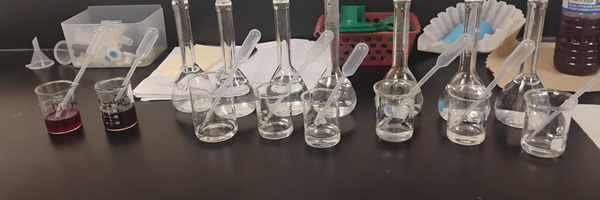
Materials Red cabbage Distilled water Tap water Cotton gauze pads Sutures (optional) NaOH solutions (basic) HCl solutions (acidic) Beakers Pipettes pH strips
Methods
1. Prepare Red Cabbage Extract Chop the red cabbage into small pieces. Boil the cabbage in distilled or tap water at a 1:2 cabbage-to-water ratio. Distilled water is preferred, as tap water contains minerals and additives that could introduce uncontrolled variables. Strain the solution to remove solid pieces. Allow the extract to cool. The extract is stable at room temperature, and the pH-sensitive pigments remain active without risk of denaturation.
2. Prepare pH Test Solutions Mix the cabbage extract with test solutions at a 1:4 ratio (extract to pH solution) to observe initial color changes. Confirm that the extract acts as a dynamic pH indicator by testing whether it can transition from pink to purple to blue in basic conditions and back in acidic conditions.
3. Prepare Cabbage-Dyed Gauze Soak clean cotton gauze in the red cabbage extract until fully saturated. Remove the gauze and allow it to air-dry completely.
4. Test pH Response of Dyed Gauze Expose the cabbage-dyed gauze to each test solution (acidic and basic) one at a time. Observe and record the color changes to evaluate the gauze’s potential as a visual pH indicator.
Analysis
The pH solutions prepared for testing were approximately 7.5, 8.5, and 9.5. These values were selected to simulate conditions in infected wounds, which typically become more alkaline, often ranging between pH 7.0 and 9.0. The goal was to evaluate whether red cabbage extract could serve as a visible, natural indicator of infection-related pH changes. When diluted red cabbage extract was added to each solution, distinct and progressive color changes were observed. At pH 7.5 and lower, the solution appeared light pink, whereas the original extract was dark purple. At pH 8.5, the solution shifted to a green-blue color, and at pH 9.5, it became yellow-green. The chromatic shift demonstrated a clear correlation between increasing alkalinity and visible color change, with each pH range producing a distinguishable hue. This indicates that even moderate increases in wound pH could potentially be detected visually. To further assess its functionality as a dynamic indicator, the extract was subjected to reversible pH alterations. It was initially placed in a basic solution and then adjusted incrementally by adding dilute NaOH (to increase alkalinity) or dilute HCl (to increase acidity). The extract exhibited rapid and reversible color changes in response to both directions of pH alteration. Increasing alkalinity shifted the color toward green/yellow tones, while increasing acidity returned it to purple/pink. This reversibility suggests that red cabbage extract could provide continuous, real-time feedback on wound pH rather than a single threshold indication. When incorporated into cotton gauze, the extract retained its pH responsiveness, demonstrating visible color changes when exposed to basic solutions. This indicates that absorption into fibrous materials does not compromise the extract’s chromatic properties, supporting the feasibility of developing pH-sensitive wound dressings. Overall, these findings support the hypothesis that natural pigments from red cabbage could serve as a low-cost, non-toxic visual indicator for early infection detection. Such a dressing could potentially enable faster clinical intervention and reduce dependence on laboratory testing. While the current experiments are promising, laboratory conditions differ from real wound environments, which contain proteins, enzymes, and fluctuating moisture levels that could affect pigment visibility and stability. Long-term stability and sterilization effects were not tested. Future studies should evaluate performance in simulated wound fluid, quantify color change using spectrophotometry or image analysis, and assess durability over several days. Exploring these factors would enhance the practical applicability of red cabbage–based pH-sensitive wound dressings.
Conclusion
This study demonstrates that red cabbage extract can be successfully incorporated into cotton gauze while retaining its pH-sensitive properties. The dyed gauze consistently responded to changes in pH with clear and distinguishable color shifts. It remained red or pink in acidic conditions, turned purple near neutral conditions, and shifted to blue or green in basic conditions. These color transitions correspond to the pH range commonly observed in infected wounds, which typically become more alkaline and fall between approximately 7.0 and 9.0. The results support the hypothesis that red cabbage extract could function as a visible indicator of infection-related pH changes. The extract also exhibited reversible and dynamic color changes when exposed to alternating acidic and basic environments. This indicates that the material could provide continuous, real-time feedback rather than a single threshold response. In addition, incorporation into fibrous gauze did not compromise the pigment’s chromatic responsiveness, demonstrating the feasibility of embedding plant-based indicators into wound dressings. Although further research is required before medical application, including testing for sterility, long-term stability, durability in moist environments, and safety in contact with tissue, these findings highlight strong potential for developing low-cost, biodegradable, and non-invasive infection monitoring materials. Overall, this project supports the concept that natural anthocyanin pigments from red cabbage could serve as an accessible and sustainable foundation for smart wound dressings capable of providing early visual detection of infection.
Citations
Bennison, L. R., Miller, C. N., Summers, R. J., Minnis, A. M. B., Sussman, G., & McGuiness, W. (2017, June 1). The pH of wounds during healing and infection: a descriptive literature review. https://journals.cambridgemedia.com.au/wpr/volume-25-number-2/ph-wounds-during-healing-and-infection-descriptive-literature-review
Cws\, S. D. M. R. (2025\, December 12). The importance of a slightly acidic pH in skin health | Sanara MedTech. Sanara MedTech. https://sanaramedtech.com/blog/importance-of-ph-in-skin-wound-care/
Ono, S., Imai, R., Ida, Y., Shibata, D., Komiya, T., & Matsumura, H. (2014). Increased wound pH as an indicator of local wound infection in second degree burns. Burns, 41(4), 820–824. https://doi.org/10.1016/j.burns.2014.10.023
Acknowledgement
We would like to sincerely thank Mr. Shane Dawe and Mr. Luc MacKay of FFCA NHS for their invaluable support throughout our project. They generously allowed us to use the laboratory equipment and materials to create our solutions. In addition, they carefully checked our calculations and provided helpful advice to ensure our work was accurate and well-prepared.
We would also like to thank Ms. Judy Fan, our teacher coordinator for the Calgary Youth Science Fair, for her guidance and organization of the event. Her support helped make this experience both educational and rewarding.
- Sarah Shafiq and Agamya Arora