
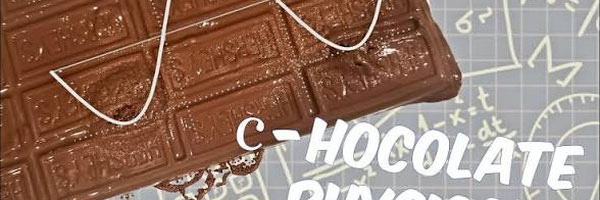
calculating the speed of light using chocolate
Mohammad Haque, Saleh Malik
Almadina Language Charter Academy, Ogden Campus
Grade 8
Presentation
No video provided
Hypothesis
We hypothesize that the milk chocolate will have the most accurate calculation for the speed of light since it melts quickly and easily, which will allow it to be a good thermal map. Milk chocolate does not melt into a liquid like butter, but it also melts in some places unlike dark chocolate, which will not melt easily enough, or it might also burn. My partner and I feel that milk chocolate will be better to use than white chocolate since white chocolate melts way more easily than milk chocolate, which will probably turn white chocolate into a weirdly shaped puddle.
Research
We have been using sites like Wonders of Physics (https://wonders.physics.wisc.edu/measure-the-speed-of-light/) and also the Waterloo University site (https://uwaterloo.ca/centre-advanced-science-education/news/microwaving-chocolate-bar), and also we also used the MIT news (https://www.popularmechanics.com/science/a34199482/chocolate-microwave-speed-of-light-experiment/) and (https://edu.rsc.org/feature/measuring-the-speed-of-light-with-chocolate/3007569.article) for a better understanding of our project.
Variables
Here are the following variables below 1. Independent variable Milk, dark, white, and Bonus is butter 2. dependent variable distance between melted spots 3. Controlled variables : microwave heating time (32 seconds) physical setup Thickness of chocolate
Procedure
We would put a no-name brand chocolate in a standard microwave, then I would keep the chocolate in there for 32 seconds, and I would take it out to measure the melted spots (half a wavelength), then multiply that wavelength by 2. After that, we would convert the number into a Meter then I would multiply that by 2450,000,000 Hz to get our final answer in Meters per second (m/s).
Observations
So far, after testing out the milk and white chocolate, I noticed that using a chocolate bar that has a large surface area of 7 inches makes it easier to measure the distance between the melted point. I also noticed that the white chocolate has the most accurate calculation when we add up all the melted points (13cm), By also measuring for 32 seconds, we are able to get more accurate melted points rather than a sticky mess. I also noticed that this method of experiment is the simplified version of the cavity resonance, which was the actual method scientists used to get the most precise speed of light calculation.
Analysis
Below is the data I acquired from my experiments (final perfected results), Dark chocolate: 4x 2450,000,000= White chocolate: x 2450,000,000= Milk chocolate: 6.1 x 2450,000,000 =
Butter (as an extra): 10x2450,000,000
Converted to, Dark: 0.08m x 2450,000,000 White: Milk: 0.122m x 2450,000,000 Butter: 0.20mx2450,000,000
Conclusion
Our final conclusion is that the most accurate calculation and result is what we got from milk chocolate, but the rest of the chocolates did give some pretty good calculations too. Butter was not as accurate as we thought it would be, though, so in conclusion, milk chocolate has the most accurate results based on our expeiriments so our hypothesis was wrong.
Application
The way this can be useful is by giving us an understanding of telecommunications, of wifi, phone, radar, and GPS. This also helps us understand electromagnetic waves and it also helps us understand that light is just not only for seeing it is also a form of radiation (dielectric heating) and this helps us understand why sometimes there is a message delay on calls as your data travels at the speed of light, this also shows an explanation for how our GPS works since our phone calculates our exact position based on the time it takes for a signal to travel from the satellites. This also helps us understand physics a little more. There is also the fact that this is a less costly, pretty accurate, and tasty solution to a high and complex question
Sources Of Error
We made a few minor but noteworthy mistakes. In our dark chocolate experiment, we heated it up for 25 seconds, but then we saw there was no change, so we heated it up for an extra 20 seconds and half of the chocolate melted so badly that it became pretty hard to measure and calculate. We also made a mistake where I never thought of how we were going to measure the butter if it was just a block, but when I got to school, I realized the mistake, so my partner used my teacher's knife (under her supervision), and he used it to size up the butter into a bar.
Citations
Here are my Citations below in APA style, 1. Measure the Speed of Light Using Your Microwave. (2019). The Wonders of Physics. https://wonders.physics.wisc.edu/measure-the-speed-of-light/ 2. Microwaving a chocolate bar | Centre for Advanced Science Education | University of Waterloo. (2025, October 17). Uwaterloo.ca. https://uwaterloo.ca/centre-advanced-science-education/news/microwaving-chocolate-bar 3. You Can Measure the Speed of Light With a Bar of Chocolate and Your Microwave. (2020, October 22). Popular Mechanics. https://www.popularmechanics.com/science/a34199482/chocolate-microwave-speed-of-light-experiment/ 4. Ashworth2015-11-01T12:49:00+00:00\, S. (n.d.). Measuring the speed of light with chocolate. RSC Education. https://edu.rsc.org/feature/measuring-the-speed-of-light-with-chocolate/3007569.article
Acknowledgement
We have gotten some help from our grade 8 science teacher, Mrs.Santhanam, with just lending supplies in general, such as rulers, and we used websites like the University of Waterloo for a better understanding.