
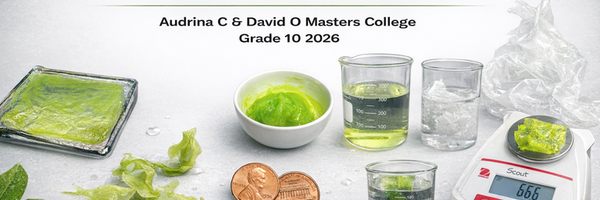
Behind the Plastic: The Inside Scoop on Eco Alternatives
Audrina Cheng, David Ojemakinde
Master's College
Grade 10
Presentation
No video provided
Hypothesis
If bioplastics were widely adopted in society, they would be able to compete with or even outperform traditional plastics while retaining their advantage of biodegradability.
Research
Plastic pollution is a major environmental issue worldwide. Most traditional plastics are made from petroleum, a non-renewable fossil fuel. These plastics can take hundreds of years to decompose and often break down into microplastics, which can harm wildlife and ecosystems. Studies show that only a small percentage of plastic is recycled, while the rest accumulates in landfills or the natural environment. Because of these problems, scientists have been researching more sustainable alternatives, such as biodegradable plastics. Bioplastics are materials made from renewable biological sources, such as corn, potatoes, or other plant-based starches, rather than fossil fuels. These materials are designed to reduce environmental impact and, in some cases, break down more easily than traditional plastics. Starch is commonly used in simple bioplastic experiments because it is inexpensive, widely available, and can form a plastic-like material when heated with water and other ingredients. Starch is a natural polymer made up of long chains of glucose molecules. When starch is mixed with water and heated, the granules absorb water and swell in a process called gelatinization. This allows the starch molecules to move more freely and form a flexible structure. When a plasticizer such as glycerin is added, the material becomes more flexible and less brittle. Many studies on starch-based bioplastics utilize glycerol as a plasticizer to enhance mechanical properties, such as flexibility and strength. However, starch-based bioplastics often have different properties compared to traditional plastics. They may absorb more water, be less durable, or break down more easily. Researchers test properties such as tensile strength, water absorption, flexibility, thermal properties and biodegradability to determine how suitable a bioplastic is for real-world use. The purpose of this project is to create a simple starch-based bioplastic using common household ingredients and test some of its physical properties. By comparing the behaviour of bioplastics, this project examines whether starch-based plastics could be a more environmentally friendly alternative to traditional plastics. This research is important because reducing plastic waste is a major global challenge. If biodegradable materials can replace some traditional plastics, it could help reduce pollution, protect wildlife, and support more sustainable manufacturing practices.
Variables
Independent Variable: The type of material being tested: starch-based bioplastic compared to traditional petroleum-based plastic.
Dependent Variables: The physical and environmental properties of each material, including moldability, weight-bearing strength and water absorption.
Controlled Variables: To ensure a fair comparison, several factors will be kept constant throughout the experiment. These include the size or mass of each sample, the drying time before testing, the amount of water used in absorption tests, the time taken during tests and the methods used to measure each property.
Procedure
Water Absorption Test: 1 sample of bioplastic and 1 sample of trational petroleum based plastic were cut into 4.85g squares. Each sample was weighed using a digital scale to record its dry mass. 2 cups were filled with 400 mL of water each, and one sample was placed in each cup. All samples were left submerged for 24 hours at room temperature. After 24 hours, each sample was carefully removed from the water, gently patted dry with a paper towel, and weighed again to record the wet mass. The amount of water absorbed was calculated by subtracting the dry mass from the wet mass.
Durability/Weight Bearing Test: 1 sample of starch-based bioplastic and 1 sample of traditional plastic (plastic bag) were prepared. A small hole was punched near the top of each sample, and a string was tied through the hole to attach a small Ziploc bag. Pennies were gradually added to the bag until the sample tore or reached maximum capacity. The number of pennies at failure was recorded for each trial. All samples were approximately the same size and thickness.
Moldability Test: A fresh sample of starch-based bioplastic was pressed firmly against the inside corner of a rigid plastic container and left to set. Another sample was pressed onto the surface of a plastic bag to observe whether it would adopt the bag’s textured surface. The bioplastic was left in contact with these surfaces for an extended period to allow it to conform. After removal, observations were made regarding whether the material retained the imprinted shape or texture.
Observations
Water Absorption Test: After 24 hours submerged in 400 mL of water at room temperature, the starch-based bioplastic absorbed 1.87 g of water, increasing from a dry mass of 4.85 g to 6.72 g. The traditional plastic absorbed significantly more water, 7.70 g, increasing from 4.85 g to 12.55 g. This indicates that the bioplastic is more water-resistant than the traditional plastic in this experiment. These results provide insight into one of the physical properties of bioplastics, showing that while they are biodegradable, they may still have functional characteristics suitable for certain applications.
- Samples: B1 (bioplastic), P1 (traditional plastic)
- Dry Mass: Both 4.85 g
- Wet Mass (24h): Bioplastic = 6.72 g, Traditional plastic = 12.55 g
- Water Absorbed: Bioplastic = 1.87 g, Traditional plastic = 7.70 g
- Test Conditions: 24 hours, room temperature, 400 mL of water each
- Observation: Bioplastic absorbed less water → more water-resistant than traditional plastic
- Notes: Sample shape/thickness kept as consistent as possible
Durability/Weight Bearing Test: In the durability test, the starch-based bioplastic held 46 pennies before tearing, while the traditional plastic bag held 115 pennies. During the final trial, the traditional plastic bag was accidentally dropped, preventing the exact number from being recorded, but it was close to tearing. These results show that the traditional plastic bag is significantly stronger under tensile stress compared to the bioplastic.
- Bioplastic: 46 pennies before tearing
- Plastic bag: 115 pennies before tearing (final trial slightly interrupted)
- Traditional plastic is stronger than bioplastic
- The test clearly compares tensile strength
Moldability Test: The bioplastic successfully moulded to the corner of the container after left out to dry for 24 hours and retained its shape after removal. Additionally, when pressed against the plastic bag, the bioplastic adopted the bag’s textured, rough surface pattern. This demonstrates that the bioplastic is capable of conforming to detailed shapes and maintaining those forms once set.
- Took the shape of a container corner
- Maintained structure after removal
- Adopted a textured pattern of a plastic bag
- Shows high moldability before fully setting
Analysis
Water Absorption Test: The water absorption test shows that the starch-based bioplastic absorbed 1.87 g of water, while the traditional plastic absorbed 7.70 g over the same 24-hour period. This indicates that the bioplastic is more water-resistant than the traditional plastic in these conditions. The lower water absorption may be due to the structure of the bioplastic, the thickness of the sample, or the plasticizer (glycerin) helping it retain its form. These results suggest that bioplastics could potentially be suitable for applications where moderate water resistance is needed, although other properties such as durability and flexibility must also be considered before drawing broader conclusions.
Durability/Weight Bearing Test: The bioplastic’s maximum weight capacity is less than half that of the traditional plastic, indicating lower mechanical strength. While bioplastics may offer environmental advantages, their tensile strength is limited compared to conventional plastics. Minor errors, such as accidentally dropping the bag, may have slightly affected the maximum recorded value for the plastic bag.
Moldability Test: The results indicate that starch-based bioplastic has strong moldability properties before fully drying. This characteristic is beneficial for manufacturing, as it suggests the material can be shaped into complex forms or detailed moulds. Although the bioplastic has lower tensile strength compared to traditional plastic, its ability to retain detailed shapes could make it useful for specific applications such as packaging inserts, disposable molds, or biodegradable containers.
Conclusion
This project investigated whether DIY starch-based bioplastics are competitive with traditional petroleum-based plastics in terms of water absorption, durability, and moldability. The results showed that the bioplastic absorbed 1.87 g of water compared to 7.70 g for the traditional plastic after 24 hours, indicating moderate water resistance under the tested conditions. In the durability test, however, the bioplastic held only 46 pennies before tearing, while the traditional plastic held 115 pennies. This demonstrates that the bioplastic has significantly lower tensile strength. During the drying process, the bioplastic sheets began to curl at the edges, suggesting uneven moisture loss and internal stress within the material. Additionally, once the bioplastic cracked or tore, it became very fragile and snapped easily under minimal pressure. This brittleness indicates that while the material can function in certain conditions, it lacks the flexibility and structural resilience of traditional plastic. In the moldability test, the bioplastic successfully conformed to detailed shapes and textures and retained those forms after setting. This shows that the material has strong formability before fully curing, which could be useful in manufacturing molded biodegradable products. Overall, the results suggest that DIY starch-based bioplastics are not yet fully competitive with traditional plastics in terms of mechanical strength and durability. However, they demonstrate promising properties such as moldability and some water resistance. With further refinement, such as adjusting thickness or composition, starch-based bioplastics could become more practical for lightweight or biodegradable applications.
Application
The results of this project suggest that starch-based bioplastics could be used in applications where high strength is not required but biodegradability is beneficial. For example, this type of material could potentially be used for lightweight packaging, disposable food containers, protective inserts, or moulded biodegradable products. The moldability of the bioplastic makes it suitable for shaping into custom forms or detailed packaging designs. Although the bioplastic demonstrated lower tensile strength compared to traditional plastic, it showed moderate water resistance and strong formability before curing. With further improvements to its composition, thickness, or reinforcement, starch-based bioplastics could become more durable and practical for wider commercial use. Replacing certain single-use petroleum-based plastics with biodegradable alternatives could help reduce long-term plastic waste and environmental pollution. Therefore, continued research and refinement of bioplastic materials is important for developing more sustainable materials in the future.
Sources Of Error
Several factors may have affected the accuracy and consistency of the results. First, the thickness of the bioplastic samples may not have been perfectly uniform, which could influence water absorption and durability measurements. Uneven drying also caused the edges to curl, suggesting that moisture was not lost evenly throughout the material. This internal stress may have weakened certain areas. In the durability test, punching a hole through the samples may have created a stress concentration point, causing the material to tear more easily than it would under even force distribution. Additionally, during one trial, the bag of pennies was accidentally dropped, which prevented recording the exact maximum weight the traditional plastic could hold. Measurement limitations may also have contributed to minor inaccuracies. For example, small differences in scale precision, slight variations in sample size, and manual handling during testing could have affected results. Finally, since the bioplastic was homemade, slight inconsistencies in ingredient mixing, heating time, or drying conditions could have influenced the final material properties.
Citations
Works Cited “Advantages and Disadvantages of Bioplastics Production from Starch and Lignocellulosic Components.” PMC, https://pmc.ncbi.nlm.nih.gov/articles/PMC8348970/. Accessed 3 January 2026. “Are bioplastics really biodegradable? | Ask a Scientist.” YouTube\, 7 November 2024\, https://www.youtube.com/watch?v=66DuiKc2L0U. Accessed 15 January 2026. “Bioplastic vs. Traditional Plastic: Which Path Leads to a Sustainable Future?” Biodegradable Tableware Manufacturer | Eco-Friendly Food Packaging | Bioleader®\, 20 February 2025\, https://www.bioleaderpack.com/bioplastic-vs-traditional-plastic/. Accessed 3 November 2025. “5 Types of Bioplastics: Starch, Cellulose, Protein, and More.” Green Business Benchmark, 13 September 2024, https://www.greenbusinessbenchmark.com/archive/5-bioplastic-types. Accessed 7 February 2026. Folino, Adele, et al. “Assessing bioplastics biodegradability by standard and research methods: Current trends and open issues.” ScienceDirect, Elsevier Ltd., April 2023, https://www.sciencedirect.com/science/article/pii/S221334372300163X. Accessed 24 November 2025. Kumar, Ravinder, et al. “An investigation of the environmental implications of bioplastics: Recent advancements on the development of environmentally friendly bioplastics solutions.” ScienceDirect, March 2024, https://www.sciencedirect.com/science/article/abs/pii/S0013935123025112. Accessed 9 December 2025. McGreal, Hayden. “You are now in the main content area Rethinking Plastics: The Promise and Challenges of Starch-Based Bioplastics for Sustainable Packaging.” Toronto Metropolitan University, 18 November 2025. Accessed 17 December 2025. Sobeih, Mahmoud Omar, et al. “Starch-Derived Bioplastics: Pioneering Sustainable Solutions for Industrial Use.” National Library of Medicine, Multidisciplinary Digital Publishing Institute, 11 April 2025, https://pmc.ncbi.nlm.nih.gov/articles/PMC12028573/. Accessed 21 January 2026.
Acknowledgement
We would like to thank Mrs. Calvert for allowing us to use classroom equipment and supporting our experimental testing. We also sincerely thank Shreya Kaushik for organizing the event, answering our questions, and providing guidance throughout the project process. Finally, we appreciate the encouragement and support from our families during the completion of this project.