
The Force Awakens
Kiersen Mickle
R. T. Alderman School
Grade 5
Presentation
Hypothesis
If I spin a wheel with magnets on it that are close to (but not touching) samples of varying materials, then the material that conducts electricity the best (which I think will be copper) will slow down or stop the wheel the quickest because of stronger eddy currents.
Research
Things need stopping. Friction brakes use pads that squeeze against an object that creates friction to slow down or stop the object. The main disadvantages of friction brakes are that the pads wear down over time, and that the dust particles that are emitted from the pads have been shown to be more harmful than exhaust. (According to a Yale University study) Eddy current brakes are brakes that don’t use friction like regular brakes. Instead, they rely on electromagnetic induction. Discovered by Michael Faraday in 1831, electromagnetic induction occurs when you have a changing magnetic field around an electrical conductor, or a conductor moving through a magnetic field. This creates or “induces” electrical currents in the conductor. If the conductor is a plate, it will create tiny swirling electrical currents called eddy currents. These eddy currents create their own magnetic fields and create drag against the main magnetic field to slow down an object. The main magnetic field is usually created using electromagnets, but can also be created using permanent magnets.
Eddy current brakes are usually used on big industrial vehicles like trains, some semi trailer trucks, and some buses. They are also found on some roller coasters and other amusement park rides, fitness equipment (such as the desk cycle in Ms. Lee’s classroom), elevators for emergency braking systems, and some power tools and machines. Two main advantages of eddy current brakes are that they don’t wear out and they are silent. Some disadvantages are that they are really heavy and too expensive to be in every car, they can’t fully stop or hold an object, and because they can’t fully replace friction brakes, you have to have both.
Variables
| Manipulated Variable | The plates of different materials |
|---|---|
| Controlled Variables |
|
| Responding Variable | How much time it took the wheel to stop spinning after the weighted string came off the spool |
Procedure
I started with a pendulum design where the sample swung in between magnets to slow it down, but it kept hitting them because the pendulum was a little too flexible. So I came up with a new design that had a wheel with magnets attached to the bottom such that they would spin close to a sample plate. I designed and 3D printed a number of parts that attached to the wheel to control as many variables as possible. These parts included:
- A spool on top of the wheel
- Magnet holder plate under the wheel
-
A baseplate that has an axle and an indented sample slot
-
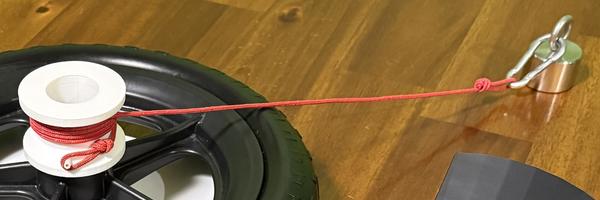
Insert the spool into the hub on top of the wheel – this will have a weighted string wound around it to accelerate the wheel
Put a little nub on the spool so that the string comes off when the weight hits the floor, and doesn’t get wound back up 2. Now put a square plate in the bottom hub and screw neodymium magnets into the corners of the plate\, facing downward – these will pass very closely above the samples to induce eddy currents in them 3. Use bearings in the top and bottom of the hub to make it spin more freely on the axle 4. Now\, put the wheel and magnet plate on the baseplate axle 5. Find a piece of string and cut it so that it touches the spool on one end and the other end touches the floor 6. Tie the top end of the string in a loop 7. Attach a weight to the bottom end of the string (make sure to double knot the string) 8. Now make a piece that will help smoothly guide the string over the edge of the table
- Put the eddy current brake on a grippy mat and position it on the table so that the string lets go of the spool when the weight hits the floor
- Hook the top end of the string onto the little nub on the spool
- Use the wheel to wind up the string until the weight is at the bottom of the string guide
- Get the stopwatch and the sample ready
- Release the wheel
- When the weight hits the floor, slide the piece of metal into the slot and start the stopwatch at the same time
- Stop the stopwatch when the wheel stops spinning and record the time
- Repeat the experiment with different materials
Observations
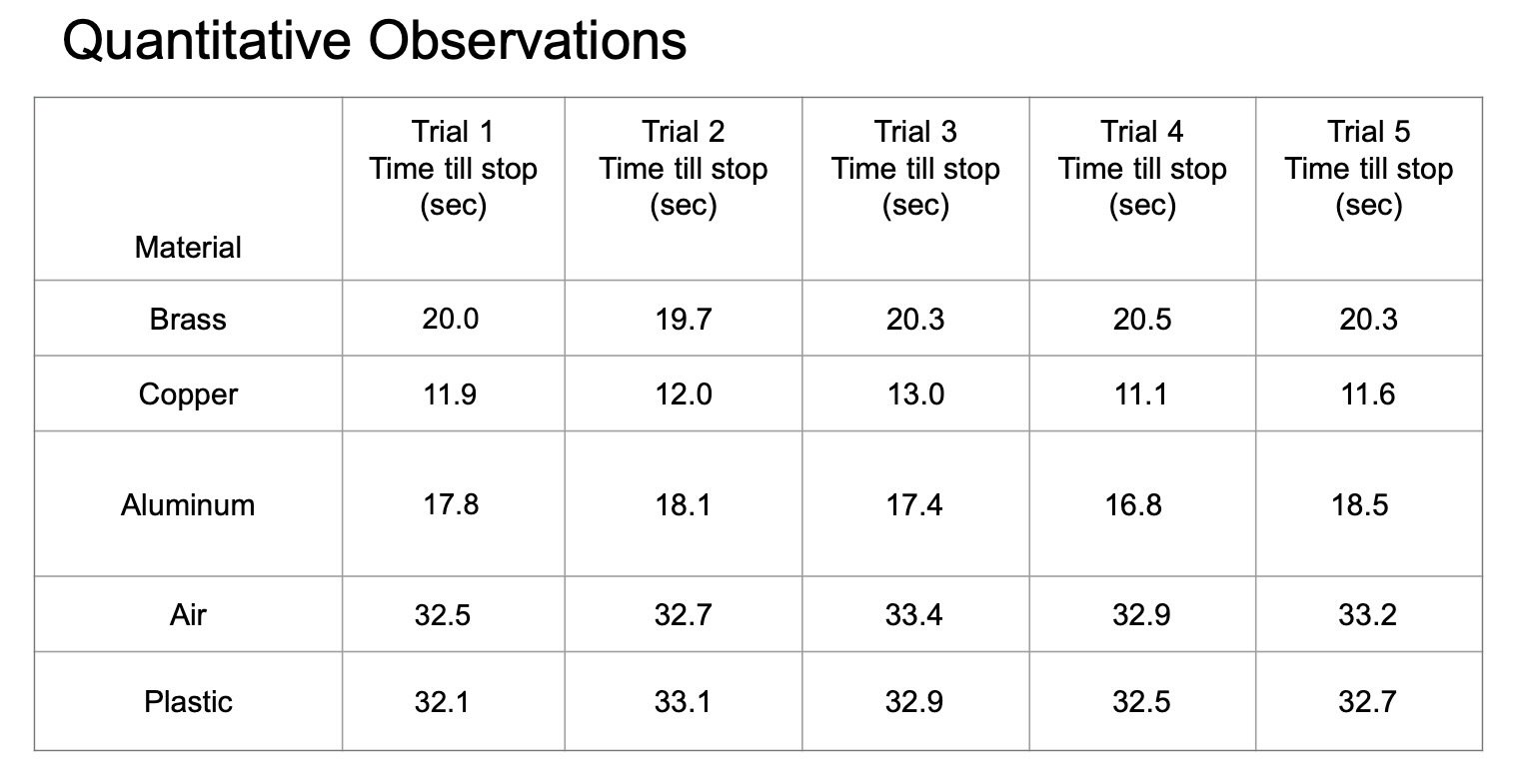
Quantitative Observations
Qualitative Observations
- The copper slowed down the fastest
- When I stuck my hand close to the magnet holder plate I felt air movement
- It looked like the nothing sample and the plastic sample slowed down the least
- The wheel seemed to be spinning at the same speed when the weight hit the floor for each test
- After spinning the wheel really fast I felt a little tiny bit of heat in the metal sample


Analysis
I used my data and made graphs with it. The first graph shows how long it took the wheel to come to a stop for the different materials. This shows that the eddy current braking is affected by using different materials.
The second graph shows how long it took for the wheel to stop with the different electrical conductivities. The line on the graph shows that the time to stop gets lower as the electrical conductivity gets higher. This means that the eddy current brake gets stronger with higher electrical conductivity.
I also learned that copper has a higher electrical conductivity so it will slow the wheel down the fastest. One connection I had is that at Canada's Wonderland, I saw a long piece of metal on a drop tower and I asked my dad what it was, he said it was a eddy current brake and that they use that to slow the dropper down. I also learned during my background research that friction brakes can damage your lungs.


Conclusion
Conclusion
In conclusion my hypothesis was proven to be correct because the copper plate did slow the wheel down the fastest and that the higher the electrical conductivity, the stronger the eddy current braking will be. The aluminum plate was a little slower because it had a lower electrical conductivity. The experiment worked better than I thought, the copper was working way better than I thought it would too. I thought the copper would take at least 15 seconds to slow down because I thought it had less electrical currents.
Application
Vehicles that have eddy current brakes on them:
- Trains, semi trailer trucks, and some buses.
Amusement park rides that have eddy current brakes on them:
- Roller Coasters, drop towers (Such as the tall drop tower at Canada's Wonderland), and free fall rides.
Fitness equipment that has eddy current brakes in them:
- Desk cycles
Sources Of Error
- I didn’t necessarily start the timer exactly at the same time
- The weight didn’t have exactly the same fall height every time
- I didn’t slide the samples in exactly the same each time
- The bearings slowed the wheel down a little bit
- String does not let go at the same moment
Citations
“Dust from Car Brakes More Harmful than Exhaust, Study Finds”, YaleEnvironment360, Yale School of the Environment, February 14 2025, https://e360.yale.edu/digest/brake-pads-lung-damage-study
“Eddy current brake”, Wikipedia, Wikimedia Foundation Inc, September 16 2025, https://en.wikipedia.org/wiki/eddy_current_brake
Veritasium, “Levitating Barbecue! Electromagnetic Induction”, Youtube, Google, October 9 2012, https://www.youtube.com/watch?v=txmKr69jGBk
Chris Woodford, “Eddy current brakes”, explainthatstuff, E. I. Du Pont de Nemours, December 3 2022, https://www.explainthatstuff.com/eddy-current-brakes.html
Mike W, “How to Increase Eddy Current Braking”, UNIVERSITY OF ILLINOIS URBANA-CHAMPAIGN, National Science Foundation, March 26 2014, https://van.physics.illinios.edu/ask/listing/26681
Acknowledgement
Thank you to my dad that helped me make the actual eddy current brake and for helping me with my presentation and my video and thank you to my mom that came up with the idea for the wheel.