

How well does hand sanitizer actually disinfect your hands compared to washing them?
Amelie Klassen
Connect Charter School
Grade 6
Presentation
Hypothesis
I believe that washing your hands with soap and water will be more effective at disinfecting your hands than sanitizer because soap and water washes bacteria and viruses off of your hand, whereas sanitizer tries to kill bacteria and viruses by dissolving their outer layers or denaturing proteins in them. Certain types of bacteria and viruses are immune to the effects of hand sanitizer and therefore will stay on your hand.
Research
Definitions of germs
- Bacteria: Small, one-celled organisms. Some types of bacteria can be helpful that keep your digestive system functioning and fight the harmful bacteria. The harmful kinds of bacteria release toxins into your body that can cause sickness or infections.
- Viruses: Genetic material inside of a protein capsule. Since viruses do not have living cells of their own they need a host with living cells to reproduce. If a virus finds a host they can multiply all over your body and make you ill.
Bacteria shapes and growth
- Bacteria grows best at 37°C (98°F) - 49°C (120°F)
- These are main shapes of bacteria: cocci (spherical), bacilli (rod shaped), Vibrio (comma shaped), and spirillum (spiral shaped)
Ways to kill bacteria
- Heat (Such as boiling)
- Sanitizing
- Disinfecting
- Beach
Why does soap and water work to clean your hands?
Soap molecules have two parts, a polar head and a non polar tail. The polar tail is hydrophilic (attracted to water) and the non polar tail is hydrophobic (repels water) but gets attracted to oil and grease. Most viruses and bacteria are covered in oil and grease or are in places with lots of oil and grease, and so the tails of the molecules attach themselves onto the bacteria and viruses and lifts it off of your skin and then the water caries it off of your body down the drain.
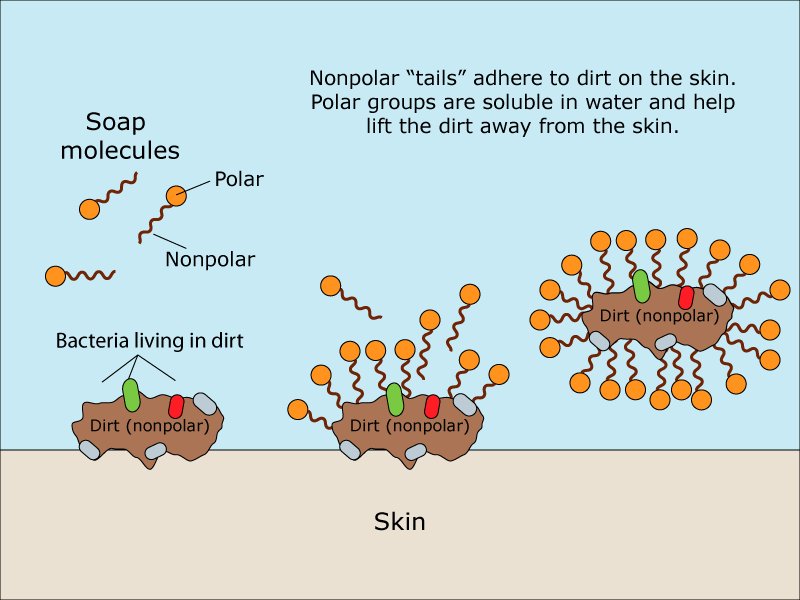 Photo credit: Https://www.frenchsoaps.co.uk/blogs/news/why-does-soap-work?rsltid=AfmB0ooQaqS413Hr-_kNfYGvLls15KZf18CiGaA4b2FfQzKdl_Jh-F6A
Why does hand sanitizer work to disinfect your hands?
The alcohol in hand sanitizer removes most types of viruses outer layer of protection that’s usually a lipid membrane or a protein shell. Hand sanitizer can also denature certain kinds of proteins. When the hand sanitizer removes the virus’s outer layer of protection or denatures some proteins it kills the virus. When a protein is denatured it means that it is changed a little bit so that it doesn’t function exactly the way it’s supposed to.
Variables
Controlled variables
- The amount of time I washed my hands for
- The amount of time I stuck my hand in dirty water
- The type of soap I used
- The temperature of the room I stored the Petri dishes in
- The type of agar on each Petri dish
- The amount of times I swabbed each Petri dish
- The amount of soap and sanitizer I used on my hands
Manipulated variable (independent variable)
- If I use soap and water or hand sanitizer to clean my hands
Responding variable (dependent variable)
- The number, size and colour of the colonies of bacteria on each Petri dish
Procedure
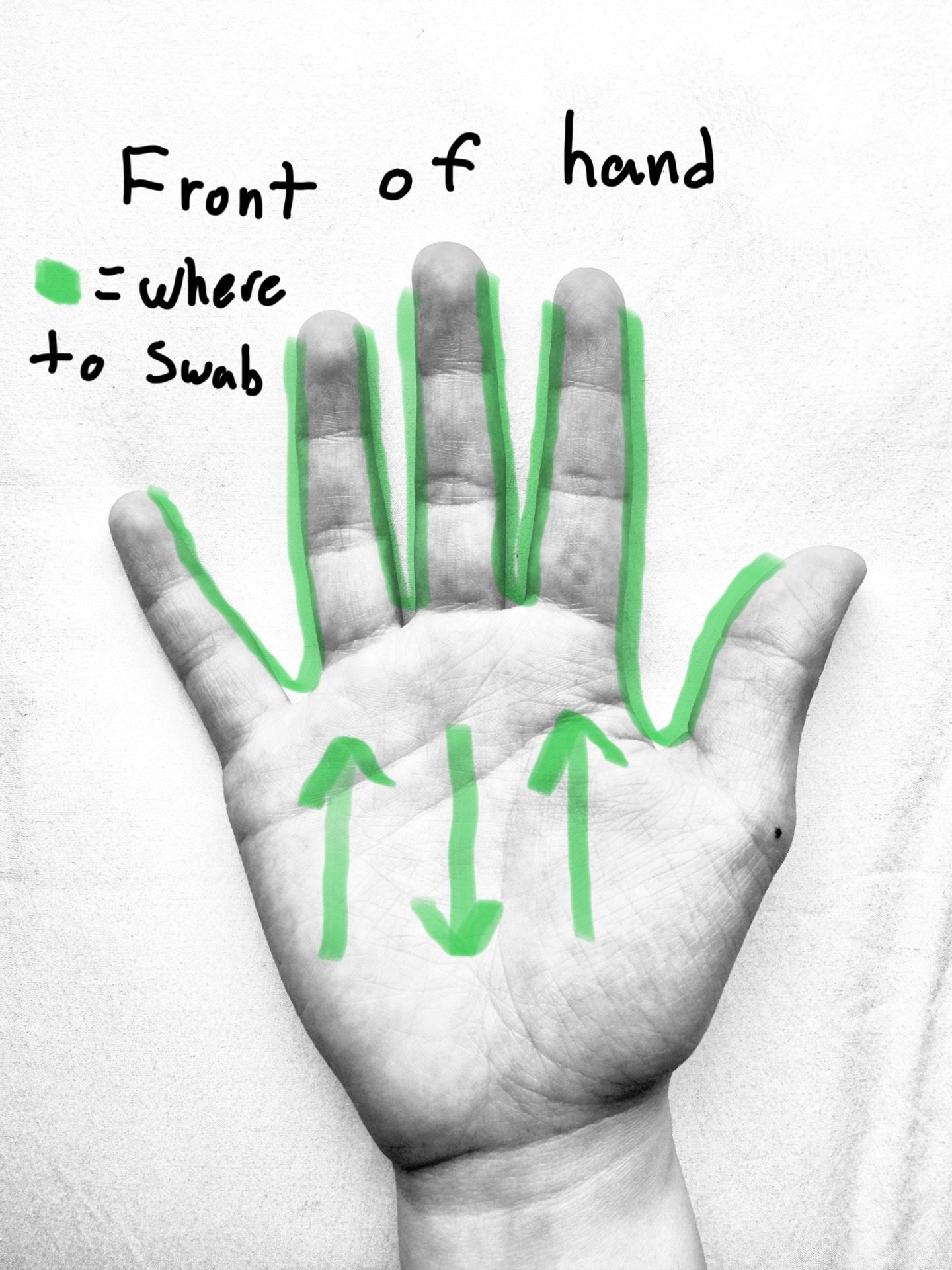
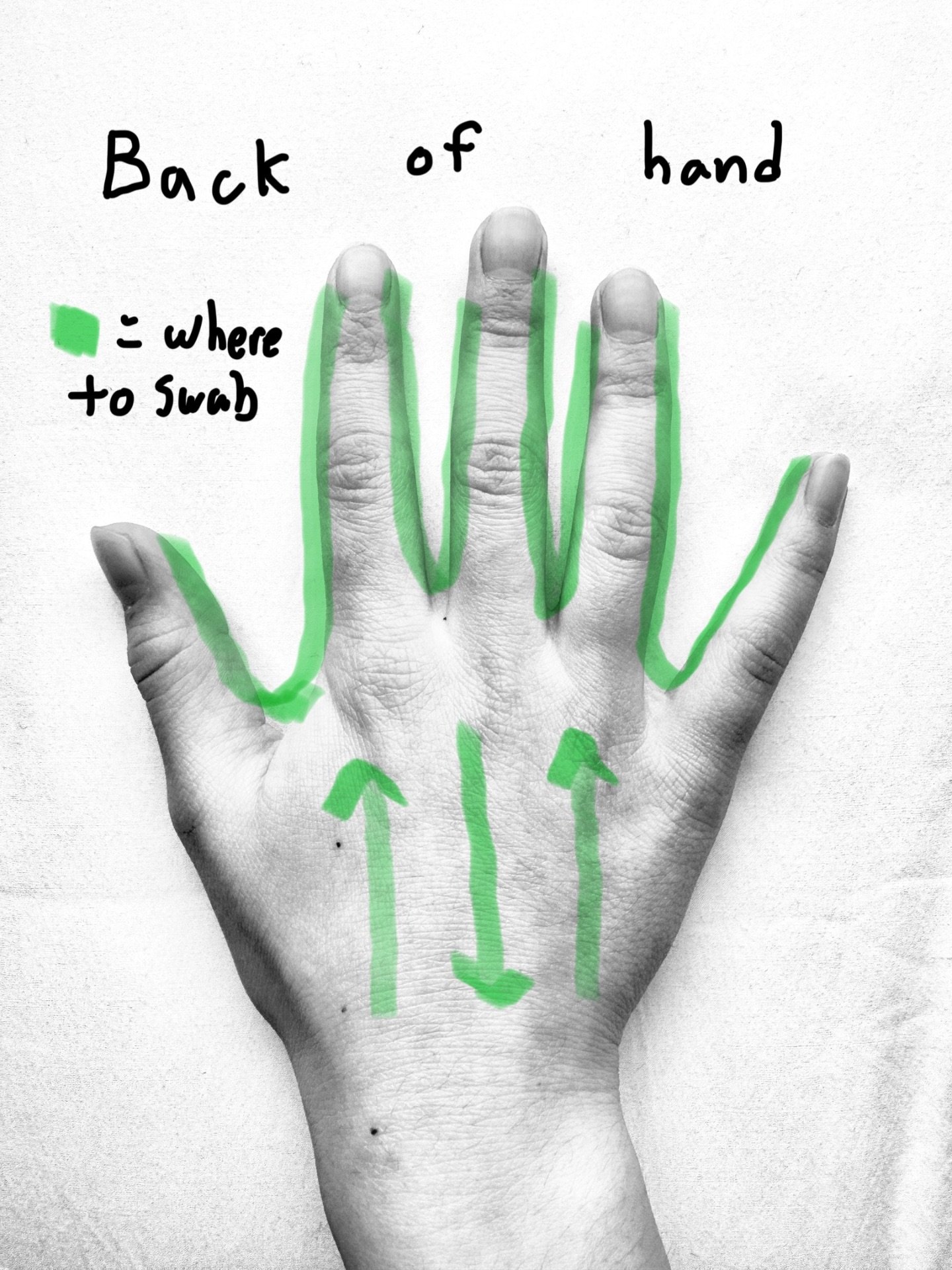
*Swabbing diagram:
Procedure
1: Take an antibacterial wipe and wipe off your work station and make sure to not touch any of your equipment while wiping and wait one minute before continuing your experiment
2 : Grab a Petri dish and loosen but don’t remove the lid
3 : Wash your hands in warm water for 60 seconds
4 : Take a new swab and wet it with distilled water and swipe it 3 times on the front and back of your non dominant hand *see swabbing diagram
5 : Grab the swab you just rubbed on your hand and the open the lid of the Petri dish you just loosened and take off the lid and rub the swab 12 times horizontally and 12 times vertically on the agar (yellowish jelly) on the Petri dish
6 : Place the lid back onto the Petri dish
7: Label this Petri dish “control: hand before contamination” and write the date that you swabbed this Petri dish
8: Place your “ Control: hand before contamination” Petri dish in a cardboard box and write “Control: hand before contamination” beside the Petri dish
9: Combine 2 cups of room temperature tap water and one tablespoon of dirt (from outside) in a medium sized bowl and mix for one minute
10: Grab a Petri dish and loosen the lid but don’t open it yet
11: Take a new swab and swirl it around in the dirty water for 10 seconds
12: Rub the swab 12 times vertically on the Petri dish and 12 times horizontally on the agar (yellowish jelly)
13: Place the lid back on the Petri dish and and label it dirty water
14: Place the dirty water Petri dish lid down in a the cardboard box and write beside it dirty water
15 : Grab a Petri dish and loosen the lid but don’t open it yet
16: Wash your hands for 60 seconds in warm water
17 : Swirl your non dominant hand around in the water for 10 seconds
18 : Grab a swab and swipe it three times on the bottom of your dirty hand, three times on the top, once in between each of your of your fingers
19: Open the lid of your Petri dish you just loosened and rub the swab 12 times horizontally, 12 times vertically around the inside of the Petri dish and screw the lid of the Petri dish back on.
20: On the outside and bottom of the Petri dish in permanent marker write : “Hand after touching dirty water” and the date you swabbed this Petri dish
21: Place the “Hand after touching dirty water” Petri dish into a cardboard box lid down
22: Place the Petri dish lid down and write in permanent marker“ Hand after touching dirty water on the cardboard box beside the Petri dish
23 : Wash your hands for 60 seconds in warm water
24 : Loosen the lid of a new Petri dish but don’t open it
25 : Swirl your non dominant hand in the dirty water again for 10 seconds and then remove your hand from the dirty water
26 : Wash your hands again for 60 seconds in warm water
27 : Take a new swab and rub it three times on the bottom of the hand that touched the dirty water and three times on the top and one stroke in between all of your fingers
28 : Open the lid of the Petri dish you just loosened and then take the swab that you just rubbed on your washed hand, and do 12 strokes vertically and 12 strokes horizontally with the swab on the agar ( yellowish jelly) and then screw the lid back on to the Petri dish.
29: Take the Petri dish you just screwed the lid onto and label it “Hand after washing”
30 : Place your “hand after washing” Petri dish and place it in the cardboard box lid down and write “Hand after washing” beside your “hand after washing” Petri dish
31 : Grab a new Petri dish and loosen the lid but don’t take off the lid yet
32: Wash your hands in warm water for 60 seconds
33 : Swirl your non dominant hand around in the dirty water for 10 seconds and then remove your hand from the dirty water
34 : Grab your hand sanitizer and squirt a teaspoon of hand sanitizer onto your hands and then rub the hand sanitizer all over your non dominant hand and let it dry for 60 seconds
35 : Open a new swab and swipe the swab three times on the back of your non dominant hand and three times on the front and once in between each of your fingers
36 : Take off the lid of the Petri dish you just loosened and grab the swab you just rubbed on your hand and do 12 strokes vertically and 12 strokes horizontally on the agar (yellowish jelly) in the Petri dish. Put the lid back onto the Petri dish.
37 : Take the Petri dish that you just put the lid on and write in permanent marker “Hand after sanitizer” and the date you swabbed this Petri dish on the bottom of the Petri dish
38 : Take a picture of all of the Petri dishes and write your observations on the chart
39: Repeat step 38 once per day for 7 more days
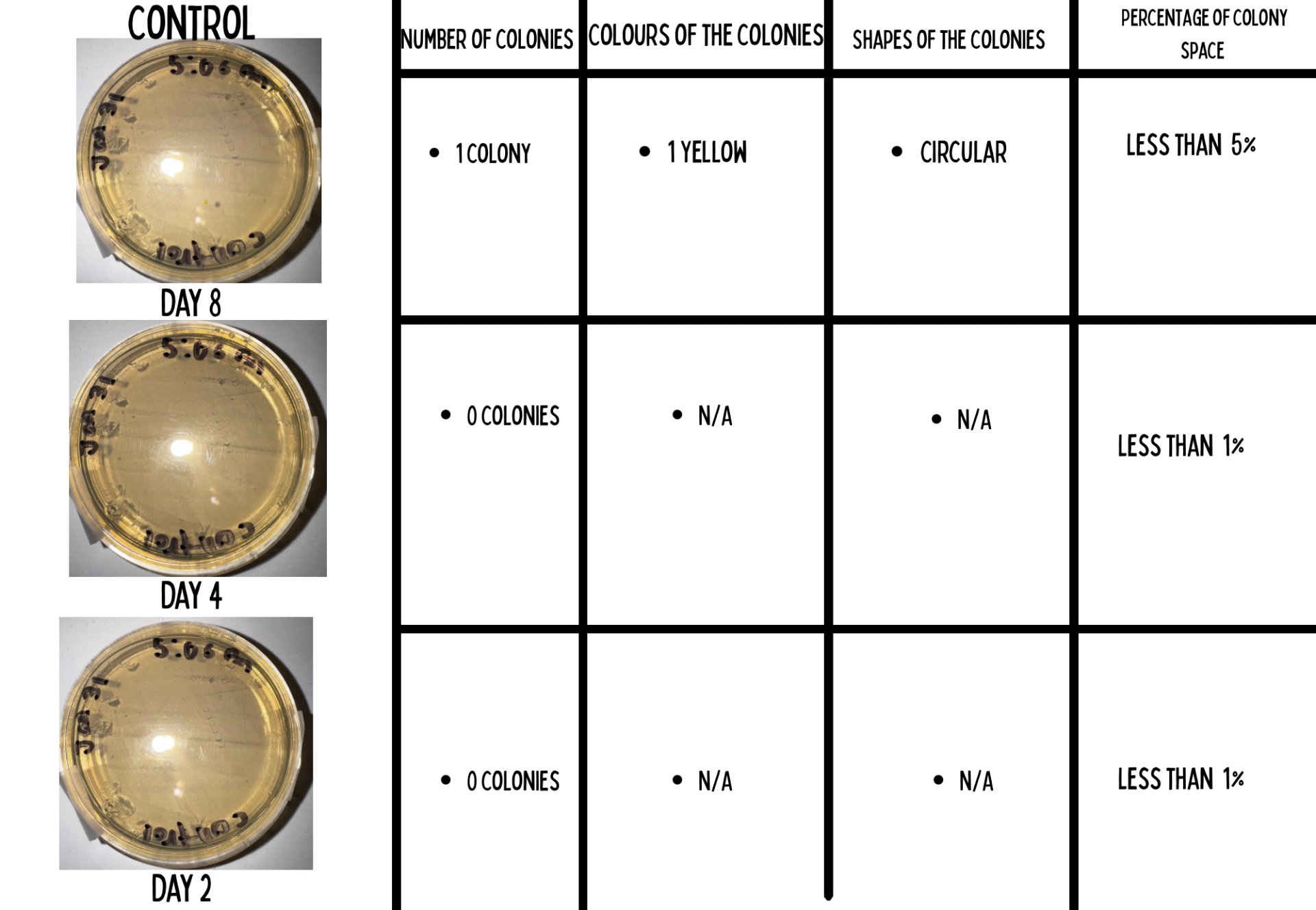
Observations
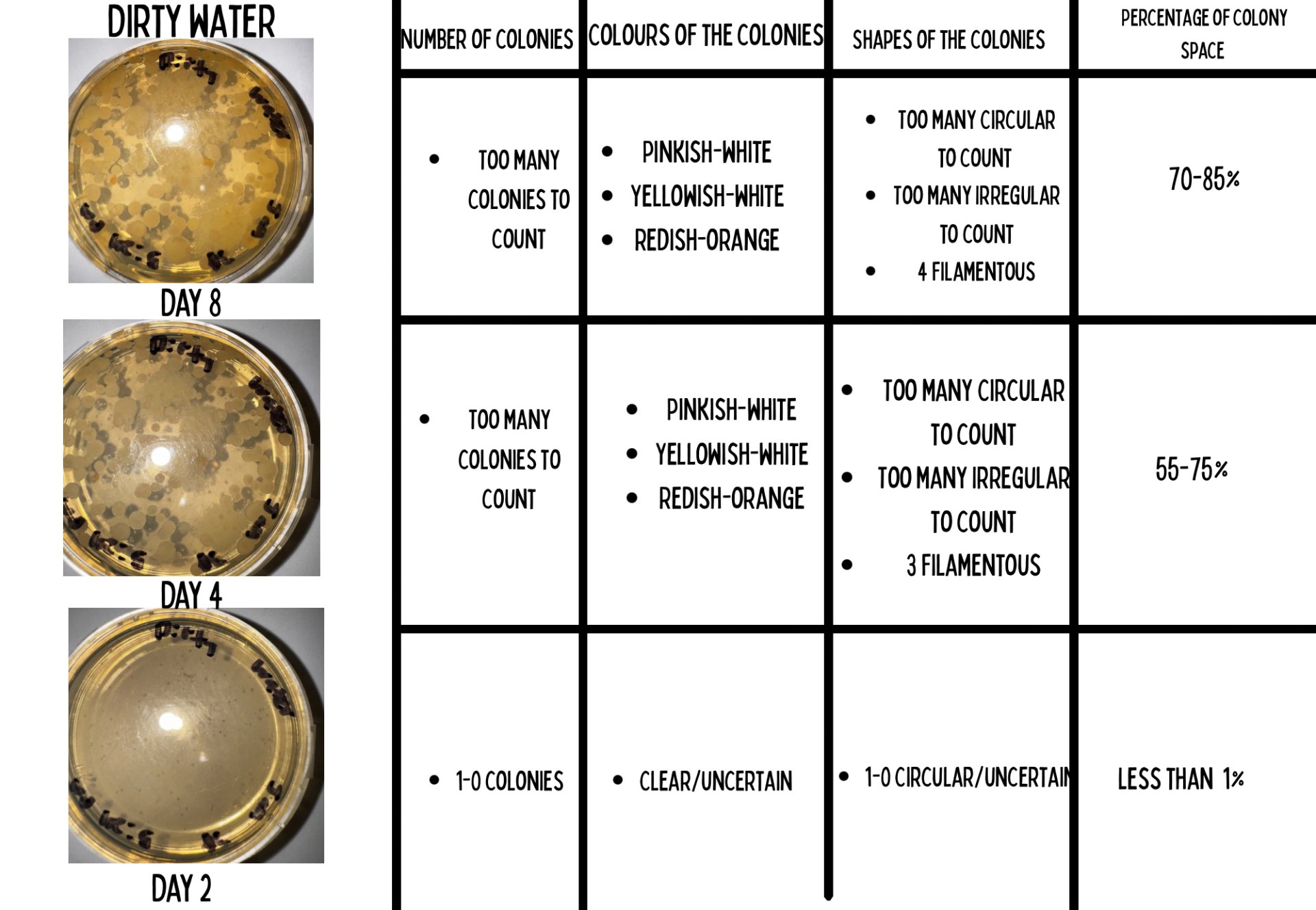
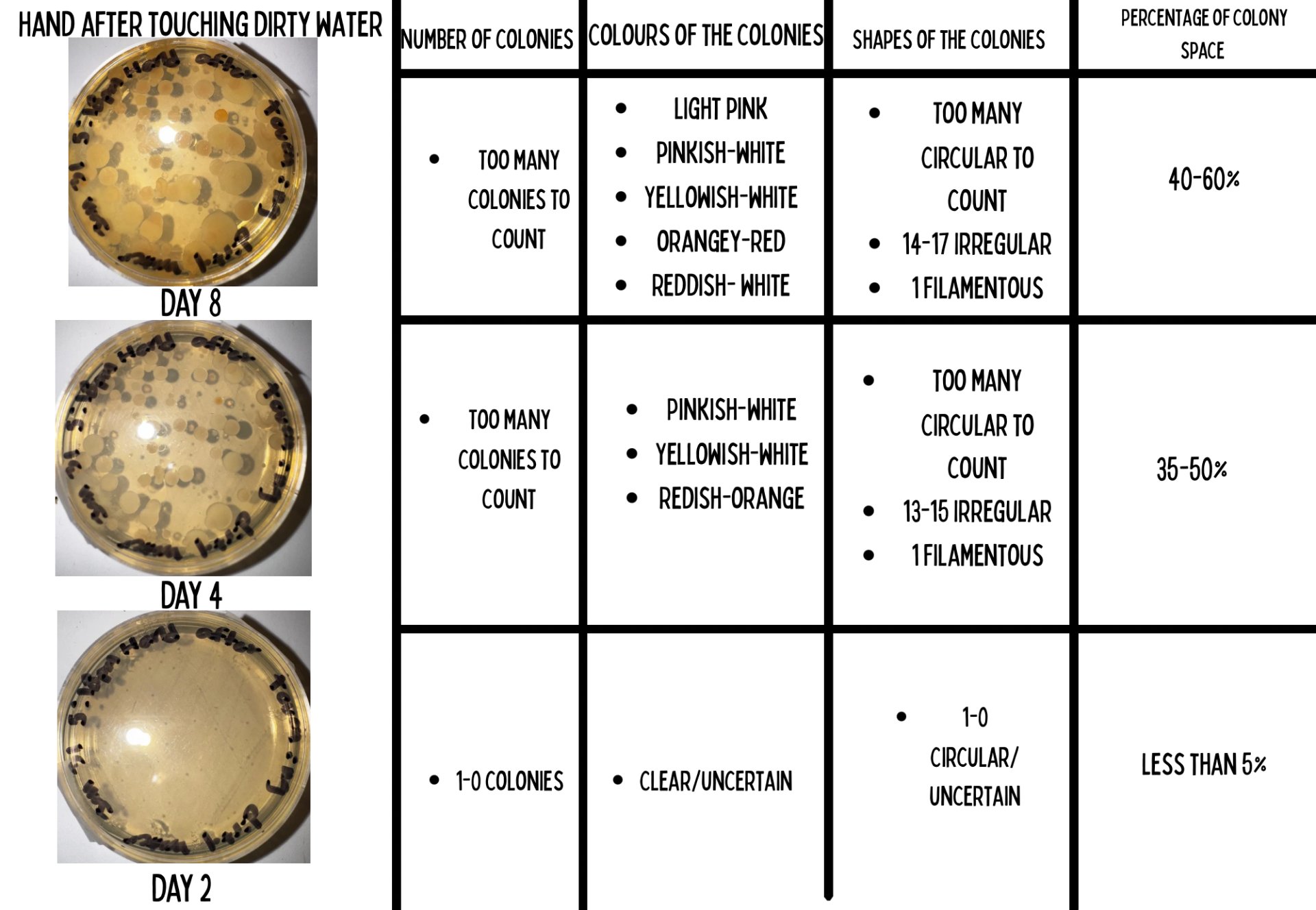
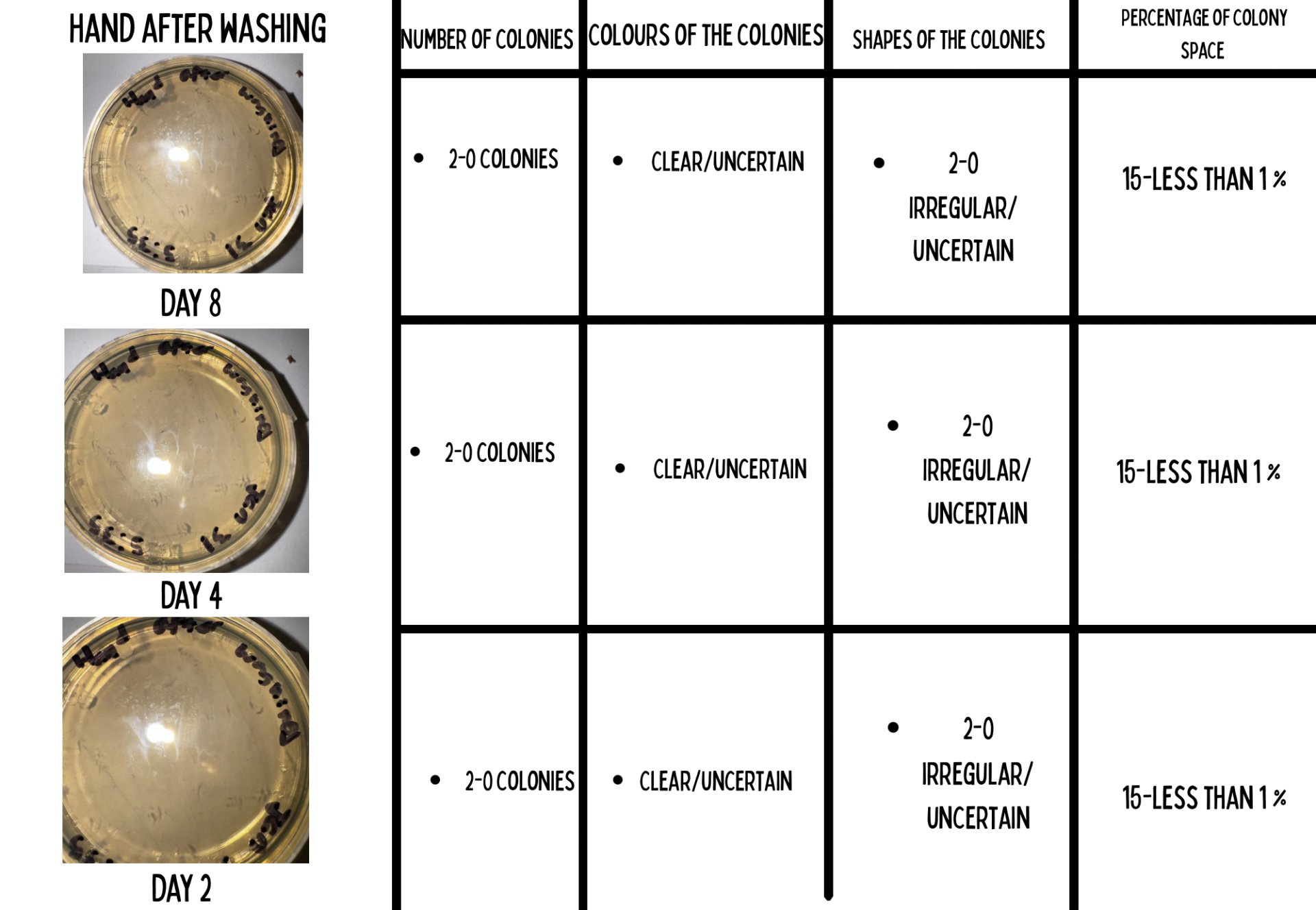
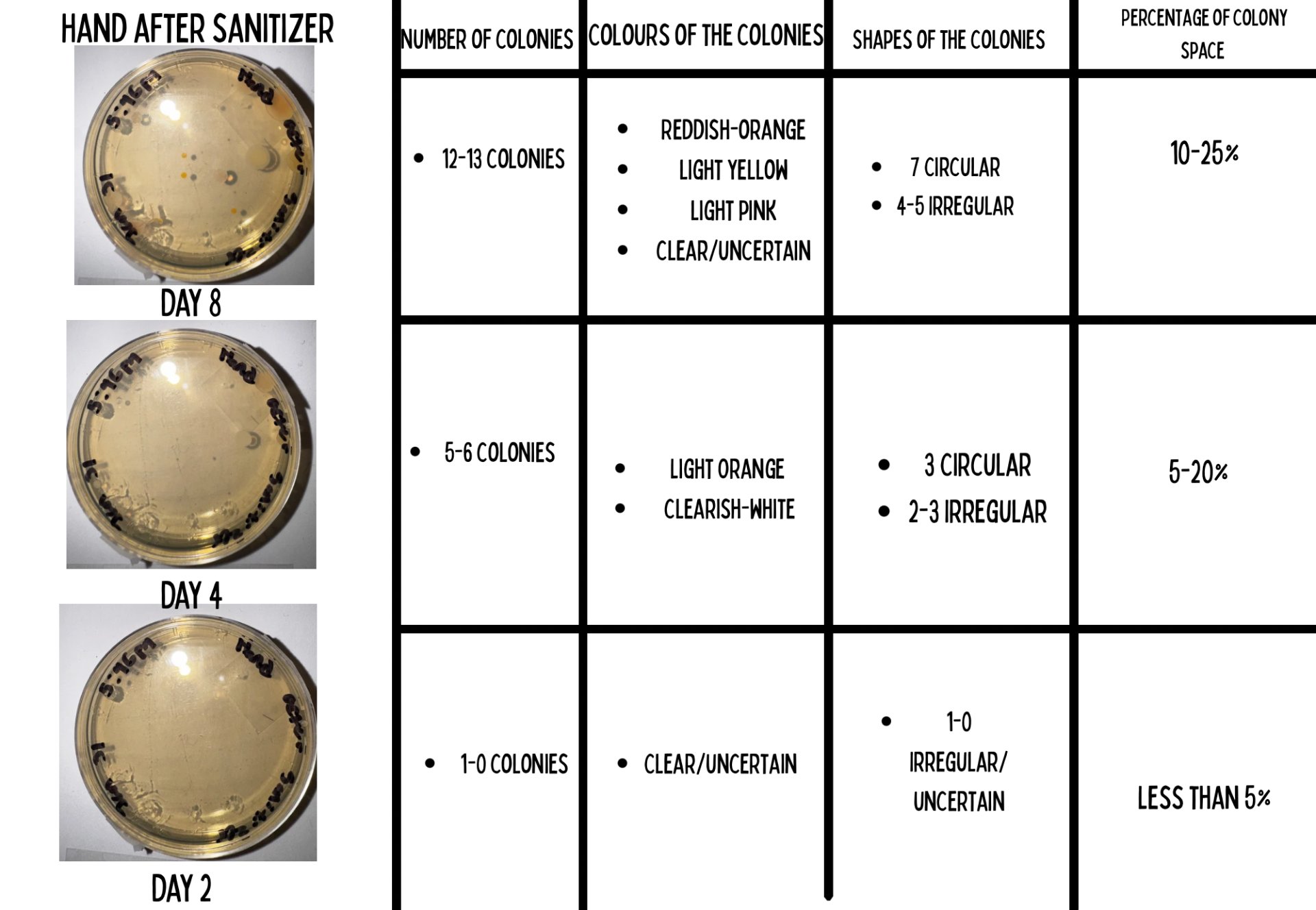
Analysis
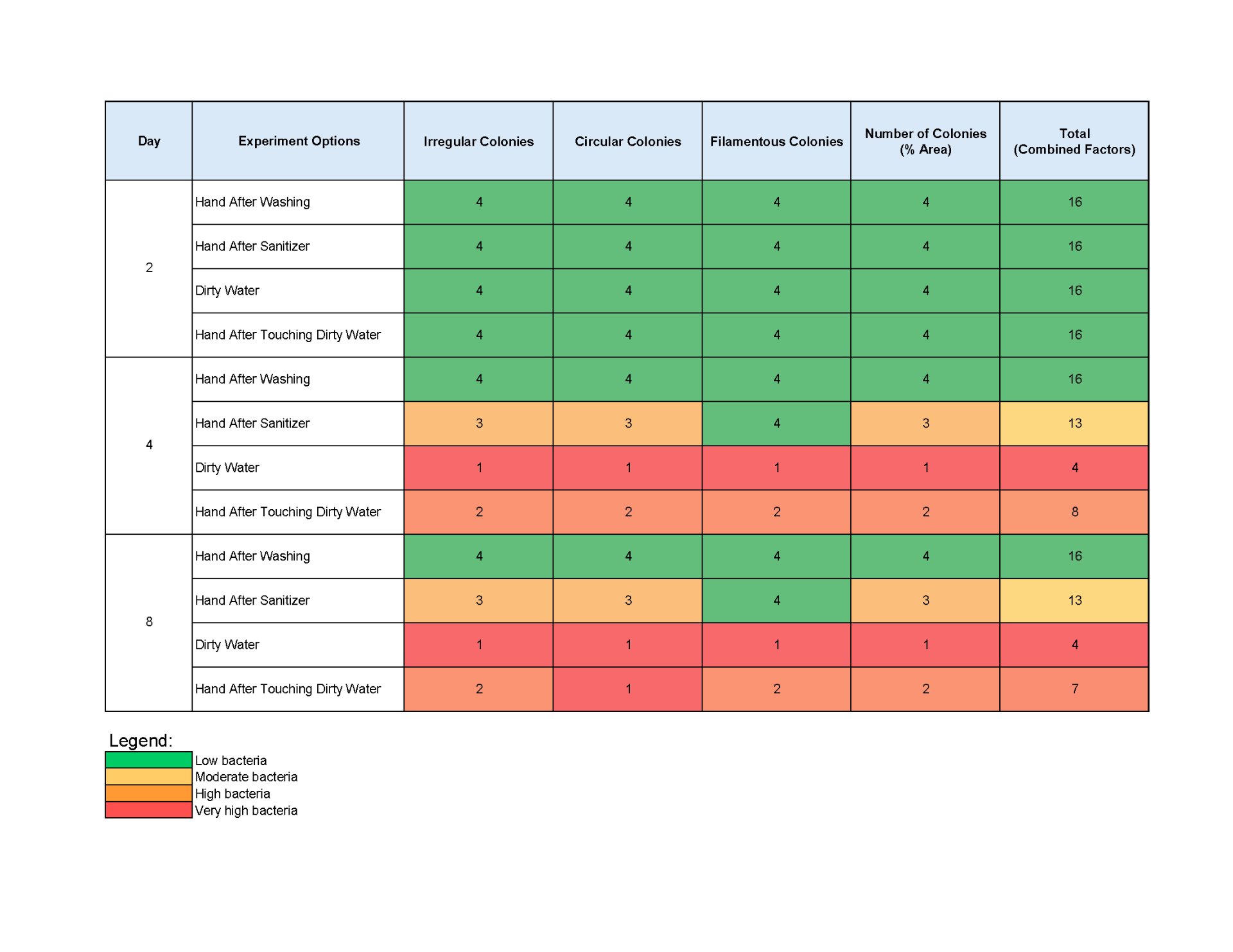
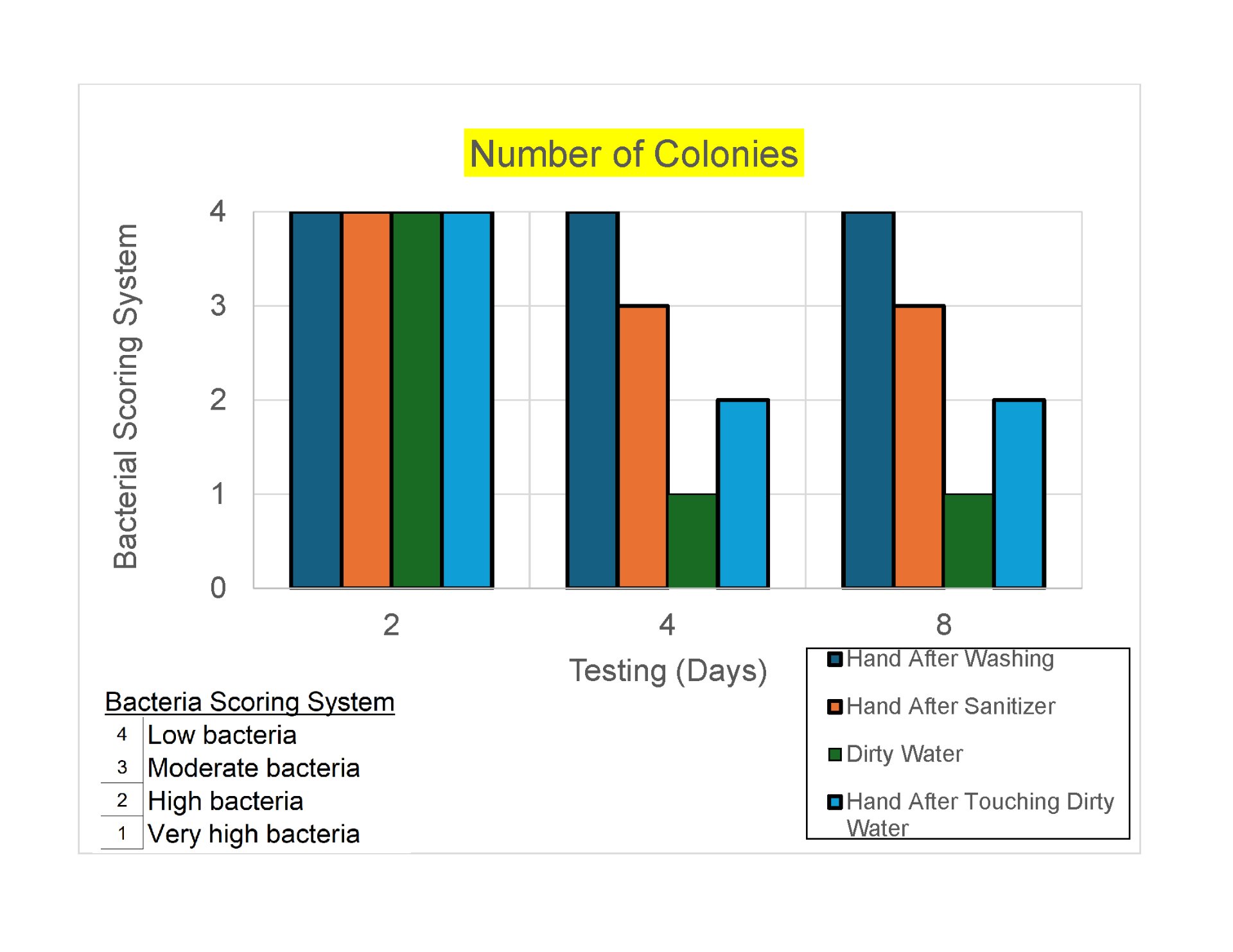
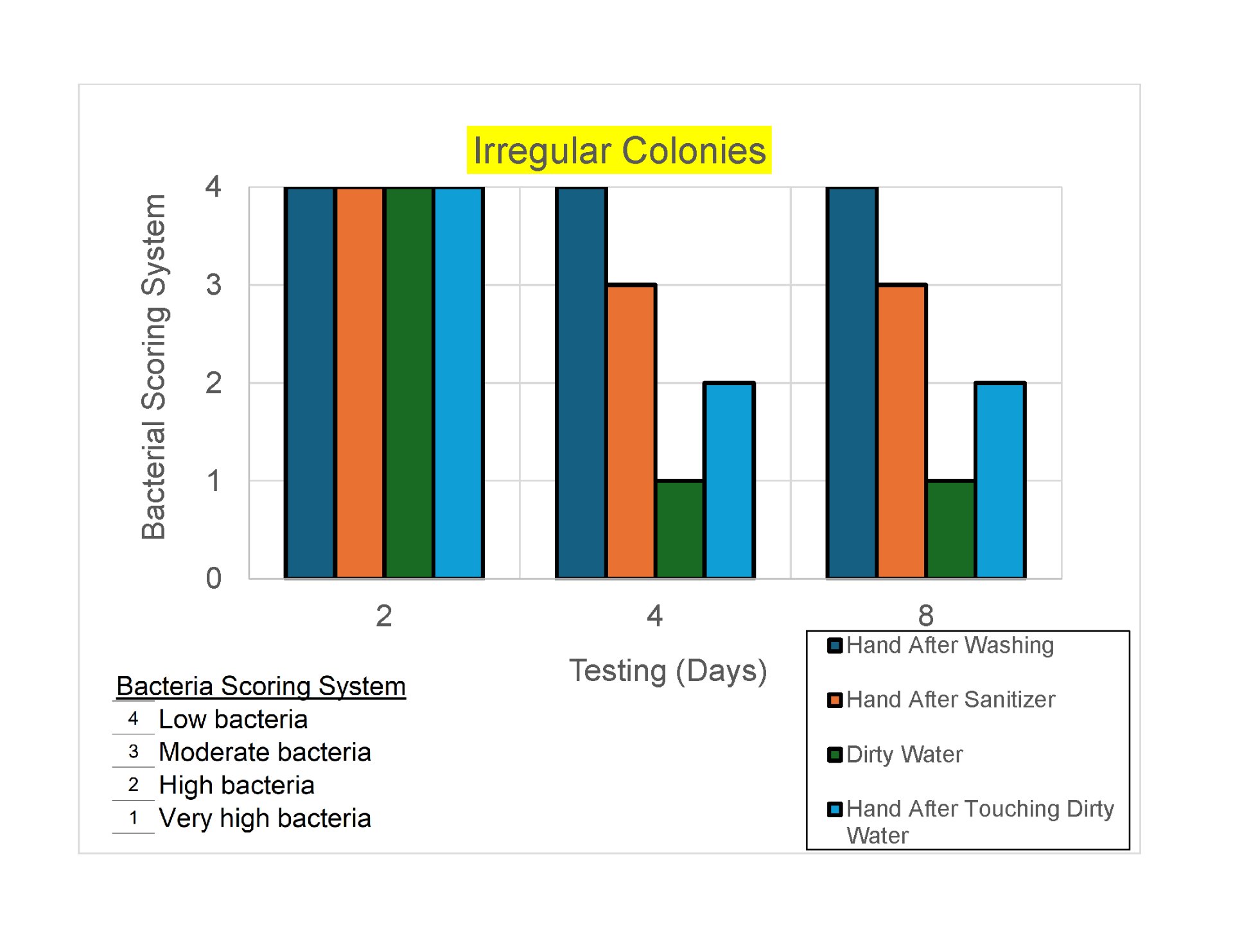
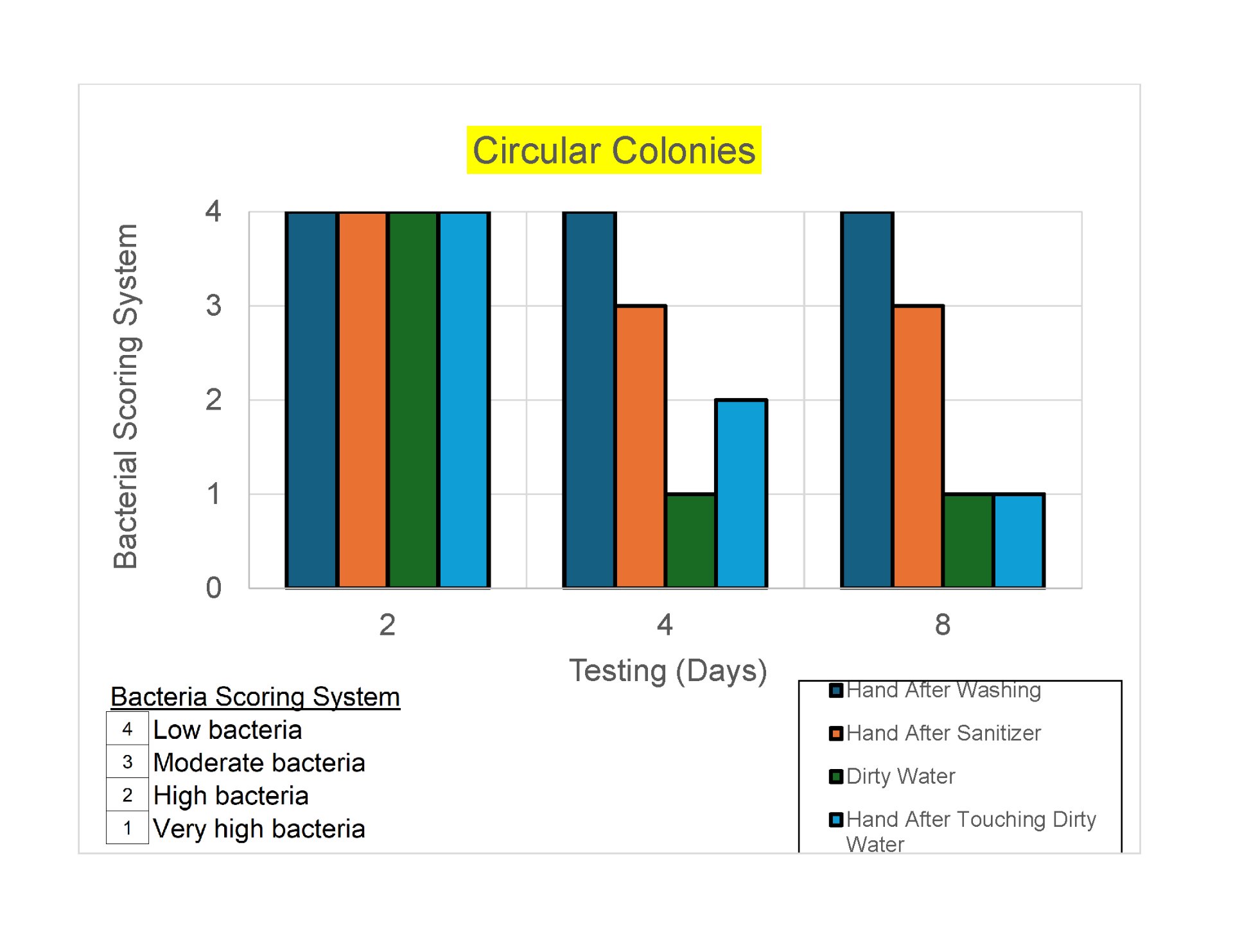
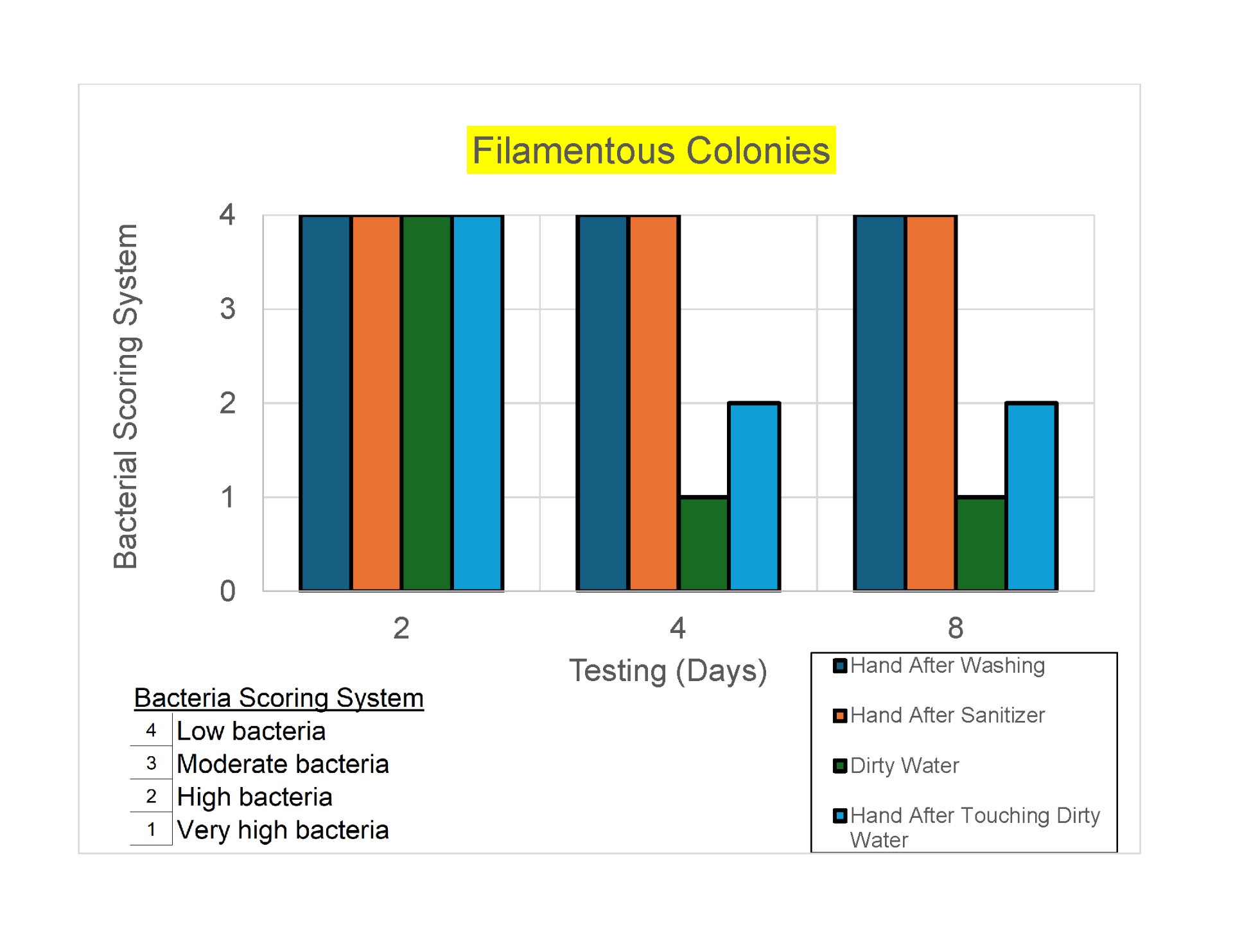
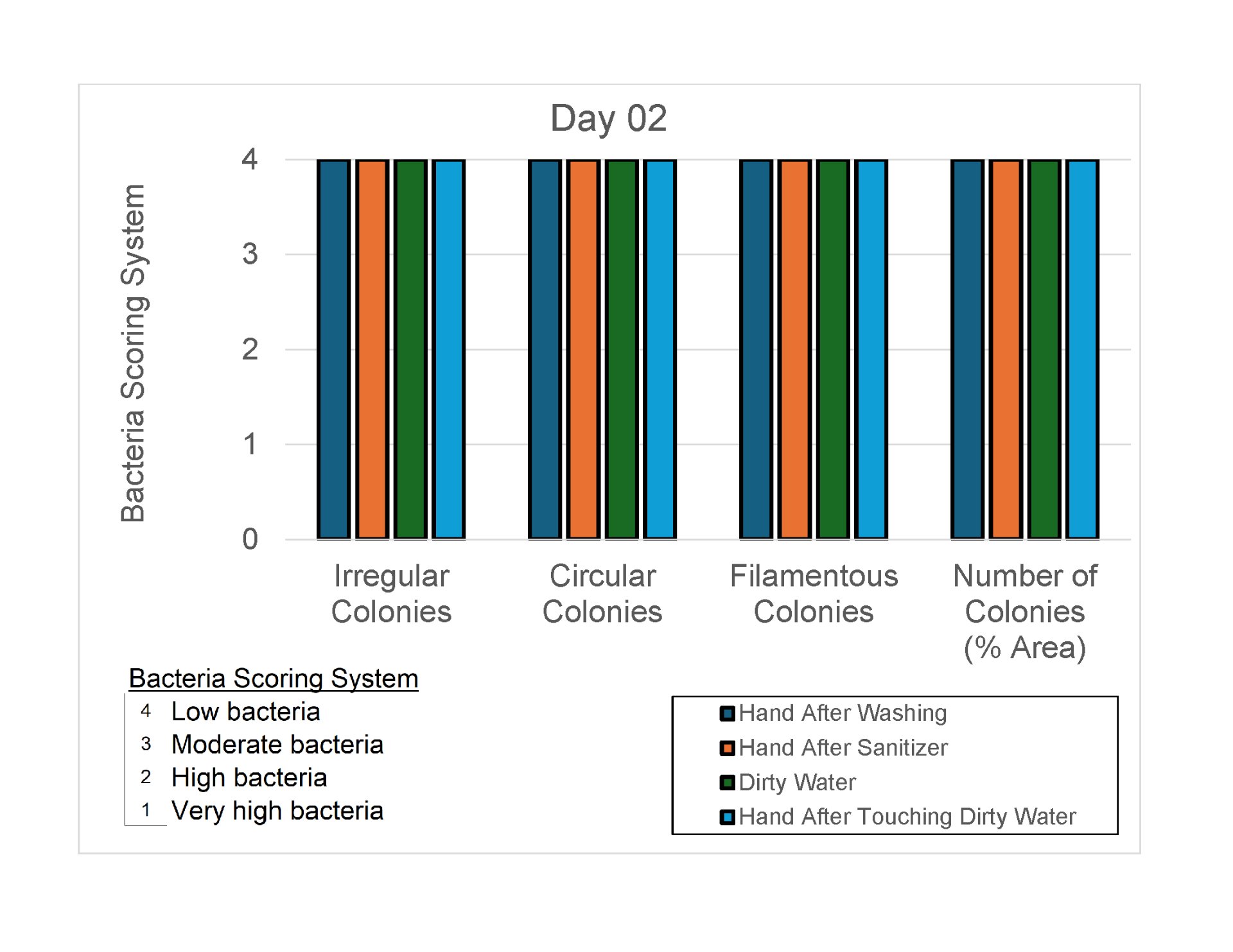
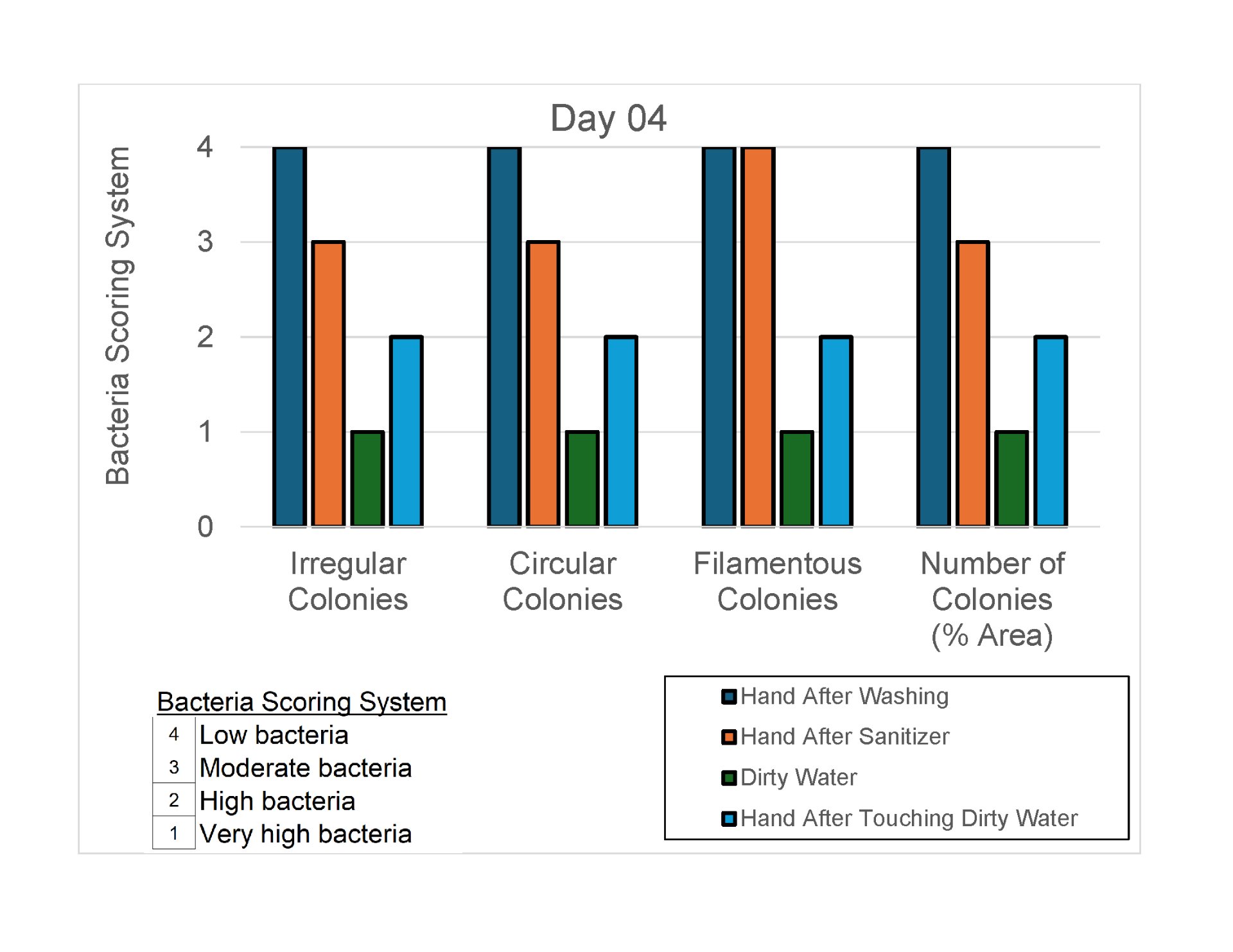
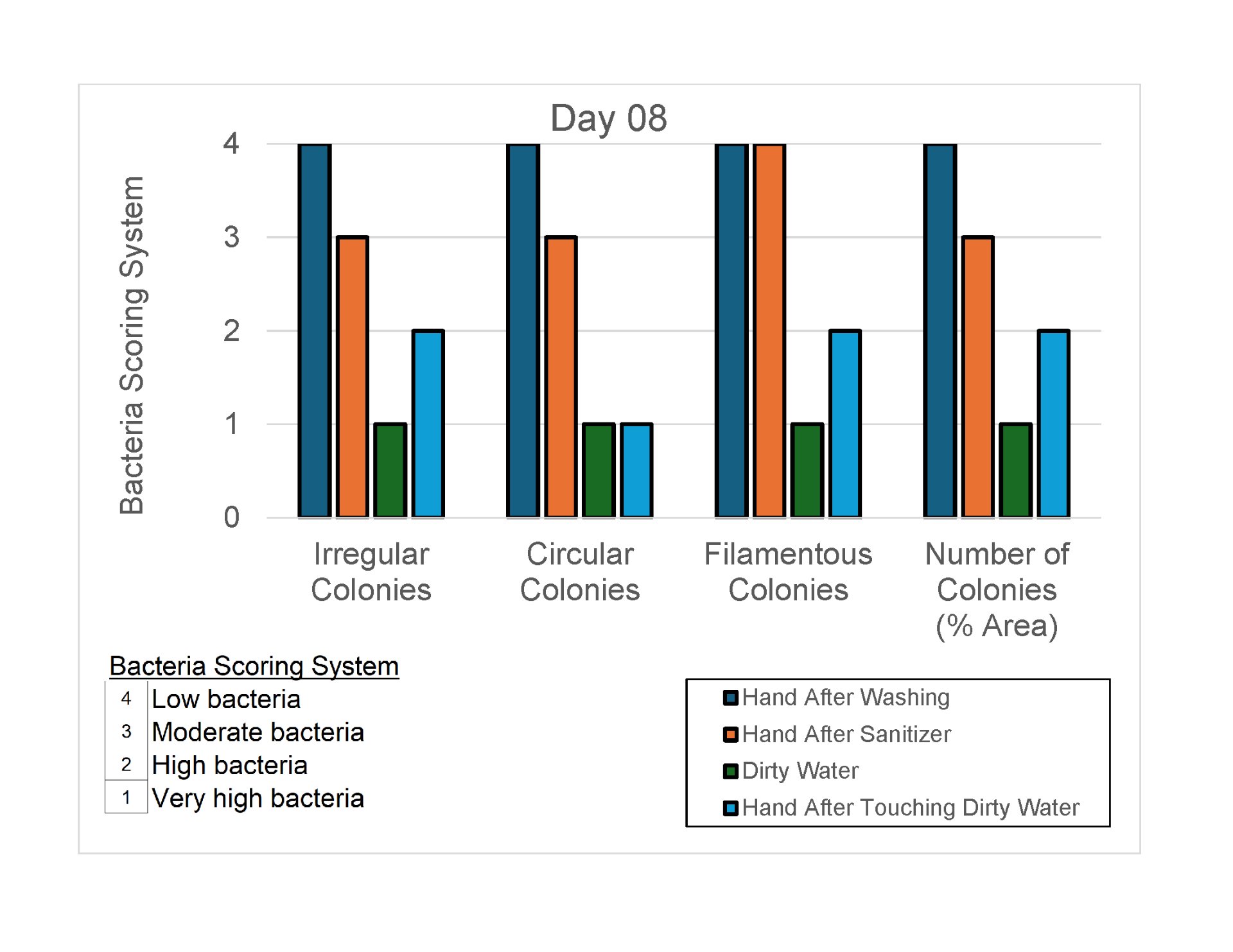
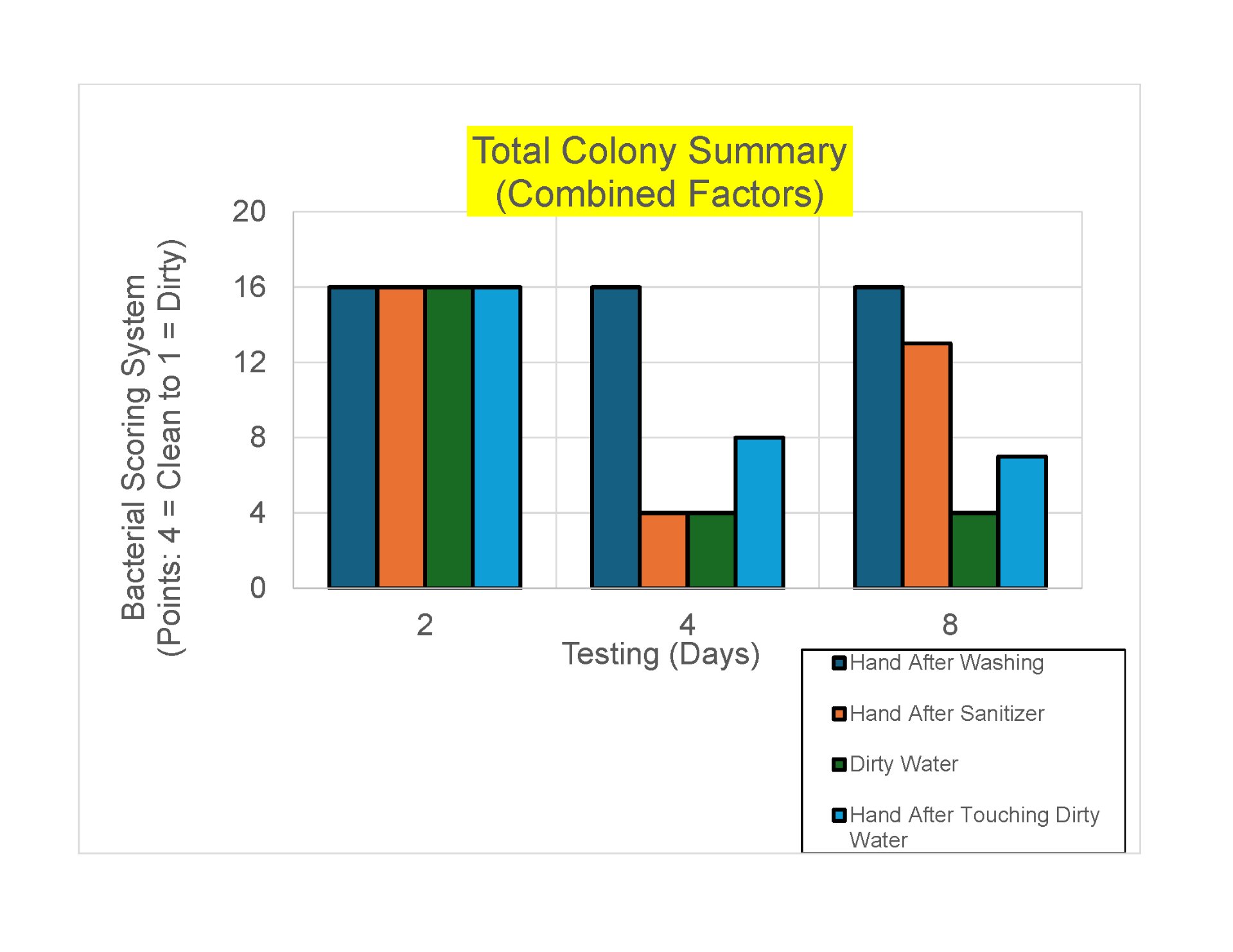
Photo credit ( for the graphs): My dad and Excel
Conclusion
In conclusion the results of my study supports my hypothesis. The “Hand after washing” Petri dish has the lowest measured bacteria (cleanest) and the “Dirty Water” Petri dish had the highest measured bacteria (dirtiest). To compare the amounts of bacteria on the different Petri dishes, I created a bacteria scoring system to observe the different Petri dishes based on different measuring factors (i.e irregular, circular, filamentous and number/area of colonies). The total was calculated based on all of the measuring factors combined(48 points being the highest and cleanest score possible). The “Hand After Washing” Petri dish came in first place with a full 48/48 points. The “Hand After Sanitizer” came in second place with 42/48 points. The “Hand After Touching Dirty Water” Petri dish came in third with 31/48 points. Last but not least is the “Dirty Water” Petri dish in fourth place with 24/48 points.
- The “Hand After Washing” Petri dish grew 2-0 colonies after 8 days
- The “control” Petri dish only grew 1 colony after 8 days
- The “Dirty Water” Petri dish way too many colonies to count after 8 days
- The ”Hand After Touching Dirty Water” Petri dish had less colonies of bacteria then the “Dirty Water” Petri dish but still too many to count after 8 days
- The “Hand After Sanitizer” Petri dish grew 12-13 colonies of bacteria after 8 days
In the end this experiment has shown that even though hand sanitizer still works, it is far more effective to disinfect your hands by washing them.
Application
Most people think that washing your hands and using hand sanitizer are equally good at disinfecting your hands but they actually aren’t. Even though hand sanitizer can still disinfect your hands it isn’t a replacement for washing your hands. Knowing how to disinfect your hands properly and knowing what happens if you don’t is very important. My project shows how dirty water has more bacteria than you would expect. It also shows the importance of properly washing your hands compared to just using hand sanitizer.
Sources Of Error
These are some of my sources of error:
I was planning to do two experiments to test the effects of hand sanitizer vs soap and water one with a door handle and one with dirty water. But when I came to take pictures of my Petri dishes on the third day of the door handle experiment, the agar on the Petri dishes had cracked because the room was too dry. When the agar on Petri dishes cracks sometimes the colonies of bacteria don’t grow as well.
Since the Petri dishes are not air tight some of the bacteria on the Petri dishes might have came from bacteria around the Petri dishes that contaminated the inside.
Citations
Sources:
science fair project ideas:
- Championship science fair projects: 100 sure-to-win experiments
What temperature bacteria grows best at:
- Https://www.wechu.org/food-safety/critical-temperatures
Bacteria on a doorknob
- Https://granitegold.com/blogs/cleaning/what-grows-on-the-doorknobs-in-your-home
Bacteria in water:
- Https://longsecowater.com/blog/what-bacteria-can-be-found-in-drinking-water
How to kill bacteria
- Https://www.cdc.gov/hygiene/about/cleaning-and-disinfecting-with-bleach.html
- Https://www.cdc.gov/hygiene/about/when-and-how-to-clean-and-disinfect-your-home.html
Bacteria and virus definitions:
- Https://my.clevelandclinic.org/health/articles/24495-germs
Why does soap work:
- Https://www.frenchsoaps.co.uk/blogs/news/why-does-soap-work?rsltid=AfmB0ooQaqS413Hr-_kNfYGvLls15KZf18CiGaA4b2FfQzKdl_Jh-F6A
How to find out what type of bacteria is on your Petri dish:
- https://www.sciencebuddies.org/science-fair-projects/references/interpreting-agar-plates
Pronunciation:
- https://youtu.be/rt_LuKpR5s0?si=eefTXzFb1L1S0aO
- https://youtu.be/En6QmkxYGyw?si=soqNx7DI4NIFg-tF
Header image:
- Shutterstock.com
- Https://www.freepick.com
Presentation:
- Canva.com
What type of Petri dish to
- Grandpa
Graphs:
- My dad
- Excel
Protein denaturing:
- https://youtube.com/shorts/5u78AipWbhM?si=E6aQM9ZJbPkGVzHy
Acknowledgement
I would like to thank the following people:
- My parents for supporting me every step of the way
- Our librarian
- My science teacher Ms. Price
- Mr. Neil