
NeuroSleep: How REM Sleep affects your daily mood, focus, and reaction time.
Muhammad-Yahya Khan
Shehneela Farheen-Khan
Grade 5
Presentation
No video provided
Hypothesis
If one goes to bed earlier and receives sufficient sleep, they are more likely to complete full REM cycles, which may result in improved daytime performance.
Research
Sleep is not one continuous state but occurs in cycles made up of different stages. There are four stages in a sleep cycle. N1(Non REM 1), N2 (Non REM 2), Delta, and, REM sleep. A typical sleep cycle lasts for about 90 to 175 minuets. Earlier in the night Delta sleep is longer and REM sleep is shorter. As night progresses, REM increases and Delta sleep decreases. REM is defined as the Rapid Eye Movement. Here, new neural pathways are formed and strengthened resulting in learning efficiency and moving the short-term memory to a long-term space. REM sleep is also strongly connected to the hippocampus, which plays an important role in forming and organizing memories. During REM sleep, the brain replays information learned during the day and strengthens the connections between neurons. This process helps move information from short-term memory storage to long-term memory storage in the cerebral cortex. REM sleep also affects the prefrontal cortex, which is responsible for decision-making, attention, and focus. When REM sleep is sufficient, the prefrontal cortex can function more efficiently the next day, helping with quicker thinking and better concentration. In addition, REM sleep is associated with activity in the amygdala, which is involved in processing emotions. Scientists believe that REM sleep helps regulate emotional responses and may reduce stress levels. This suggests that good REM sleep may improve mood and emotional stability during the day. To investigate the above hypothesis, an experiment was designed where bedtime was chosen as an independent variable. Mood, focus, reaction time, and memory were the dependant variables to determine the daytime performance. For the controlled variable, bedtime routine, environment, and the participant remained constant through the experiment to make the test fair.
Variables
Independent Variable: Bedtime was chosen as an independent variable. Dependent Variables: Mood, focus, reaction time, and memory were the dependant variables to determine the daytime performance. Controlled Variables: Bedtime routine, environment, and the participant remained constant through the experiment to make the test fair.
Procedure
Procedure
1. A clear procedure was followed to collect data. 2. Galaxy 5 pro smartwatch was used by the participant to measure the REM hours. 3. To measure daytime performance, some basic activities were done on Human Benchmark (website) for 16 days (19:00 hrs everyday). 4. Simple games like aim trainer (focus), visual memory (memory), and reaction time clicker (reaction time) were played.
Observations
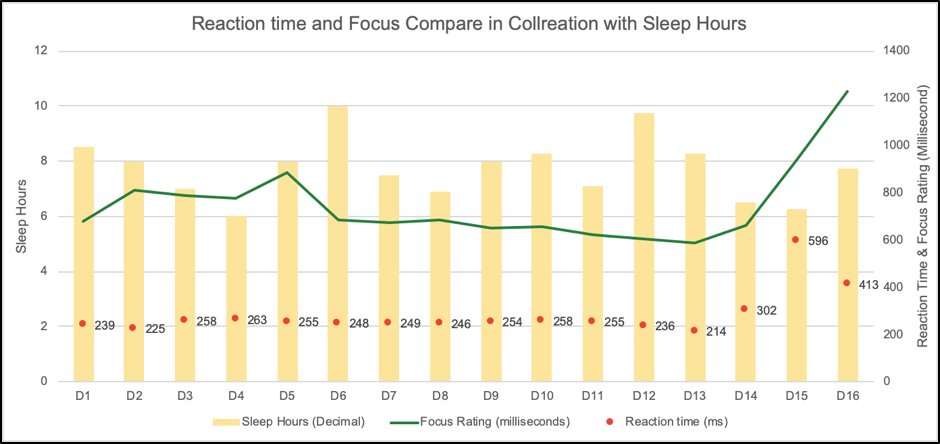
The results were calculated through excel and tabulated into graphs. The 1st graph shows reaction time and focus in correlation to sleep hours. The average amount of reaction time measured from reaction time clicker was 281 milliseconds, and the average focus time from aim trainer was 745 milliseconds. To measure reaction time, the player had to wait until the box changed colours, then they had to react quickly and click it. For focus, the player had to click on 30 targets to win. The graph shows that on days when the participant had more REM hours, they took less time to react and had a higher score on the focus game.
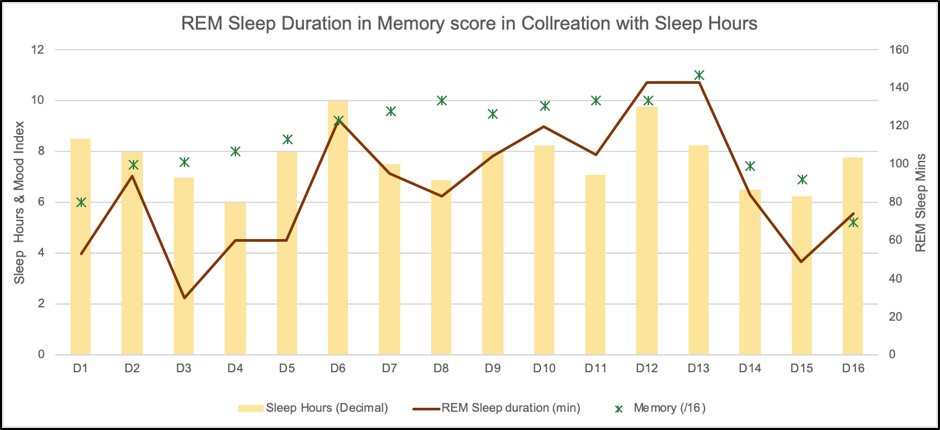
The 2nd graph shows REM sleep duration and memory in correlation to sleep hours. To measure memory, a game called visual memory was played on Human Benchmark where the player had to memorize the sequence of the highlighted squares and punch in the same squares after a specific interval. With each progressing level, the memorization became harder. Therefore, the results from this graph support that on days the participant had more REM hours, his memory score improved as compared to the days when his REM hours were less.
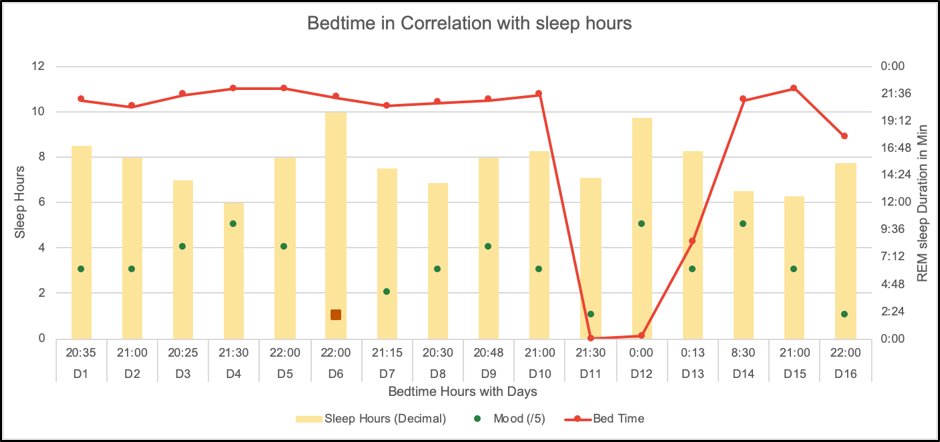 The 3rd graph examines the mood and bedtime in correlation to sleep hours. The data shows a positive correlation. This means that when REM sleep increased, mood ratings improved. On nights with less REM sleep, mood was often lower. As expected, there is an outlier in the data, which is due to the health of the participant. Even though the data shows higher REM hours, his mood ratings were extremely low.
Analysis
With more REM sleep, one’s prefrontal cortex can process information more efficiently, helping with quick decision making. As we know, REM helps with strengthening neural pathways, which helps with recall and retention. REM is associated with increased activity in the amygdala and hippocampus, which suggests that REM sleep may help the brain manage emotions and improve overall well-being during the day as well. These scientific findings explain why the data in this experiment showed improvements in reaction time, memory, focus, and mood when REM sleep increased.
Conclusion
This experiment suggests that pushing bedtime earlier improves daytime performance. REM sleep strengthens the neural pathways and has a profound effect on the amygdala, prefrontal cortex, cerebral cortex, and hippocampus, meaning that REM sleep also helps with memory, mood, reaction time, and focus respectively. Therefore, the hypothesis was supported by the results of this experiment.
Application
This experiment helped me understand how important REM sleep is for my brain. After doing this project, I became more aware of my bedtime and how it affects my performance the next day. I learned that even small changes in sleep can affect memory, mood, focus, and reaction time. This research can also help other students understand why sleep is important for school success. Parents and teachers may use this information to encourage healthy bedtime routines. Athletes may also benefit because better reaction time and focus can improve performance in sports. If more students learn about REM sleep, schools might better understand how sleep affects learning and overall well-being. In the future, this research could be expanded by including more participants or studying different age groups. This may help students and educators better understand how sleep supports brain development and academic performance.
Sources Of Error
In every experiment, there are limitations. Some of them are listed below. 1. The technology was a limitation as the smartwatch wasn’t a medical-grade device, so the REM sleep hours were an estimation since heartbeat, breathing, and brain activity cannot be calculated precisely as one could do in a professional sleep lab. 2. The experiment sample size is small since there was only one participant; therefore, the data cannot be generalized to all 10–11-year-olds. Also, at this age, brain development is very unique to every individual. 3. The mood ratings were a personal bias of the participant. 4. The duration of the experiment was small, which is the reason there were unexpected fluctuations in the data due to the health of the participant. 5. Other significant limitations that might skew the data a bit can include screens before bed, sugar intake, physical activity, or school stress, etc.
Citations
CITATIONS Unwin Ann Lucy, Caswell Barry. Inside Your Brain. Thames & Hudson Ltd., 2025. Bjazevich, Eingner. Sleep: A Kids Guide to the Science of Slumber. Bushel & Peck Books, 2024. Boucher, Gill. Big Brain Book. Magination Press, 2021. Gavin, Mary L. “What Is Sleep and Why All Kids Need It?” KidsHealth, 1 June 2020, https://kidshealth.org/en/kids/not-tired.html. “Kids Sleep Linked to Brain Health.” NIH News in Health, Oct. 2022, https://newsinhealth.nih.gov/2022/10/kids-sleep-linked-brain-health
Acknowledgement
With this Report, I would like to thank my mother, for helping me with all of my work and keeping me on the right track. I would also like to thank my Science Teacher Mr. Finnerty for guiding and helping me prepare for this project.