
Balloon Powered Cars
Arshgeet Kaur, Bhaag Kaur
Gobind Sarvar School Guru Nanak Gate Campus
Grade 5
Presentation
No video provided
Hypothesis
- If a balloon-powered car has larger wheels, then it will travel the farthest because larger wheels cover more distance per rotation.
- If a balloon-powered car is made from stronger materials, then it will move farther because the car will be more stable.
- If the balloon-powered car is lighter and has less friction, then it will move the farthest because the air from the balloon can push it more easily.
Research
This experiment focuses on balloon-powered cars made from different materials, including:
- Cardboard car
- Lego car
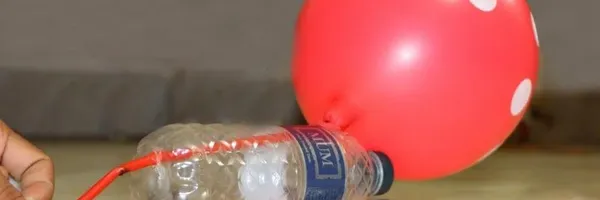
- Plastic bottle car
A Balloon-Powered Car is a lightweight vehicle that moves when air is released from an inflated balloon. This demonstrates Newton’s Third Law of Motion: “For every action, there is an equal and opposite reaction.” The air rushing out of the balloon pushes the car forward, making it a fun way to explore physics!
The experimental question is which type of balloon-powered car moves the farthest using the same size balloon?
Variables
Independent Variable (what you change):
- Type of car
Dependent Variable (what you measure):
- Distance the car travels
Controlled Variables (what stays the same):
- Amount of air
- Type and size of balloon
- Surface the car moves on
- Wheels and axles
- Way the balloon is attached
Procedure
Steps for how we made the cardboard car:
- Cut a 7×4 cardboard square and tape two cut straws pieces to the bottom
- Flip it over, and prick two bottle caps with a skewer going into the straws (x2). Do this for the front and the back of your Balloon Car.
- Insert the straw into the balloon and hold in place by securing a rubber band around the bottom of the balloon. Do not tighten too much as this could restrict the airflow into the balloon. Tape the straw down.
- Blow into the balloon to fill it up with air. Place your thumb over the end of the straw to keep the air inside the balloon until you are ready to let the air out. This will make your balloon car move.
Steps on how we made the Lego car:
- Build the body of the car using LEGO bricks to make a strong, simple frame.
- Attach the wheels using a rod so they can spin easily.
- Create a small holder at the back of the car to place the balloon.
- Inflate the balloon and pinch the end to keep the air inside.
- Attach the balloon securely to the back of the car using tape.
- Place the car on a flat surface and release the balloon to let the air push the car forward.
Steps on how we made the plastics bottle car:
- Check that the car rolls smoothly on a flat surface. If not, make sure the rods are straight, the bottle cap holes are centered, and the straws are taped tightly. Add glue if needed.
- Tape the balloon tightly to one end of the straw.
- Cut a small hole in the bottle and push the other end of the straw through it.
- Secure the straw with tape.
- Blow into the straw, then release your finger to watch the car move.
Observations
- When the balloon had air in it then the car only moved, but when the balloon started to decrease the amount of air in it, the car moved slowly and stopped when the balloon had no air.
- Every time when we tested the plastic bottle car, it moved further every trail. This is because it was lighter comparing to the other car models.
- When we tested the Lego car, it did not go as far as comparing to the other cars. This is because, the balloon did not have much force to push the Lego car due to its heaviness.
Analysis
The results show that car design affected how far each balloon-powered car traveled. The lighter cars with straighter axles went farther because they had less friction and less mass, so the air force from the balloon could push them more easily. Heavier cars did not travel as far because more force was needed to move them. Since the balloon size, starting line, and surface were kept the same, the differences in distance were caused by weight and friction. This shows that lower friction and lower mass help objects move farther, which matches the science of force and motion.
Conclusion
In conclusion, the balloon-powered car experiment showed how air pressure can create motion. The plastic bottle car traveled the furthest distance, which proved the hypothesis correct. This happened because the plastic bottle car was lighter and had less friction, allowing it to move more easily. The experiment also showed that car design and weight affect how far a balloon-powered car can travel. Overall, this project helped demonstrate Newton’s Third Law of Motion and how science and engineering work together.
Application
This experiment applies to daily life because it shows how force, friction, and weight affect how objects move. These same ideas are used when designing cars, bikes, wheelchairs, and even shopping carts so they can roll more easily and use less energy. Engineers try to make vehicles lighter and reduce friction so they travel farther and faster with less power. The balloon car also demonstrates thrust, which is the same principle used in rockets and jet engines. Understanding this helps us see how better design can improve movement in everyday machines and transportation.
Sources Of Error
Some errors could have affected the results of this experiment. The balloon may not have been inflated to exactly the same size each time, which could change the amount of force pushing the car. The floor surface might not have been perfectly smooth, causing extra friction in some trials. The cars may not have been released in exactly the same way each time, which could change how straight or fast they started. Measurements of distance could also have small mistakes. These sources of error could slightly change the distances recorded.
Citations
- https://littlebinsforlittlehands.com/lego-balloon-car-diy-lego-building-kit/
- https://extremesteamscience.com/engineering-activity-10-balloon-car/
- https://www.scientificamerican.com/article/build-a-balloon-powered-car/
- https://www.scienceworld.ca/
- google the most
Acknowledgement
The Acknowledgement are
- Mrs. Isha Anand
- Mrs. Seran
- Ms. Singh
- Judges
- Agam Kaur 7A
- Parents
- Samarbir 8C