
How Can Liquids Affect The Rate Of Dissolving Candies?
Guruki Hallan, Parmveer Sandhu
Gobind Sarvar School Guru Nanak Gate Campus
Grade 5
Presentation
No video provided
Hypothesis
We did our hypothesis based on which liquid would dissolve the candy the fastest.
We thought that the Sprite would dissolve first, and then second the coke would, third the regular water, forth the orange juice and fifth the salt water.
Research
How Does The Type Of Liquid Affect How Fast Candy Dissolves? What Is Solubility & Dissolving? How Do They Help Us In Real Life?
What Is Dissolving & Solubility?
- Solubility is how well a solid dissolves in a liquid.
- Dissolving happens when a solid breaks into tiny particles and mixes evenly with a liquid.
- Candy is mostly sugar, which can dissolve in liquids.
- Different liquids dissolve sugar at different speeds.
- This is why the type of liquid can affect how fast candy dissolves.
How It Helps Us In Real Life
- Medicines And Effectiveness: For a medication to be absorbed and to have an effect it must be in a dissolved or in a soluble form.
- Nutrient Absorbance: The body relies on the solubility of vitamins, minerals, and other nutrients in water or fats to absorb them from the food.
- Kidney Function: The kidneys use solubility principles to filter waste products from the blood
- Flavor & Taste: Dissolving sugar in coffee or salt in soup relies on solubility to achieve the desired taste
- Carbonation: The fizz in soft drinks is due to carbon dioxide gas dissolving in water under pressure
- Baking & Desserts: Achieving specific food textures, like in candy mixing, requires controlling the solubility and saturation of sugar solutions
Variables
- Independent Variable (what we changed)
-
The type of liquid
-
Dependent variable (what you measured)
-
Rate of dissolving
-
Controlled variable (what stays the same)
- Same brand and type of candy
- Same size of candy
- Same amount of liquid in each cup
- Same temperature
- Same cup size
- Same time set in the liquids
Procedure
-
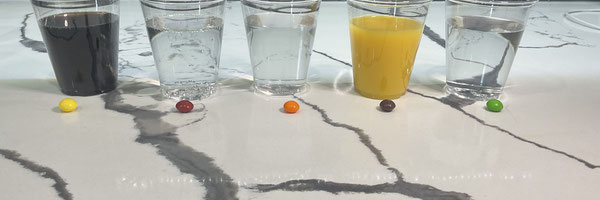
4 plastic cups
-
Orange Juice
-
Coke
-
Sprite
-
Salt Water
-
Regular Water
-
Skittles
Observations
General Observations
- The coloured coating began dissolving first.
- The inside of the candy remained solid.
- Different liquids caused colour to spread at different speeds.
- Bubbles formed in soda during dissolving.
Sprite: colour spread quickly, bubbling observed
Coke: colour harder to see due to dark liquid bubbling observed
Orange Juice: colour made it hard to see dissolving, colour spread differently
Water: clear colour spreading, no bubbles, dissolved at a steady rate
Analysis
The end result was that the regular water dissolved the skittle the best, next was the sprite, then it was the coke, after the coke was the salt water, and then last was the orange juice.
Why did water dissolve skittles the fastest? Because the outer coating is highly water soluble, and warm water speeds this up due to its faster moving molecules, quickly carrying away sugar and dye through diffusion.
Why did the orange juice dissolve the skittle the least? Orange juice does not dissolve skittles the fastest because the speed of dissolving depends more on the liquids temperature the type of solvent water vs other substances the amount of carbonation rather than its sugar or acidity alone.
Why did the sprite dissolve the skittle better than the coke? Its because sprite is a lemon lime soda with a generally higher acidity and more citric acid, which breaks down the sugar coating of a skittle faster than coke, though both are acidic and dissolve skittles well, with less coloring you see the skittles colors dissolve and spread more clearly in sprite.
Why did the regular water dissolve faster than the salt water? Its because salt water already has salt sodium and chloride ions dissolved in it. The water molecules are busy interacting with the salt ions making them less available to dissolve the new solute the skittles sugar.
Conclusion
The purpose of our experiment was to determine how different liquids affect the rate at which a Skittle dissolves. Our results showed that water dissolved the Skittle the fastest, while orange juice dissolved it the slowest. This partially supported our hypothesis. We predicted that certain liquids would dissolve the Skittle faster due to their chemical properties, and our results confirmed that water, being a polar substance, dissolves sugar efficiently. The slower dissolution in orange juice may be due to its pulp and different chemical composition, which could have interfered with the dissolving process. One limitation of our experiment was that we conducted a limited number of trials. In future investigations, we would perform multiple trials and measure volume and mass changes more precisely to improve accuracy.
Application
-
Medicines And Effectiveness: For a medication to be absorbed and to have an effect it must be in a dissolved or in a soluble form.
-
Nutrient Absorbance: The body relies on the solubility of vitamins, minerals, and other nutrients in water or fats to absorb them from the food.
-
Kidney Function: The kidneys use solubility principles to filter waste products from the blood
-
Flavour & Taste: Dissolving sugar in coffee or salt in soup relies on solubility to achieve the desired taste
-
Carbonation: The fizz in soft drinks is due to carbon dioxide gas dissolving in water under pressure
-
Baking & Desserts: Achieving specific food textures, like in candy mixing, requires controlling the solubility and saturation of sugar solutions
Sources Of Error
Our overall experiment didn’t have any big errors but these are just some inconsistencies that occurred.
-
Juice pulp interference
-
Human timing error
-
Unequal liquid volume
-
Inconsistent candy coating thickness
Citations
Acknowledgement
We’d like to give an appreciation to our families for helping us with the experiment, we’d also like to say a huge thanks to Ms Isha for helping us when needed and guiding us with what to do.