
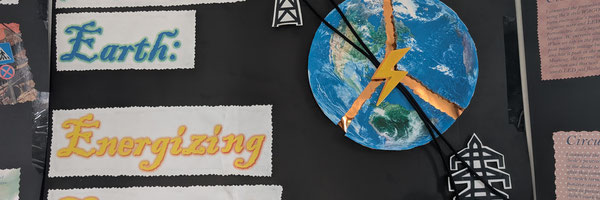
Fractured Earth: Energizing Tomorrow!
Hirav Sakhuja
Annie Gale School
Grade 7
Presentation
No video provided
Problem
The fractures of the Earth are caused by the movements of tectonic plates on the Earth's crust. There are 3 types of tectonic plates movements namely: convergence , transform, and divergence.
Convergent plate movements is further divided into three types . When continental crusts moves towards another continental crusts, plates collide with each other and move upwards for example the Himalayas. When continental crust moves towards oceanic crust subducts beneath the continental crust resulting in volcanoes. Lastly, when oceanic crusts moves towards oceanic crust causing the older oceanic plate to subduct making volcanic island arcs.
Transform plate boundaries slide past each other example the San Andreas fault.
Divergent plate boundaries spread apart from each other for example the Mid-Atlantic Ridge. These movements cause earthquakes.
Earthquakes have always been feared as ONLY natural disasters. Ring of fire, Alpide belt, and the mid-Atlantic ridge these places are the most prone areas for earthquakes where they release massive amounts of kinetic energy that goes unaccounted for. We can't afford to lose that much energy, so how can I invent a device that can utilize these humongous amounts of energy? Can we harness them and energize our tomorrow?
Method
To put my proposed experiment to action these are the following steps.
Materials: -4 diodes or a bridge rectifier -piezoelectric disc -capacitor -switch -led -wires (if you need) - plastic clear box -bouncy ball (which is neither too soft nor too hard) -2 to 3 inches of foam -jute thread -glue/super glue -drill machine -needle
Method: 1st step: I used 4 diodes to make a bridge rectifier so all that AC voltage from piezoelectric disc can be converted to DC voltage. 2nd step: I connected the piezoelectric disc's wires to the AC terminals of the bridge rectifier ( which are non polarized). 3rd step: I connected the capacitor's negative leg to the negative side of the bridge rectifier. 4th step: I connected the capacitor's positive leg to the positive side of the bridge rectifier. 5th step: I connected the negative wire of the led to the negative leg of the capacitor. 6th step: I connected the positive wire of the led to the positive leg of the capacitor. One of my modifications was to add a switch between the positive wire of the led to positive leg of capacitor, so I can toggle when to turn the light on or off. 7th step: glue the piezoelectric disc to 1" piece of foam 8th step: now glue the foam that has piezo disc glued on it to the opposite sides of the box (inside) 9th step: drill a hole on top of the box in the middle 10th step: sew the jute thread to the needle, then make the needle go through the ball so that the thread can hang the ball 11th step: now make the needle go through the hole (that we made from earlier) from inside and knot the thread so it won't fall down, after that the ball should hang and ready to hit the piezo disc when we are shaking the box. 12th step: for the second piezo disc repeat 7 and 8 steps. 13th step: connect the 2nd piezo disc's wires to the AC terminals of the bridge rectifier.
When the ground shakes the clapper hits the side of the Piezo plant (box) where there are piezoelectric discs. Here they generate electricity due to mechanical energy from the clapper converting AC to DC voltage because of the bridge rectifier and then store it in the capacitor. Lastly, the electricity stored goes to the LED and lights it up unless there is a switch in between.
Limitation: I had a limitation of the size of the piezoelectric disc, because there are only these sizes or even smaller are available in the market. As it was small it had to be positioned exactly where the clapper can hit piezoelectric disc to generate electricity.
Result: My project design worked, and generated electricity which could be stored in the capacitor. For my project the materials were cost effective. It was tested by the ball (clapper) that hits the side walls of the box when we shake it and hence generating electricity to light up my LED successfully.
Analysis
All my circuits ever made and which one was the best out of all 3 explained:
Circuit 1: Piezoelectric disc to led I connected the piezoelectric disc directly to the led using the 2 style WAGO connecter, making the piezo electric disc's positive wire to the LED's negative wire and LED's positive wire to the piezoelectric disc's negative wire. It didn't work because AC currents always change directions. When we tap on the piezoelectric disc it goes to peak positive voltage but then it goes to negatives and hits it peak in the negatives, polarity changes. Meaning, the current is going in the other direction and this way the cycle repeats. In other words LED just flashes.
Circuit 2: Single Diode circuit I connected the piezoelectric disc's black wire to diode's positive side, then connected negative side of the diode to the negative leg of the capacitor, after that connected the positive leg of the capacitor to switch terminal 1, then switch terminal 2 to positive wire of the LED, then LED's negative wire to piezoelectric disc's red wire (positive). It didn't work because I am using a single diode (half wave rectification) in this circuit because it wastes 50% of the current (negative) as it only takes the positive current. So that's the reason it won't stay lit for long,. As there's barely any electricity stored in the capacitor to light an LED. Meaning when we tap on our piezoelectric disc, 50% of it's energy will be wasted and be less efficient for my model.
Circuit 3: The Rectifier circuit (The best one) I made a full wave bridge rectifier out of 4 diodes, connected the piezoelectric disc's wires to the AC terminals of the bridge rectifier, then connected the capacitor's legs to the positive and negative sides of the bridge rectifier, after that connected the positive leg of capacitor to switch terminal 1, connected the switch terminal 2 to the LED's positive wire, then connected the LED's negative wire to the capacitor's negative leg. It worked because a full wave bridge rectifier does not waste the negative current like the half wave rectification (single diode, circuit 2) as it converts the negative current to positive current, so it can be constant and the light won't die out until all the electricity stored in the capacitor runs out. Meaning with a full wave bridge rectifier in our circuit, and tap on the piezoelectric disc it won't waste 50% of it's energy like circuit 2 instead it will use 100% of it's current and be in a steady flow.
Hence, I was able to achieve the constant electric current that was required to be generated when the earthquake happens with circuit 3.
| Circuits | Light the LED | Duration of the light | How much voltage created | Diodes | Successful in my model |
|---|---|---|---|---|---|
| 1 | ✅ | Fraction of a second | 1v to 5v for a fraction of a second | 0 | ❌ |
| 2 | ✅ | 1 second | 0.37/ of 30 seconds of tapping | 1 | ❌ |
| 3 | ✅ | Stays stored | 0.66/ of 30 seconds of tapping | 4 | ✅ |
In Conclusion: the first two circuits were not a success as a solution to my problem, but with the 3rd circuit we were able to light the LED and also store it for future use. In other words, when an earthquake happens we can generate electricity which was otherwise thought to be an ONLY a disastrous event!
Conclusion
In conclusion, for my innovative project the problem was solved as we can finally use the positive side of earthquakes as they were thought to be ONLY harmful to the environment. We can use these Piezo plants to get renewable energy in earthquake prone areas where tectonic plates interact with each other a lot. As we all know, energy is never wasted it is always converted in one form or the other. In other words where can we cannot control the movement of tectonic plates and the resulting earthquakes as well, but we can always use the kinetic energy released for ENERGIZING OUR TOMORROW
For my proposed idea the whole walls should have a big piezoelectric sheet that covers the entire walls, because in a real earthquake the clapper would hit any where inside the box not in the one exact spot every time and that won't generate that much electricity, but with the piezoelectric sheet and cover the whole walls of the box would generate so much electricity. The reason I couldn't use multiple discs was because there's a big outer circle that is not the actual piezoelectric element only the white circle is, if I would have used multiple discs there would be more of the outer circle of the piezoelectric than the actual piezoelectric element hence not generating that much electricity.
Citations
https://share.google/AiAconKXntdBAaugt
https://share.google/Nu8XkvzfdBU23txzU
https://www.facebook.com/share/v/1Bcs7CSxCq/
This is the reel I watched where Japan uses footsteps to generate electricity with the help of piezoelectric element 👆
https://youtu.be/_XABS0dR15o?si=InSh4PiINaFxNisJ
Plate continents By Julia J. Quinlan ( book )
Fault lines and Tectonic plates By Kathleen M. Reilly ( book )
What do you know about plate tectonics? By Gillan Gosman ( book )
The incredible plate tectonics comic By kanani K.M Lee and Adam Wallenta ( book )
How the Earth works By Dr. Lucía Pérez Díaz ( book )
https://youtu.be/wcJXA8IqYl8?si=bKruRCII8MrdwBUO
https://share.google/J0WtHpHNWiYONx98i
https://share.google/ValzS0nlgAzABsSWE
https://youtu.be/CsstNk5jxA4?si=JzlYsJH7v2OvlYnF
👆This video helped making my base
https://share.google/nzSHTwUUXpIIzuDFJ
https://share.google/8Z0XgE0JL16AfIwbi
https://share.google/VduQQsOWYmpMKCuem
https://youtu.be/vN9aR2wKv0U?si=ARvZ5IdD3u0bmylA
https://youtu.be/lctzxrv6RJU?si=TPW76sv2kJICU3ZW
https://www.nanomotion.com/nanomotion-technology/the-piezoelectric-effect/
https://www.pi-usa.us/en/expertise/technology/piezo-technology/fundamentals
Acknowledgement
I would like to thank my Mentor Mr. Chiu for guiding me whenever i needed his support,.
I would like to thank My maternal grandfather and shopkeeper who guided me on how to make circuit 2. He did not make the circuit as he is in India
I would like to thank My mother who helped me solder the materials together. She only helped me solder/connect the materials together she did not help me build the circuit
I would also like to thank Mr. Laduke as guided me with my trifold.