
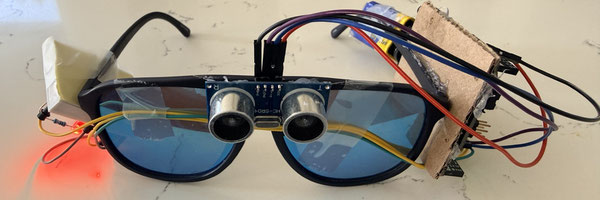
Smart Glasses to Help Blind People Detect Obstacles
Vedhang Tentu
STEM Innovation Academy Jr. High SW
Grade 7
Presentation
No video provided
Problem
- The purpose of this project is to build glasses that help blind people detect nearby obstacles. By using an ultrasonic sensor and buzzers , the glasses will warn the user when an object is close, helping them move more safely This project is meant to show how technology can be used to solve real-life problems .
Method
- Prepare the Glasses Frame . Attach the ultrasonic sensor to the front of the glasses frame using hot glue
- .Set Breadboard .Place the breadboard on the glasses
- .Connect the Ultrasonic Sensor
- VCC to 5V on Arduino
- GND to GND on Arduino
- TRIG to Digital pin 8
- ECHO to Digital pin 9
- Connect the Buzzer
- Positive (+) leg to Digital pin 10
- Negative (–) leg to GND on Arduino
- Upload the Code Connect the Arduino to the computer using a USB cable. Open Arduino IDE, paste the obstacle detection code, and upload it to the Arduino.
- Test the System Power the Arduino. Move your hand in front of the sensor. The buzzer should beep faster as an object gets closer.
- Secure All Parts Once it works, secure all wires and components to the glasses frame so nothing moves.
- Start observations by measuring how far the glasses are detecting
- Final test wear the, glasses move around to make sure everything is in place .
Analysis
- During testing, I noticed that the detection distance became closer to the programmed distance. This shows that the sensor became more reliable over a lot tests. I also saw that the buzzer beeped more faster and sounded stronger when the object was within the 5 cm range. This is a good thing because it provides a clear and urgent warning. The faster and more noticeable sound reaching estimating nearly about 85 db ,would help visually impaired users better tell when an object is very close, increasing safety and reducing the risk of collision.
Conclusion
In conclusion, the glasses work pretty well and was accurate. Based on my observations the glasses sent a signal at average distance of33 cm, which is only a 3 cm difference from the distance set in the code. This shows that the sensor was good and worked as expected. .Overall, the project was successful and demonstrated that smart glasses can help detect obstacles and improve safety for visually impaired individuals.
Citations
American Foundation for the Blind. (n.d.). Blindness and low vision. https://www.afb.org/blindness-and-low-vision Arrow Electronics. (2019). What is I/O? Computer and electronic input/output explained. https://www.arrow.com/en/research-and-events/articles/what-is-io-computer-and-electronic-input-output-explained Cambridge Dictionary. (n.d.). Obstacle. https://dictionary.cambridge.org/dictionary/english/obstacle Cleveland Clinic. (n.d.). Blindness. https://my.clevelandclinic.org/health/diseases/24446-blindness Fighting Blindness Canada. (n.d.). The way I see it: Restoring confidence with the white cane. https://www.fightingblindness.ca/news/the-way-i-see-it-restoring-confidence-with-the-white-cane/ MaxBotix Inc. (n.d.). How ultrasonic sensors work. https://maxbotix.com/blogs/blog/how-ultrasonic-sensors-work National Eye Institute. (n.d.). Low vision. https://www.nei.nih.gov/learn-about-eye-health/eye-conditions-and-diseases/low-vision National Library of Medicine. (n.d.). The impact of vision loss. https://www.ncbi.nlm.nih.gov/books/NBK402367/ Pepperl+Fuchs. (n.d.). Environmental influences on ultrasonic sensors. https://blog.pepperl-fuchs.com/en/ PicoBricks. (n.d.). What is a buzzer? https://picobricks.com/blogs/info/what-is-buzzer SparkFun Electronics. (n.d.). What is an Arduino? https://learn.sparkfun.com/tutorials/what-is-an-arduino/all Stack Overflow. (n.d.). How to differentiate active and passive buzzers in Arduino. https://stackoverflow.com/questions/41578741/how-to-differentiate-active-and-passive-buzzers-in-arduino World Health Organization. (n.d.). Assistive technology. https://www.who.int/news-room/fact-sheets/detail/assistive-technology World Health Organization. (n.d.). Blindness and vision impairment. https://www.who.int/news-room/fact-sheets/detail/blindness-and-visual-impairment YouTube. (n.d.). How Arduino works [Video]. https://www.youtube.com/watch?v=yi29dbPnu28 Science Buddies Last edit date: 2025-11-05 Project idea https://www.sciencebuddies.org/science-fair-projects/project-ideas/Elec_p108/electricity-electronics/obstacle-detecting-glasses
Big credit to pi girl https://pigirl2020.blogspot.com/2020/05/using-ultrasonic-distance-sensor-hc.html
Acknowledgement
This project would not have been successful without the guidance and support from my parents. I am extremely grateful to my dad, who helped me adjust the code and was my greatest cheerleader for the entire process. My mom also contributed substantially to the setting up of the trifold and compiling the data. Without my parents support, this project would not have been as successfully so I am extremely thankful to the both of them.
Thank you!