
An oily mishap: how to separate oil from water
Ashika Agalawatte
Indira Weerasinghe
Grade 6
Presentation
Hypothesis
Question
Can I improve how oil spills are cleaned up?
Reason for Hypothesis #1
Most materials that are used as absorbents in oil spills such as cotton wool absorb oil, but they also absorb water. I thought if I cover the already known material with something that is hydrophobic and lipophilic it would let the oil get through and keep the water out. Making it easier for the material inside to absorb more oil.
Initial experiment
- 4 ounces of cotton wool, peat moss, hair, coconut husk, bees wax and flour were placed in similar size pockets of cloth and similar size cloth pockets that were covered with bees wax.
- My initial experiment was to see if the bees wax which I read repels water (hydrophobic) will prevent the water from entering the cloth pockets causing the oil to go in more than water and be absorbed into the material inside the pockets.
- I coloured the oil with oil soluble dye to make it easier to see a clear separation of the oil from the water.
- I added 6cm of water and 2cm of oil into each jam jar.
- I placed a pocket of cloth (covered as well as not covered in bees wax) in separate jars.
- My plan was to wait 24 hours and see how much oil remained in the jars.

Oily Mishap
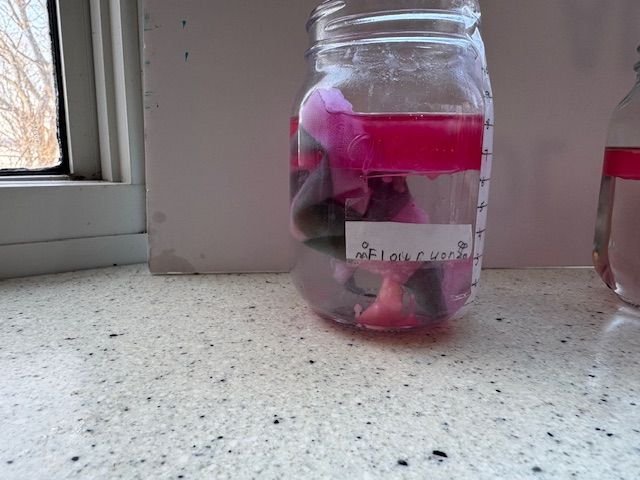
- My pocket containing flour was not well sewn by myself. So it opened up inside the jam jar and made a goopy mess.
- I panicked! as my parents have told me that I can't throw any goop down the sink as it clogs up the pipes.
- I took a coffee filter from the cupboard and filtered the oil, ware and goop mixture.
New Discovery!
When I filtered the oil and water mixture with the goop through the oil filter I noticed that the oil and the goopy mess stayed on top while the clear water filtered out into the jam jar!
Hypothesis #2
Oil can be separated from water.
Experiment #2
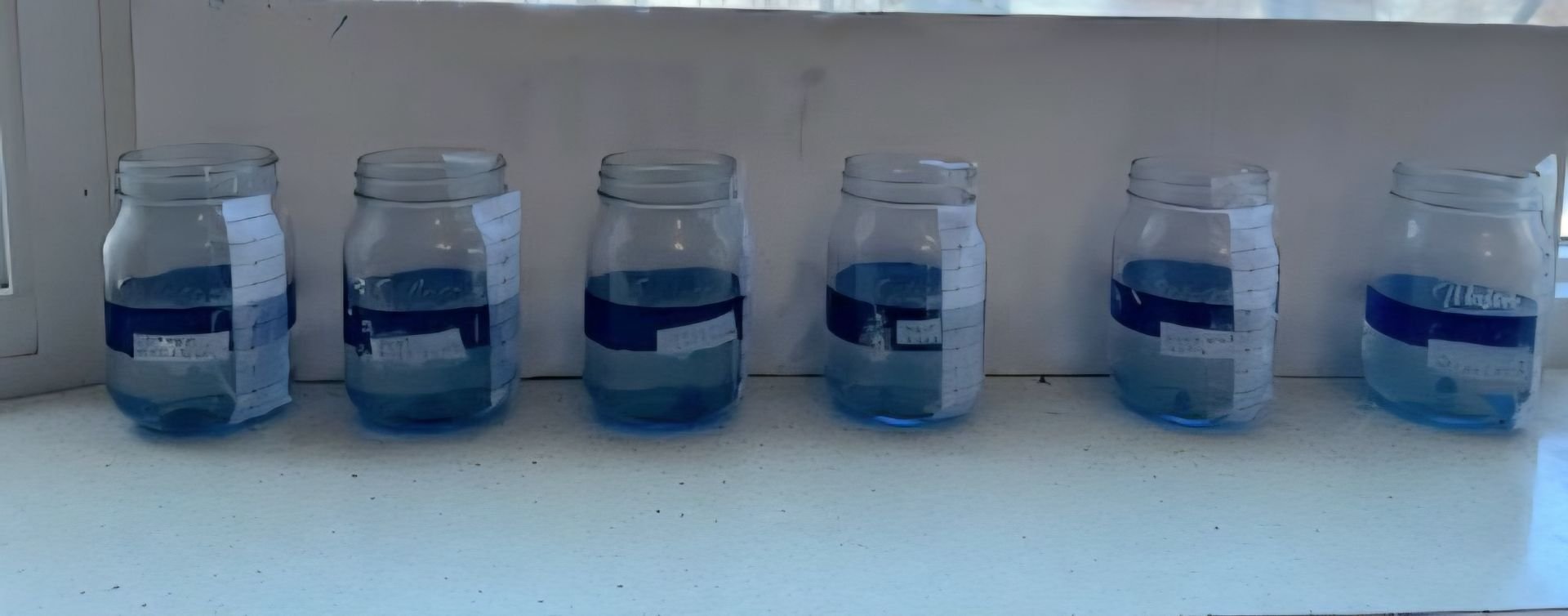
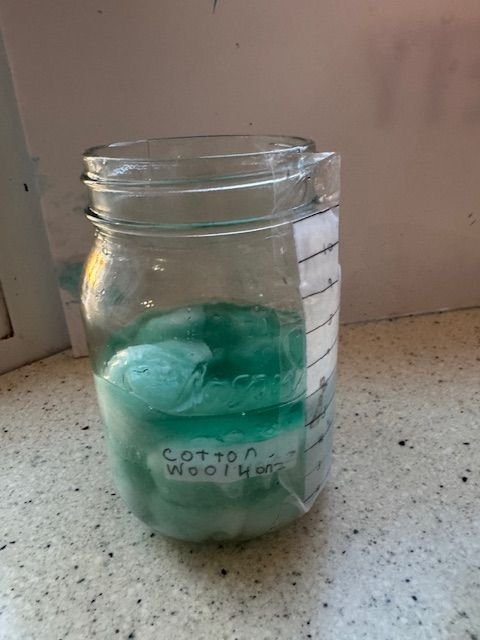
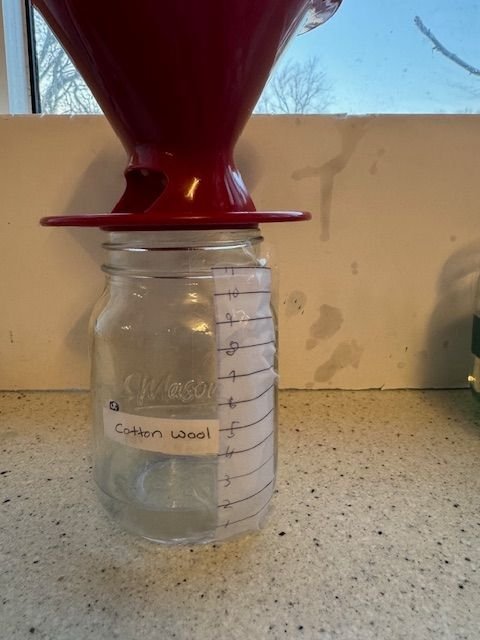
- 7 identical Jam jars were marked as control, cotton wool, peat moss,hair, coconut husk, bees wax and flour.
- On the side of each jar measurements in centimeters were pasted.
- 4cm of water was placed in each jar.
- Oil was mixed with oil soluble dye.
- 2cm of colored oil was placed into the jam jars with water.
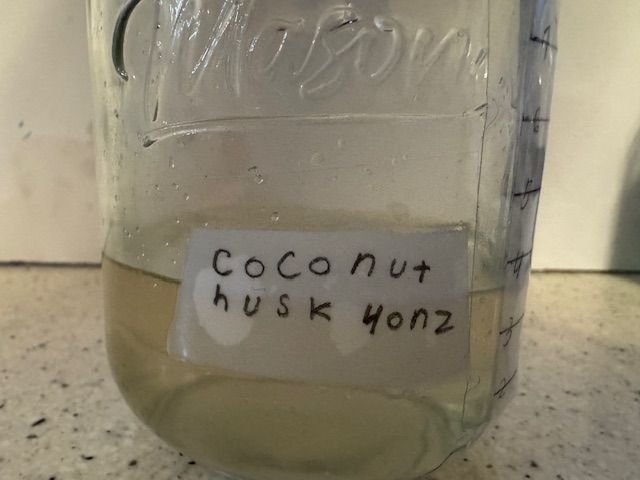
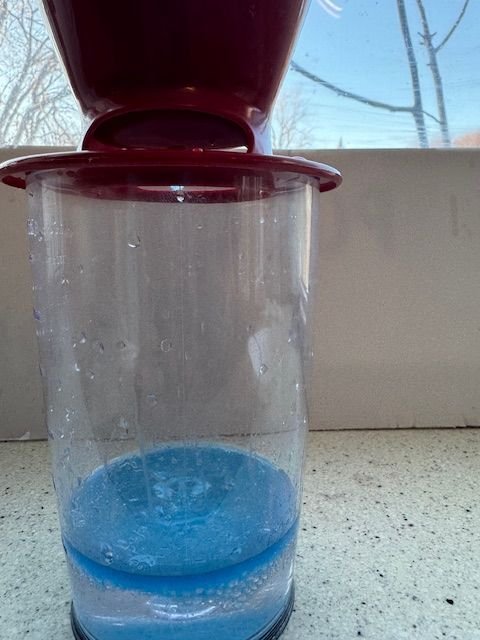
- Nothing was placed into the control jar but to each of the other jars 4 ounces of the material that was marked on the bottle was placed andthen each bottle was stirred and as soon as the material went in and then immediately filtered through a coffee filter paper.
- Each material was allowed to filter for 3mins.
- 2 trials were done to make sure that the results were accurate.
Hypothesis #3
I can make an apparatus that can efficiently separate oil from water.
Experiment #3
- After many trials I was able to find an efficient way to separate oil from water using a coffee filter and coconut husk.
- I used a fish tank to simulate a body of water such as a lake or an ocean.
- I added 100 ml of coloured oil that floated on top of the water.
- I sewed a pouch containing coffee filter and coconut husk and replaced it with the fish tank filter.
- I connected an oil skimmer so that the water could be sucked up into my filter.
- When the motor was turned on as shown on the video the water that flowed out of the filter was clear! With no colouring or oil droplets in the water!
Research
Oil is a type of liquid fossil fuel that is used around the world as an affordable energy source. Energy from burning oil is mainly used in vehicles to help with transportation of people and goods. Oil is also used to produce energy for industries as well as to make plastics, paints and even some clothes.
Canada is one of the largest oil producers in the world and our oil mostly comes from the oil sands in Alberta. While producing oil helps Canada's economy it can also have detriments to the environment such as producing green house gases and oil spills.
oil spills are a significant environmental concern. In 2025 there were 3 greater than 700 tonne oil spills and 3 oil spills that were between 7-700 tonnes in the world. Most major oil spills occur due to ruptured pipelines and oil sands tailing pond leaks. Oil spills could also happen due to rig leaks, refinery accidents, improper disposal and due to war.
One of the most recent major spills in Alberta was the Imperial Oil Kearle Mine incident in 2023 which occurred due to an undetected leak of tailing pond seepage in to the waterways. This caused 5.3 litres of waste water to enter into our water sources.
Some of the impacts of oil spill to our ecosystem are:
- Oil can coat the feathers of birds, and this can remove the natural water proofing of their feathers by clumping them together and by
- preventing air from going in between the feathers and causing an insulating layer. They can develop hypothermia and die.
- Oil can poison the food chain of fish and other animals in lakes and oceans, and this can cause a decline in the fish population.
- Oil spills can also cause a decrease in drinking water and also impede swimming and other recreational activities.
Some of the ways that oil spills are currently managed are:
- Using booms to contain the oil spill
- Burning the oil
- Using skimmers to scoop up the oil
- Chemical dispersants to break down the oil into smaller droplets so that they can be cleaned up by nature more easily
- Bioaugmentation – using bacteria that breaks down oil.
- Using absorbent material
Variables
Experiment #1 (Initial Experiment)
- Independent variable - pocket embedded with bees wax vs pocket not embedded with bees wax, type of material inside each pocket.
- Dependent variable - centimetres of oil remaining at the end of the experiment
- Controlled variable - type of jar, centimetres of water and oil at the beginning of the experiment in each jar, weight of material (cotton wool, peat moss, coconut husk, hair, bees wax and flour ) inside each pocket
Experiment #2 (using coffee filter)
- Independent variable - type of absorbent material on top of the coffee filter
- Dependent variable - centimetres of oil remaining at the end of the experiment
- Controlled variable - type of jam jar, centimetres of oil and water at the beginning of each experiment, weight of material (cotton wool, peat moss, coconut husk, hair, and bees wax) on top of each coffee filter
Procedure
Experiment #1 ( can I help improve the amount of oil absorbed by different material)
- 12 cloth pockets of the same size were made and 6 of those pockets were embedded with bees wax.
- 4 ounces of cotton wool, peat moss, hair, coconut husk, bees wax and flour were placed in 6 cloth pockets and then another 4 ounces of each of those material was placed on cloth pockets embedded with bees wax.
- My initial experiment was to see if the bees wax which I read repels water (hydrophobic) will prevent the water from entering the cloth pockets causing the oil to go in more than water and be absorbed into the material inside the pockets.
- I coloured the oil with oil soluble dye to make it easier to see.
- 12 Jam jars that were the same size were labelled with the name of the material inside the pocket and if the pocket was embedded with bees wax.
- On the side of each jar measurements in centimetres was pasted.
- Each jam jar was filled with 4 cm of water and 2 cm of oil coloured with oil soluble dye.
- Each of the 12 pockets were placed in the appropriately named jam jar.
- In 24 hours measure the amount of oil and water remaining in the jam jars.
Experiment #2 (best material to help separate oil from water)
- 7 identical Jam jars were marked as control, cotton wool, peat moss, hair, coconut husk, bees wax and flour.
- On the side of each jar measurements in centimetres were pasted
- 4 cm of water was placed in each jar
- Oil was mixed with oil soluble dye.
- 2 cm of coloured oil was placed into the jam jars with water.
- Nothing was placed into the control jar but to each of the other jars 4 ounces of the material that was marked on the bottle was placed and then each material was stirred once and then immediately filtered through a coffee filter paper.
- Each material was allowed to filter for 3 minutes.
- 2 trials were done to make sure that the results were accurate.
Experiment #3 (simulation of an efficient apparatus to separate oil from water)
- After many trials I was able to find an efficient way to separate oil from water using a coffee filter and coconut husk.
- I used a fish tank to simulate a body of water such as a lake or an ocean.
- I added 100 ml of coloured oil that floated on top of the water.
- I sewed a pouch containing coffee filter and coconut husk and replaced it with the fish tank filter.
- I connected an oil skimmer so that the water could be sucked up into my filter.
- When the motor was turned on as shown on the video the water that flowed out of the filter was clear! With no colouring or oil droplets in the water!
Observations
Experiment #1
- Cotton wool, peat moss and coconut husk absorb the most oil (25% of the oil) and peat moss absorbs the least amount of water.
- Bess wax is hydrophobic but is also lipophobic as it did not let much oil enter the pockets.
Experiment #2
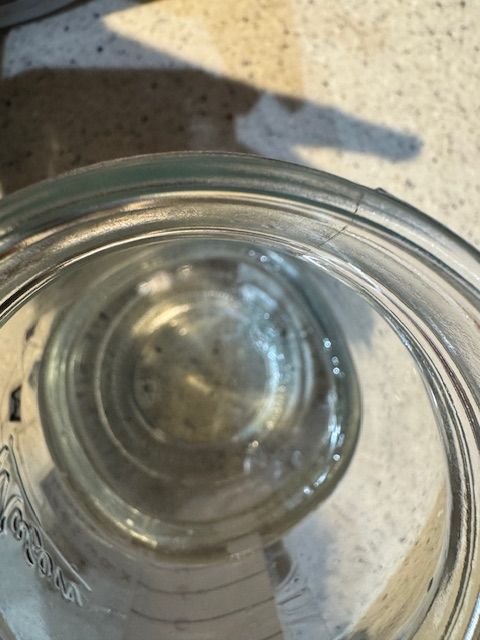
- A simple coffee filter can filter out most of the oil from water.
- A combination of either coconut husk or peat moss with a coffee filter can remove almost all of the oil from water!
Experiment #3
- As shown by my apparatus oil can be separated from water quite efficiently by using an oil skimmer and a filter containing a coffee filter and coconut husk.
Analysis
Experiment 1
| material | cm of water at start | cm of oil at start | cm of water at end | cm of oil at end |
|---|---|---|---|---|
| Cotton wool | 6 | 2 | 4 | 1 |
| Cotton wool with bees wax | 6 | 2 | 4 | 1.5 |
| Peat moss | 6 | 2 | 5.5 | 1 |
| Peat moss with bees wax | 6 | 2 | 6 | 1.5 |
| Coconut husk | 6 | 2 | 4 | 1 |
| Coconut husk with bees wax | 6 | 2 | 5 | 1.5 |
| Hair | 6 | 2 | 6 | 1.5 |
| Hair with bees wax | 6 | 2 | 5.5 | 2 |
| Bees wax | 6 | 2 | 6 | 2 |
| Bees wax with bees wax | 6 | 2 | 6 | 2 |
| Flour | 6 | 2 | N/A | N/A |
| Flour with bees wax | 6 | 2 | N/A | N/A |
Experiment 2 (with 2 trials)
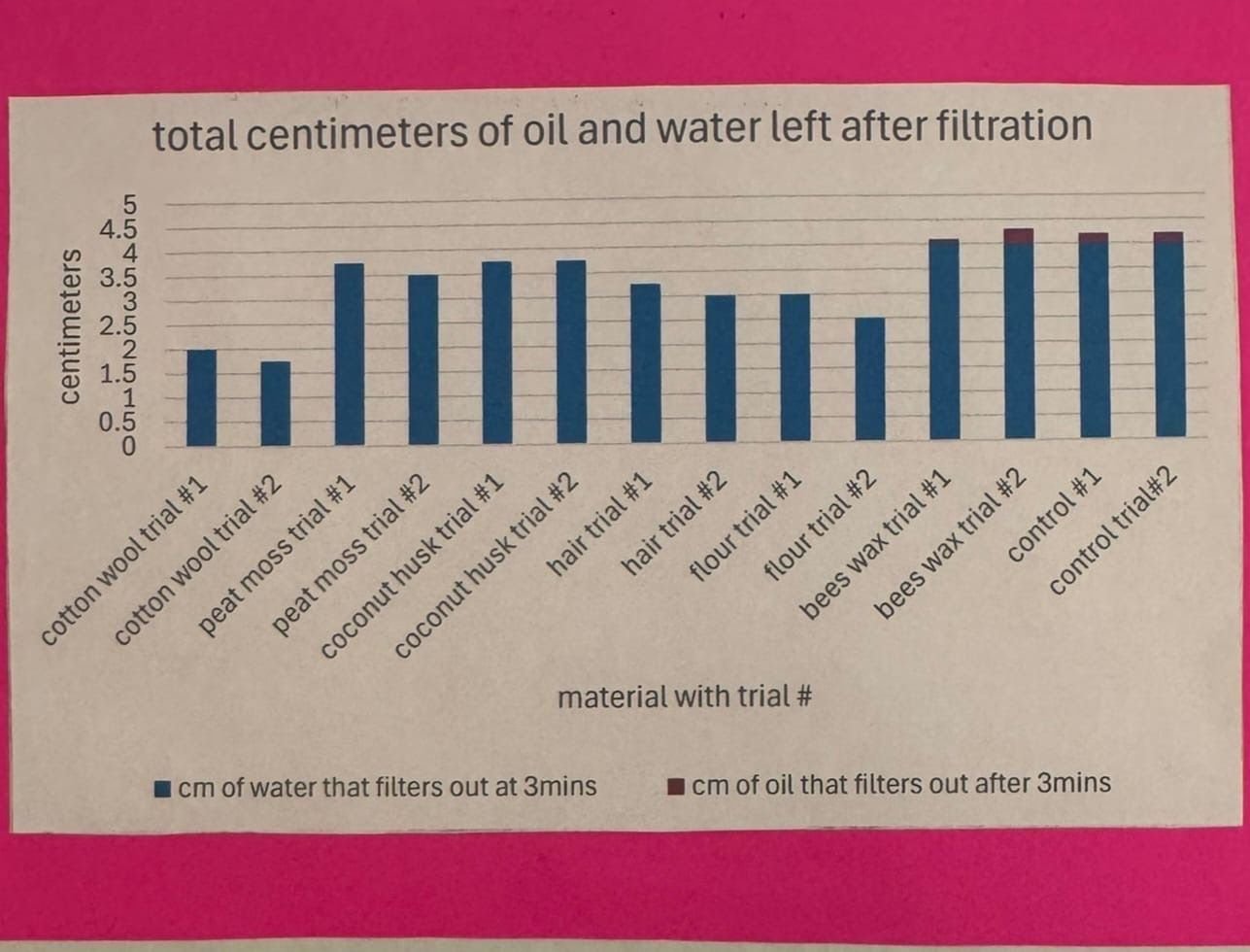
| Material | cm of water at start | cm of oil at start | cm of water that filters out at 3 mins | cm of oil that filters out at 3 min |
|---|---|---|---|---|
| Cotton wool | ||||
| (trial 1) | 4 | 2 | 2 | |
| Cotton wool | ||||
| (trial 2) | 4 | 2 | 1.75 | |
| Peat moss | ||||
| (trial 1) | 4 | 2 | 3.75 | |
| Peat moss | ||||
| (trial 2) | 4 | 2 | 3.50 | |
| Coconut husk | ||||
| (trial 1) | 4 | 2 | 3.75 | |
| Coconut husk | ||||
| (trial 2) | 4 | 2 | 3.75 | |
| Hair | ||||
| (trial 1) | 4 | 2 | 3.25 | |
| Hair | ||||
| (trial 2) | 4 | 2 | 3.00 | |
| Flour | ||||
| (trial 1) | 4 | 2 | 3.00 | |
| Flour | ||||
| (trial 2) | 4 | 2 | 2.50 | |
| Beeswax | ||||
| (trial 1) | 4 | 2 | 4.00 | Drops of oil |
| Beeswax | ||||
| (trial 2) | 4 | 2 | 4.00 | thin layer of oil on top |
| Control | ||||
| (trial 1) | 4 | 2 | 4.00 | Very thin layer of oil on top |
| Control | ||||
| (trial 2) | 4 | 2 | 4.00 | Very thin layer of oil on top |
Conclusion
From Experiment #1:
- I conclude that cotton wool, peat moss and coconut husk absorb the most oil and peat moss absorbs the least amount of water.
- I conclude that bees wax is hydrophobic but also lipophobic as it did not let much oil get in either.
From Experiment #2:
- I conclude that a simple coffee filter can filter out most of the oil from water.
- I conclude that a combination of either coconut husk or peat moss with a coffee filter can remove almost all of the oil from water!
From Experiment #3:
- I am able to simulate that oil can be separated from water quite efficiently by using an oil skimmer, coffee filter and coconut husk.
Application
- As shown in the video, we can use an oil skimmer together with a filter made out of a coffee filter and coconut husk to separate oil from water .
- This would be a simple but cost effective way of tackling oil spills in our water bodies.
- My hope is to scale this up into a version that could be used in the real world when oil spills happen out in water bodies.
Sources Of Error
- My experiment was done on a small scale using jam jars and a small fish tank and could be done on a bigger scale to see how practical it is.
- I used vegetable oil for my experiment as it was more cost effective but could trial other oils like petrol or Diesel in the future.
Citations
Acknowledgement
- I would like to thank my father for his patience and help with setting up the fish tank for my simulations.
- I would like to thank my brother who listened to my many ideas.
- I would like to thank my mother for enrolling me for the Calgary youth science fair.