
Attack of the Zombie Mold: Does Water Make It Grow?
Blake Todd, Mia White
Nickle School
Grade 6
Presentation
No video provided
Hypothesis
If extra water is added to bread and apple samples, then mold will grow faster and cover more surface area because fungi need moisture to grow and spread. This helps explain how zombie fungi like Ophiocordyceps unilateralis grow and infect their hosts in moist conditions.
Research
We could not safely study real zombie fungi in a classroom, so we used mold that grows on bread and apples as a safe model. Mold is a type of fungus, and it grows in ways similar to zombie fungi — by spreading tiny spores and feeding on nutrients. In order to grow, mold needs four things: water, food, suitable air quality, and the right temperature. Tiny mold spores are all around us in the air, and in moderation, they are not harmful to our health. When a spore lands on a surface, it searches for water and nutrients to feed on. Some molds can cover food in as little as 12 to 24 hours, while others may take weeks, depending on the conditions.
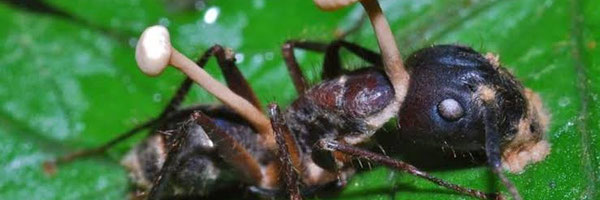
Zombie fungi, like Ophiocordyceps unilateralis, act in some ways like mold on food, but instead of growing on bread or fruit, they infect insects. The fungus releases tiny spores from a leaf above an ant colony. When a spore lands on an ant, it grows inside the ant’s body, using its nutrients and even controlling the ant’s behavior. Over about a week, the fungus makes the ant climb to the perfect height and bite down on a leaf. It prefers the ant to be in a moist and warm location, similar to the conditions mold needs to grow. After about three weeks, the fungus grows out of the ant’s head and releases new spores to start the cycle again.
Interesting facts:
Even though zombie fungi always kill the ants they infect, they don’t take over the whole colony. Only a few ants get infected at a time so that the rest of the colony can survive. This helps keep the ecosystem balanced.
Scientists discovered that zombie fungi don’t actually grow in the ant’s brain! Instead, the fungus spreads through the ant’s body and uses special chemicals to control its muscles, making the ant do exactly what the fungus wants.
Variables
Independent Variable :
- Our manipulated variable in our experiment was the amount of moisture each sample received. Some samples were sprayed with water, while others were left dry.
Dependent variable:
- How much mold grew on each sample, and how fast.
Controlled variables:
- Type of samples used.
- Where our samples were place ( Next to the window, in direct sunlight)
- The size of each sample.
Procedure
- Collect the supplies: bread slices, apple peels, cardboard, water, spray bottle, sealable plastic bags, and labels.
- Place each item in its own plastic bag.
- Spray one spray of water into three of the bags: one with bread, one with an apple, and one with cardboard. Leave the other bags dry.
- Seal and label all bags.
- Place all bags in the same area, by the window, to ensure they experience the same temperature and light conditions.
- Observe the bags daily to see if mold grows.
Experiment dates: January 20, 2026 – March 3, 2026 (43 days)
Observations
| Week | Morning Observations |
|---|---|
| Week 1 | No mold was seen on any samples (sprayed apple, unsprayed apple, wet bread, dry bread, cardboard). |
| Week 2 | Small amount of mold appeared on the sprayed apple. Very tiny amount appeared on the wet bread. No mold on unsprayed apple, dry bread, or cardboard. |
| Week 3 | Mold appeared on the unsprayed apple for the first time. Mold continued growing on the sprayed apple. No significant change on wet bread. Dry bread and cardboard still had no mold. |
| Week 4 | No major changes observed. Mold continued growing on both apples and the wet bread. Dry bread and cardboard still showed no mold. Samples appeared to receive more sunlight than previous weeks. |
| Week 5 | Sprayed apple showed more mold and began clearly rotting/decaying. Other samples remained mostly the same. |
| Week 6 | Both apples continued decomposing quickly. Mold continued growing on wet bread. Dry bread had no mold and became very hard. Wet bread remained soft. Cardboard still had no mold. |
| Week 7 | Both apples were very mushy and highly decomposed. Mold amount on apples was difficult to estimate visually. Wet bread had approximately 10–15% mold coverage. Dry bread and cardboard had no mold growth throughout the experiment. |
Analysis
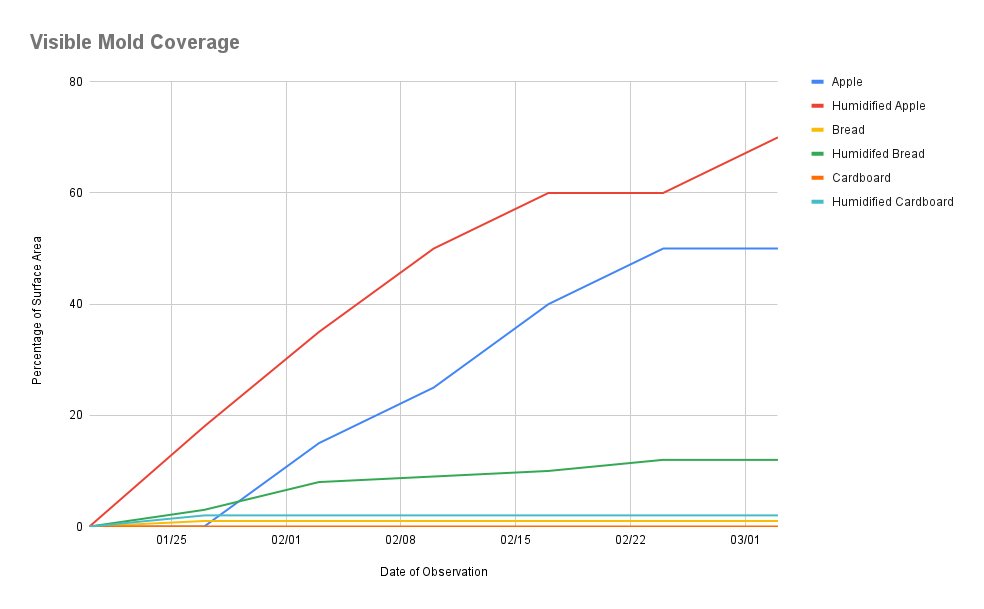 Our experiment shows that moisture and the type of sample strongly affect mold growth. The sprayed apple grew mold first and decomposed fastest, while the unsprayed apple also developed mold more slowly. Wet bread grew a small amount of moldm approximately 15%, but dry bread and cardboard showed none. This shows that moisture speeds up fungal growth, but the type of sample matters too.
This is similar to how “zombie fungi” in rainforests spread. These fungi need moist environments to grow and infect insects. Just like our wet apple, water helps fungi grow quickly and spread. Overall, our results support the idea that moisture encourages mold growth, and nutrient-rich, soft materials like apples are more susceptible.
Moisture is the secret ingredient to help fungi grow!
Conclusion
In this experiment, mold grew on both apple samples and on the wet bread. The apples began to decay and developed mold, while the wet bread grew a small amount of mold after a few weeks. The dry bread and the cardboard did not grow any mold. These results show that moisture helps mold grow, but the type of material also matters. The apples decayed even without added water, suggesting they already contained enough moisture to support mold growth. Overall, the results partially support our hypothesis that moisture helps fungi grow and spread.
Application
This experiment is important because it helps scientists understand how fungi grow and spread. By studying mold on food, we can learn what conditions fungi need, like moisture, to grow. This is similar to how zombie fungi infect insects. Understanding how fungi infect and spread is important for scientists who study fungi because it can impact the ecosystem. If these fungi evolve, they might be able to infect more insects or other animals, which could impact the ecosystem even more.
Sources Of Error
- One error could be that the bag with the moist bread was accidentally dropped on the ground.
- We used a spray bottle to add water, but we didn’t measure the exact amount. Some samples may have gotten more water than others.
- The time of day we checked the samples was slightly different on some days, which could affect observations.
- We measured the mold approximately by eye instead of using a device, so different people might have estimated the size differently.
Citations
Farrelly, Lauren. “How Does Mold Grow on Food?” Sciencing, Sciencing, 24 Mar. 2022, www.sciencing.com/why-does-mold-grow-food-4966797/.
Lu, Jennifer. “How a Parasitic Fungus Turns Ants into ‘Zombies.’” Animals, 10 Oct. 2025, www.nationalgeographic.com/animals/article/cordyceps-zombie-fungus-takes-over-ants.
Mackintosh, Sinead. “Zombie Fungus.” Simply Genetics, Simply Genetics, 7 Jan. 2021, www.simplygenetics.org/post/zombie-fungus.
Acknowledgement
Thank you to my dad because he helped us with the idea of the zombie mushroom and ideas to make it better. Also a big thank you to Mia's mom she helped us with making our slides make sense.