

Saving our waters, one filter at a time
Christina Varghese
Connect Charter School
Grade 6
Presentation
Hypothesis
Project Objective:
Explore how daily and natural materials can be used to clean micro and nano plastics
Build a filtration system using effective materials.
Project Hypothesis:
I hypothesize that
- Nanoparticles will be the most effective method for removing micro- and nano plastics from water because their small size allows them to capture tiny plastic particles that other materials cannot.
- By building a layered filtration system, I expect to separate plastics of different sizes efficiently and produce cleaner water compared to using traditional materials alone.
Research
What are Plastics? •Plastics are synthetic (man-made) materials made mainly from polymers, which are long chains of molecules, usually produced from petroleum or natural gas. •Because their structure can be changed during manufacturing, plastics can be made flexible, rigid, transparent, lightweight, or extremely strong. •They are cost-effective and used in medical equipment, food packaging, transportation, electronics, clothing, and even in clean water systems. •However, their widespread use has a hidden cost: over time, discarded plastics break down into tiny fragments called micro and nano plastics, which pollute our rivers, lakes, and oceans, posing serious risks to wildlife and human health.
What are micro and nano plastics? •Microplastics are tiny pieces of plastic - usually smaller than 5 millimetres and sometimes even invisible to the naked eye. •They originate from both the breakdown of larger plastic items or the direct release of small plastic particles from consumer products and industrial processes. They end up in rivers, lakes, and oceans. They can travel long distances and spread across the planet. •They pose a significant threat to our environment and ecosystem. They harm fish, birds, and other wildlife, and may even enter the food chain, eventually reaching humans.
Various types of microplastics are Primary microplastics are small plastic particles intentionally manufactured to be microscopic.
- They are found in:
- Toothpastes, or soaps that contain tiny plastic beads.
- Industrial plastic pellets(nurdles)
- Fibers from synthetic textiles
- Polyester, acrylic, and nylon, which are released during washing.
Secondary microplastics form from the degradation of larger plastic items through mechanical, chemical, or environmental processes.
- Broken-down plastic items
- Bottles, bags, fishing gear (like nets, ropes and cages), packaging, and other plastic trash slowly break apart into tiny pieces in water and soil.
- Synthetic fabrics
- Polyester, nylon, and fleece release tiny fibres when clothes are washed.
- Construction and renovation:
- Materials used in construction and renovation can also contribute to microplastics in the environment
- Tire wear particles
- Everyday items
Impacts of Micro and nano plastics Micro and nano plastics pose significant threats to ecosystems, wildlife, and human health, disrupting food chains and contributing to pollution across various environments.
- Aquatic Ecosystem Disruption
Micro- and nano plastics have been detected in various human organs, including the placenta of newborns. They can enter the human body through ingestion, inhalation, and skin absorption, potentially leading to serious health issues, including hormonal disruptions and genetic changes. The long-term health impacts of microplastics are still being studied, but they are associated with various health risks, particularly for vulnerable populations.
- Terrestrial Ecosystem Disruption
Microplastics are readily ingested by land animals and organisms, such as earthworms and insects.They can ingest microplastics in soil, leading to effects like those observed in aquatic organisms,such as reduced feeding rates, altered gut microbiomes, and decreased growth.
- Soil and Water Contamination
Microplastics are found in high concentrations in agricultural soils and coastal waters. They can enter soil through fertilizers made from sewage sludge, plastic used in farming, and tiny plastic particles carried by the wind. These particles can alter soil properties, such as water retention, aeration, and nutrient cycling, affecting plant growth and soil biodiversity. Microplastics can also move into groundwater and rivers, polluting drinking water and harming both land and water ecosystems.
- Human Health Risks
Micro and nano plastics have been detected in various human organs, including the placenta of newborns. They can enter the human body through ingestion, inhalation, and skin absorption, potentially leading to serious health issues, including hormonal disruptions and genetic changes. The long-term health impacts of microplastics are still being studied, but they are associated with various health risks, particularly for vulnerable populations.
- Contribution to Climate Change
Micro and nano plastics worsen climate change both directly (from production and breakdown) and indirectly (by harming ocean life that helps absorb CO₂). The production and degradation of plastics contribute to greenhouse gas emissions. When plastics break down in sunlight or in water, they can release small amounts of greenhouse gases like methane and ethylene, which warm the planet. Additionally, improper disposal of plastic waste leads to methane emissions from landfills, further contributing to global warming. Furthermore, Microplastics can harm tiny ocean organisms that help absorb carbon dioxide, reducing the ocean’s ability to store carbon and worsening climate change. Micro and Nano plastic Cleanup Methods
- Physical and Filtration Methods
Filtration is one of the most widely used approaches. Conventional waste water treatment plants employ primary, secondary, and tertiary stages to remove microplastics, achieving 57% to over 99% removal
- Chemical and coagulation methods
Coagulation and flocculation use chemical or plant-based flocculant (e.g., okra, fenugreek) to aggregate micro plastic particles making them easier to remove through animation and filtration .Advanced oxidation process can degrade certain microplastics.
- Biological Methods
Bioremediation leverages microorganisms and enzymes to degrade plastics into less harmful substances. For example, PETase enzymes and plastic-eating bacteria can break down microplastics in controlled environments.
- Nano-Based and Emerging techniques
Nanotechnology offers innovative solutions for micro and nanoplastic removal these nano-enabled methods are promising due to their high specificity and scalability potential and ability to target nanoscale plastics which are difficult to remove with conventional methods
Why does this matter to me?
- A 2024 study using a measurement method capable of detecting extremely small plastic particles found between 110,000 and 370,000 particles per liter of bottled water — 90% of these particles were nano plastics.
- 340,000 microplastics per cubic foot of ice were found in the Arctic Ocean.
- Microplastics have been found at the top of Mount Everest and at the bottom of the Mariana Trench .
- The average person globally breathes 2,000 to 7,000 microplastics per day.
- Microplastics indoors can be 60 times higher than those outdoors.
- An average person will consume an estimated 13,731 to 68,415 microplastic particles that fall onto food during a meal.
- Microplastics have been found in human placenta and human feces.
- A detailed study in 2021 analyzed data from over 170,000 fish, discovering that microplastics were present in two-thirds of the species examined..
- There are approximately 24 trillion pieces of microplastics floating on the ocean's surface.
- One study in China found that in one pound of soil, 18,000 microplastics could be found.
Variables
Independent Variable (What you change)
- Filtration material (Sand, Activated Charcoal, Pebbles, Nano particles etc)
- Use of magnetic particles (Steel wool, ferro fluid etc)
Dependent Variable (What you measure)
- Time taken for cleanup (in minutes).
- Effectiveness of the method (visual observation or oil left in water).
Controlled Variables (What you keep the same)
- Amount of water
- Amount of microplastics added
- Filtration time
- Container size
- Stirring met
Procedure
Sand-
- Placed sand at the bottom of the cup
- Pour the microplastic-simulated water through the cup with sand
- Collected and observed the water
- Repeated the process at least 3 times.
Pebbles-
- Placed pebbles at the bottom of the cup
- Pour the microplastic-simulated water through the cup with pebbles
- Collected and observed the water
- Repeated the process at least 3 times.
Activated charcoal-
- Placed activated charcoal at the bottom of the cup
- Pour the microplastic-simulated water through the cup with activated charcoal
- Collected and observed the water
- Repeated the process at least 3 times.
Coconut coir-
- Placed coconut coir at the bottom of the cup
- Pour the microplastic simulated water through the cup with the coir
- Collected and observed the water
- Repeated the process at least 3 times
Cotton-
- Placed cotton at the bottom of the cup
- Pour the microplastic simulated water through the cup with cotton
- Collected and observed the water
- Repeated the process at least 3 times.
Steel wool-
- Mixed simulated water with steel wool
- Placed a magnet on the side of the cup
- Observed the water
- Repeated the process at least 4 times.
Ferro fluid-
- Mixed simulated water with ferrofluid, containing iron fillings
- Placed a magnet on the side and bottom of the cup
- Observed the water
- Repeated the process at least 4 times.
Build a Filtration System

| Area | Why it is used | What it filters |
|---|---|---|
| Pebbles | Provides structural support, improves drainage, prevents clogging of finer layers | Large debris, prevents filter from collapsing |
| Cotton | Fibrous layer that distributes water evenly and traps small particles | Small microplastics, some fine debris |
| Activated Charcoal | Adsorbs tiny particles and impurities | Small microplastics, chemical impurities |
| Sand | Fine physical filter that slows water slightly | Very small microplastics, sediments |
| Ferrofluid | Magnetic liquid that can be removed with a magnet | Tiny microplastics, remaining particles |
| Steel Wool & Magnet (optional) | Captures metallic particles in water | Metal debris |
Observations
Sand-
- Coarse sand allows faster flow; Fine sand increases filtration efficiency
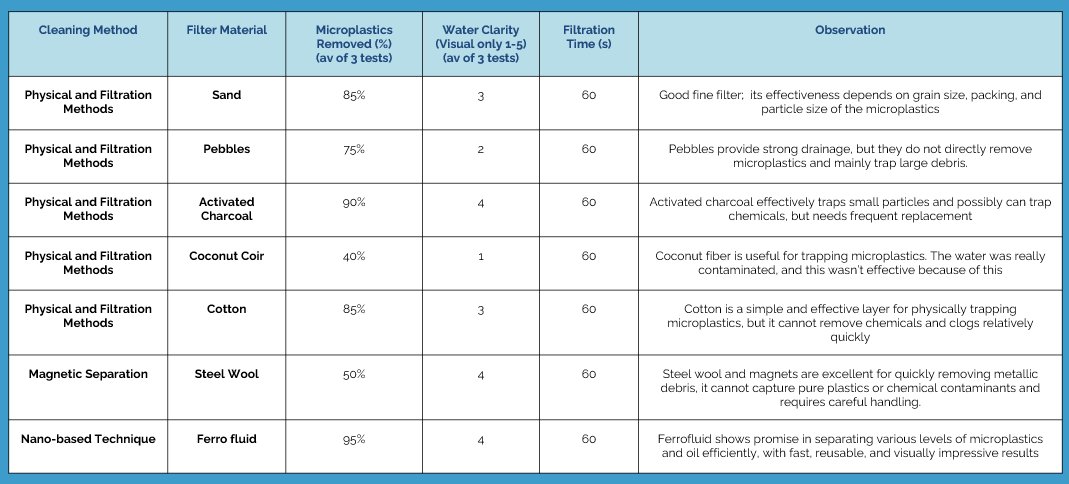
- While this is an effective, low-cost physical filter for trapping small particles, its effectiveness depends on grain size, packing, and particle size of the microplastics.
Pebbles -
- Pebbles provide strong support and improve water flow in a filtration system, but they do not directly remove microplastics and mainly trap only large debris.
Activated charcoal-
- Activated charcoal effectively traps small particles and possibly can trap chemicals, but cannot remove microbes and needs frequent replacement
Coconut coir-
- Coconut fiber is useful for trapping microplastics and supporting filtration layers, but cannot remove chemicals and saturates quickly. The water was really contaminated, and this was not effective at all
Cotton-
- Cotton is a simple and effective layer for physically trapping microplastics and supporting filtration, but it cannot remove chemicals and clogs relatively quickly.
Steel wool-
- Steel wool and magnets are excellent for quickly removing metallic debris. This can help us isolate the particle, too, but it cannot capture pure plastics or chemical contaminants and requires careful handling.
Ferrofluid-
- Ferrofluid shows outstanding promise for efficiently capturing and separating microplastics and oil at various levels, with fast, reusable, and visually impressive results.
Analysis
In the table below, you will see my Cleaning method, my filter material, the percentage of microplastics removed, my water clarity, my filtration time, and my observations.
Conclusion
- •Most microplastics come from bigger pieces of plastic breaking down in the environment. •Plastic is made of polymers, which are long chains of molecules. These chains are nonpolar, so they do not mix with water, which is polar. •Scientists say, “like dissolves like,” meaning nonpolar substances mix better with other nonpolar substances. That’s why microplastics will stick to oil but not to water. •A solvent is a liquid that can dissolve another substance, so oil can act as a solvent to grab the microplastics. •But then, how do we remove the oil from the water? This is where ferrofluids help. •Ferrofluids are magnetic liquids. They are made by mixing tiny magnetic particles into a liquid like oil. •Surfactants keep the particles from clumping together. When ferrofluid is added to water with microplastics, the plastics stick to it. •.Then, a magnet can pull the ferrofluid out of the water, taking the microplastics with it!
Nanoparticles are one of the most efficient solution for cleaning up microplastic pollution from our waters
Application
•This project can help protect the environment by showing ways to remove micro and nano plastics from water before they reach rivers, lakes, and oceans. •The filtration system I tested could be used in water treatment plants to improve how water is cleaned. •It may also help industries reduce plastic pollution before wastewater is released into nature. •The use of natural materials like sand, coconut coir, and cotton shows that low-cost and eco-friendly solutions can help reduce pollution. •The use of ferrofluid and magnets demonstrates how advanced science and nanotechnology can remove even tiny plastic particles that are hard to see. •In the future, this type of filtration system could help reduce the amount of micro and nano plastics that enter the food chain and eventually our bodies. •By improving water cleanup methods, we can protect wildlife, ecosystems, and human health.
While nanotechnology offers innovative solutions for oil spill cleanup, there are still challenges and areas for future research that need to be addressed before large-scale implementation.
| Area | Challenge | Future Growth |
|---|---|---|
| Cost | Many nanomaterials, such as ferrofluids and Nano sponges, are expensive to produce in large quantities | Finding cheaper, renewable nanomaterials (e.g., plant-based Nano sponges) |
| Scalability | Not economically feasible for large scale cleanups | Developing cost-effective mass production techniques. Partnering with industries to integrate nanotech into existing plastic cleanup plans. |
| Environmental | Some nanoparticles, especially those made of metals, could harm marine life if they enter the ecosystem and food chains. | Research on impacts and creating biodegradable or eco-friendly nanoparticles |
| Recovery | Nano pollution when some nanoparticles remain in the water after cleanup. | Developing self-recovering or self-degrading nanomaterials and improving retrieval methods |
| Regulation | There are no clear regulations on using nanoparticles for water pollution cleanup. | Establishing safe usage guidelines for nanotechnology in water pollution cleanup. |
Sources Of Error
•Microplastics may not have been evenly mixed in the water, causing some trials to have more particles than others •Errors could occur while measuring water volume, weighing materials, or in visual evaluations •If filter layers were not the same thickness in every trial, results may vary. •If the magnet was not held in the same place or for the same amount of time, ferrofluid removal could change. •Not all ferrofluid may have been fully removed by the magnet, affecting the clarity of the results. •Some materials like cotton or charcoal may clog during testing, slowing filtration and affecting performance. •Microplastics might stick to the sides of the cup or beaker instead of being filtered. • Environmental Factors - Temperature, lighting, or vibration could slightly affect measurements or visibility.
Citations
- https://iee.psu.edu/news/blog/microplastics-sources-health-risks-and-how-protect-yourself
- https://en.wikipedia.org/wiki/Microplastics
- https://www.dfo-mpo.gc.ca/science/environmental-environnement/microplastics-microplastiques/index-eng.html
- https://newsinfo.inquirer.net/1647651/microplastics-the-nearly-invisible-poison-in-our-oceans
- https://ourworldindata.org/grapher/microplastics-in-ocean?utm_source=chatgpt.com
- https://labs.waterdata.usgs.gov/visualizations/microplastics/index.html?utm_source=chatgpt.com
- https://iere.org/how-does-microplastics-affect-the-environment/
- https://consciouscharcha.com/what-are-microplastics/
- A Review of Sources\, Hazards\, and Removal Methods of Microplastics in the Environment | MDPI
- https://www.welpr.com/blog/microplastic-statistics
- https://www.sciencebuddies.org/science-fair-projects/project-ideas/EnvSci_p077/environmental-science/microplastic-removal-ferrofluids
- acsaenm.3c00711.social.jpeg_v03 (1200×628)
Acknowledgement
●My Teachers
●My Parents ○Who challenged me to take up this project ○Helped me in my experiment and its analysis ○Helped me with the slides
●My Sister ○For always being my inspiration and guide ○For preparing me for the Science Fair
●My School Science Fair Coordinator ○Mr. Greg Neil ○Mr. Kevin Sonico
●Calgary Youth Science Fair ○For the opportunity and acceptance to present my project