
Stomach in a bottle
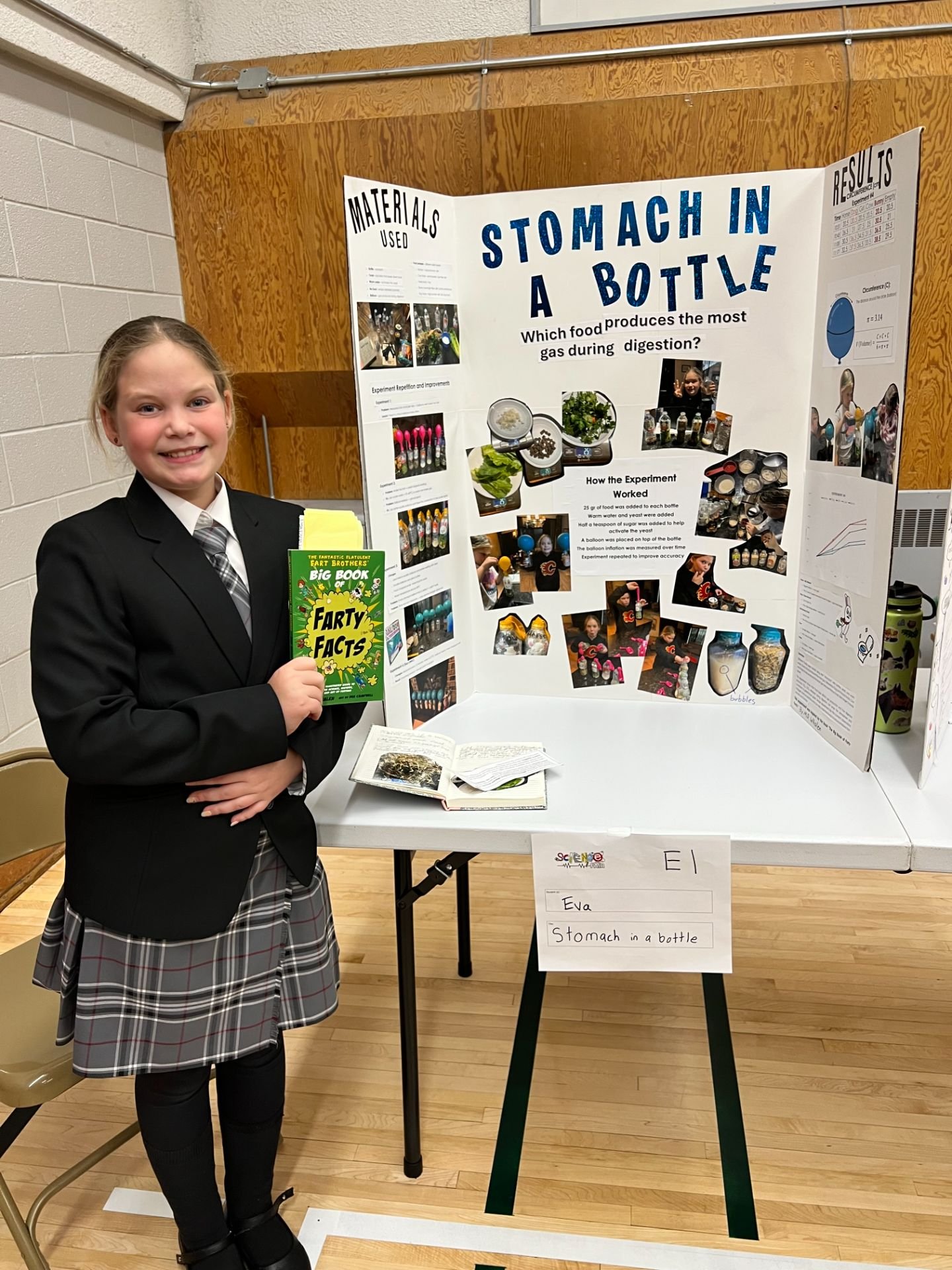
Eva Teitel
Calgary Girls Charter School
Grade 5
Presentation
No video provided
Hypothesis
In this experiment, I am testing which animals produce the most gas (farts). I am comparing five subjects — horse, cow, dog, bunny, and a person. I use yeast to model the digestion process, bottles as stomachs, and different food types. By measuring the size of the balloons placed on each bottle, I can compare all five subjects and see which one produces the most gas. I think the horse will be the gassiest and produce the largest amount of gas. I predict that each animal will produce different amounts of gas because animals have different diets.
Research
Digestion is how animals and humans break down food so their bodies can use it for energy. Some foods, especially plant-based foods with lots of fiber, are harder to digest and create more gas. In this experiment, I am testing how much gas is produced from different foods eaten by different animals. I use yeast to model digestion because yeast eats sugar and releases gas, similar to what happens in a stomach. By putting balloons on the bottles, I can measure the gas produced. The balloons grow as gas is released, and I can measure the circumference to calculate the volume of gas. This lets me compare how much gas each type of food makes.
Variables
Independent Variable: The type of diet being tested (representing different animals/people):
- Horse – hay
- Cow – plant-based greens
- Dog – dry dog food
- Bunny – carrots and lettuce
- Person – rice and meat
Dependent Variable:
- Balloon circumference
- Gas volume
Controlled Variables:
- Amount of yeast used
- Amount of warm water
- Temperature of the water
- Type of balloon
- Amount of food added
- Time allowed for gas production
Procedure
1. Label six bottles for the experiment: horse, cow, dog, bunny, person, and one empty bottle. 2. Weigh the food for each bottle so each one has the same amount. 3. Chop the food into small pieces before adding it to the correct bottle. 4. Leave the empty bottle without food to see how much gas is produced without food. 5. Add the same amount of warm water to each bottle. 6. Add the same amount of yeast to each bottle. 7. Add sugar to each bottle. 8. Place a balloon on the top of each bottle to catch the gas. 9. Seal the connection tightly so no gas escapes. 10. Leave all bottles in the same place for the same amount of time. 11. Observe how the balloons inflate and measure the circumference of each balloon. 12. Calculate the volume of the gas from the balloon circumference using the formula for the volume of a sphere. 13. Make a graph to compare the volume of gas produced by each animal/person and the control. 14. Fix any observed issues and repeat the experiment until the results is successful.
Observations
Experiment 1:
- I measured the balloons only once per day, and some balloons went down too fast.
- Lesson: Balloons need to be checked more often to get accurate results.
Experiment 2:
- The water was too hot, which stopped the yeast from making gas.
- Some balloons leaked, causing gas to escape.
- Fixes: Use cooler water (around 37–40°C) and tape the balloons to the bottles tightly.
Experiment 3:
- I made several changes: used helium-quality balloons, double balloons with glass bottles, chopped food into small pieces, and set the water temperature around 40°C.
- Problems: The empty-stomach balloon had a defect and did not work. Time was not measured consistently.
Experiment 4 (Success!):
- I measured balloon size every 15 minutes, used 200 mL of water at 37°C, taped the balloons securely, and chopped the food small.
- Result: Everything worked correctly, and we were able to record clear, consistent results for the graphs.
Analysis
After completing the successful tests, I compared the gas produced by each animal/person. I converted the balloon circumference to gas volume and subtracted the volume from the empty-stomach control bottle to see the effect of the food alone. I also generated graphs in Excel to clearly see how the gas volume changed over time for each bottle.
- Bunny (carrots and greens): Produced the most gas overall. The balloon inflated the fastest and got the largest volume in both tests. Carrots and greens are easy for yeast to digest, so gas was made quickly.
- Dog (dog food): Produced the second-most gas. The balloon inflated a lot, showing that high-energy kibble makes yeast produce plenty of gas.
- Human (rice and chicken): Produced medium gas. The balloon inflated slower and ended smaller than Bunny and Dog, because rice and chicken take longer for yeast to digest.
- Cow (lettuce): Produced less gas. The balloon stayed smaller, showing that fibrous lettuce is slower for yeast to break down.
- Horse (hay): Produced the least gas. The balloon barely inflated because fibrous hay is slowest for yeast to digest.
By subtracting the empty-stomach gas and generating graphs in Excel, I could see the true effect of the food on gas production and how it changed over time. This makes my results easier to understand.
Conclusion
Different foods were tested using mini “stomachs” made with bottles, yeast, and warm water. Bunny food produced the most gas, followed by dog and human foods. Cow and horse foods produced the least gas because fibrous foods take longer to break down. This experiment shows that the type of food affects gas production and how digestion produces CO₂. CO₂ released during digestion can enter the atmosphere and contribute to greenhouse gases. Simple experiments like this help connect observations to bigger scientific questions and can improve our understanding of ways to reduce emissions from animals and humans.
Application
This experiment helps explain how different foods and diets affect gas production in animals and humans. By measuring the gas produced from foods like carrots, dog kibble, rice, lettuce, and hay, I can see which diets lead to more gas.
Understanding gas production is useful because:
- Environmental impact: Some gases from digestion, like CO₂, contribute to greenhouse gases. Knowing which foods produce more gas can help farmers and scientists reduce emissions from animals.
- Fun learning: Even though it’s a funny experiment, it connects to real science and helps people understand biology, and how food is broken down in stomachs.
- Practical choices: This information can guide food planning, and awareness of how diet affects gas production in both humans and animals.
Overall, this experiment shows that food type matters, and even small observations from yeast models can help us understand digestion and environmental effects in the real world.
Sources Of Error
Even though the experiment worked well in the end, a few things could have affected the results:
- Leaking gas: Some balloons were not sealed perfectly, so some gas may have escaped.
- Measuring errors: Balloon circumference measurements might not be perfectly accurate.
- Food preparation: Food pieces were not always perfectly chopped, which could change how fast the yeast “digested” it.
- Water temperature: If the water was too hot or too cold, the yeast might not have worked the same in every bottle.
- Balloon differences: Some balloons stretched more than others, which could affect volume readings.
- Timing: Gas production was not always recorded at exactly the same intervals in early tests.
Despite these small errors, the final experiments gave clear results that I could compare confidently.
Citations
- Big Book of Farty Facts, M.D. Whalen, 2020
- National Geographic Kids. The Digestive System. National Geographic, 2022.
Acknowledgement
I would like to thank my mom for providing me with support and guidance throughout this project. I also thank the school science fair committee for the opportunity to present my experiment. Finally, I would like to thank the book Big Book of Farty Facts by M.D. Whale for inspiration.