
Bystander Effect
Soren Lewis
Branton School
Grade 7
Presentation
No video provided
Hypothesis
My hypothesis is that bacterium can obtain antibiotic resistance from an other species of bacteria, through resistance genes passed through bacterial conjugation. Conjugation is one bacterium connects to another and passes the advantageous genes it has developed into the other bacterium. These advantage genes usually supply adaptations for the conditions they are living in, abilities to eliminate other bacterium, but most importantly antibiotic resistance. So it is entirely possible that the bacterium can obtain antibiotic resistance from the bacterium of a different species.
Research
In the past, we have discovered a transmitted section of a bacterial genome called a plasmid. These plasmids are the part of a bacterial genome that contains advantageous genes, like adaptions to an environment, abilities to eliminate competitors, and antibiotic resistance. But most importantly plasmids are not only passed from one bacteria in a species to another in the same species, but from one bacteria to any bacterium living around it. Through the transfer of genes, these resistance qualities will be past around from one bacteria to another, and through natural selection, only the bacteria with resistance genes will be left. In 2016, Harvard medical students proved that antibiotic resistance genes are definitely a thing, and that any amount of antibiotic we dose out can be resisted. Their experiment showed that in just a few days, a bacterial colony can become resistant to over 1 000 times as much antibiotic that should be enough to kill that bacteria. My idea is that the boundary of horizontal gene transfer is not drawn at a specimens own species, but for all bacteria.
Variables
Independent Variable: The combination of the antibiotics on each agar plate and bacterial species on each plate.
Dependant Variable: Seeing if there are any bacteria colonies of the species that was not pre-resistant to the antibiotic(s) on that agar plate.
Controlled Variable: The same bacteria and the same antibiotics will be used during this experiment. Also, there will be roughly the same amount of bacterium from each species on each plate.
Procedure
To test this idea of gene transfer from one species to another, bacteriums of the species e.coli 33, e.coli 2455, CFRE, and Mmorg9 will be grown together on agar plates in different combinations all with e.coli 38. It is proven that there could be be conjugation from e.coli to e.coli, but only if my theory is correct will we see conjugation from e.coli to CFRE and Mmorg9. The reason why the bacterium used are used is because e.coli 38 is resistant to all the others antibiotic sensitivities (TOB, MEM, and CRO) but sensitive to CIT, which the others are resistant to. Here is a table that shows the resistances and sensitivities of each bacterium:
| Bacteria | CRO | MEM | TOB | CIP |
|---|---|---|---|---|
| Eco 38 | R | R | R | S |
| Eco 33 | S | S | S | R |
| Eco 2455 | S | S | S | R |
| Mmorg 9 | S | S | S | R |
| Cfre 24 | S | S | S | R |
Since e.coli 38 and the other bacteria have different resistances, any growth would have to be from passed resistances. Now for starters, we will test each bacterium before conjugation could start to make sure that everything each species will be sensitive to what they are supposed to and immune to what they are supposed to. Then the testing will start. We will test each bacterium (ecoli. 33, ecoli. 2455, CFRE, and Mmorg 9) with ecoli. 38 on drug combo plates. The drug combo will be CIT and another antibiotic so we can isolate the other bacterium from e.coli 38 (since they have different resistances and that they are being tested with a drug combo, any survival is from the passage of genes). This will prove that what is on the plate (if any) did not start with resistance to CRO, MEM, and TOB. If there are any bacterium on the plate, then they have successfully conjugated and spread resistance. Depending on the results of this experiment depend on whether or not our current system for bacteria treatment is still effective or if we need to come up with new treatment methods. Because if the boundary of conjugation is drawn at all bacteria, then a patient in a hospital could die without anybody being able to do anything just because of the combination of bacteria in that persons body and the success of bacterial conjugation. In other words, all hell could break lose and we won’t be able to do anything.
Observations
For the first part of testing, to see if the antibiotics we use are eligible, we tested each antibiotic with each bacterium so we could see firsthand how they react. The data is organized into a graph that clearly states what grew and what did not. Here are the results:
| Bacteria | Treatment | Growth (Y/N) |
|---|---|---|
| Ecoli 38 | None | Y |
| Ecoli 38 | CRO | Y |
| Ecoli 38 | MEM | Y |
| Ecoli 38 | Tob | Y |
| Ecoli 38 | Cip | N |
| Ecoli 33 | None | Y |
| Ecoli 33 | CRO | N |
| Ecoli 33 | MEM | N |
| Ecoli 33 | Tob | Y |
| Ecoli 33 | Cip | Y |
| Ecoli 2455 | None | Y |
| Ecoli 2455 | CRO | N |
| Ecoli 2455 | MEM | N |
| Ecoli 2455 | Tob | Y |
| Ecoli 2455 | Cip | Y |
| CFRE 24 | None | Y |
| CFRE 24 | CRO | N |
| CFRE 24 | MEM | N |
| CFRE 24 | Tob | Y |
| CFRE 24 | Cip | Y |
| Mmorg 9 | None | Y |
| Mmorg 9 | CRO | N |
| Mmorg 9 | MEM | N |
| Mmorg 9 | Tob | Y |
| Mmorg 9 | Cip | Y |
In summary, it shows e.coli 38 growing on all but the CIP plate, e.coli 33, e.coli 2455, CFRE, and Mmorg 9 grew on the TOB and CIP plates but on no others.
For the second part of testing, the one that shows whether or not they could pass resistance, each bacterium is tested with e.coli 38 on a drug combo plate to isolate the other bacterium from e.coli 38. They are also put into a graph to organize and clarify the results. Here are the results:
| Eco 38 | Eco 33 | No AB | Y | Y |
|---|---|---|---|---|
| Eco 38 | Eco 33 | Cro & Cip | N | N |
| Eco 38 | Eco 33 | Mem & Cip | N | N |
| Eco 38 | Eco 33 | Tob & Cip | Y | Y |
| Eco 38 | Eco 2455 | No AB | Y | Y |
| Eco 38 | Eco 2455 | Cro & Cip | N | N |
| Eco 38 | Eco 2455 | Mem & Cip | N | N |
| Eco 38 | Eco 2455 | Tob & Cip | Y | Y |
| Eco 38 | Mmorg 9 | No AB | Y | Y |
| Eco 38 | Mmorg 9 | Cro & Cip | Y | Y |
| Eco 38 | Mmorg 9 | Mem & Cip | Y | N |
| Eco 38 | Mmorg 9 | Tob & Cip | Y | Y |
| Eco 38 | Cfre 24 | No AB | Y | Y |
| Eco 38 | Cfre 24 | Cro & Cip | N | N |
| Eco 38 | Cfre 24 | Mem & Cip | N | N |
| Eco 38 | Cfre 24 | Tob & Cip | Y | Y |
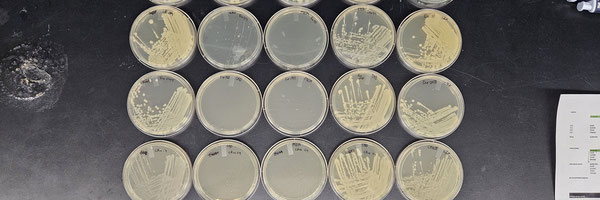
In summary, everything grew as it should be for the e.coli 33 and 38 combo, on the e.coli 38/2455 everything is as it should have been. But on the Mmorg 9/e.coli 38 there are colonies on the CRO&CIP plate #1 and #2, and the MEM&CIP plate #1. The CFRE/e.coli 38 had nothing grow out of order.
Here are images of the plates: **
** **
**
Analysis
For the first part of the experiment, everything grew and did not grow where it was supposed too, except for all the bacteria on the TOB antibiotic plates. Everything grew including the bacteria who were supposed to be sensitive to TOB. This is probably because of a flaw in the antibiotic; so for part two, any growth on TOB will not be counted for the result of the experiment.
| Bacteria | CRO | MEM | TOB | CIP |
|---|---|---|---|---|
| Eco 38 | R | R | R | S |
| Eco 33 | S | S | S | R |
| Eco 2455 | S | S | S | R |
| Mmorg 9 | S | S | S | R |
| Cfre 24 | S | S | S | R |
| Ecoli 38 | None | Y |
|---|---|---|
| Ecoli 38 | CRO | Y |
| Ecoli 38 | MEM | Y |
| Ecoli 38 | Tob | Y |
| Ecoli 38 | Cip | N |
| Ecoli 33 | None | Y |
| Ecoli 33 | CRO | N |
| Ecoli 33 | MEM | N |
| Ecoli 33 | Tob | Y |
| Ecoli 33 | Cip | Y |
| Ecoli 2455 | None | Y |
| Ecoli 2455 | CRO | N |
| Ecoli 2455 | MEM | N |
| Ecoli 2455 | Tob | Y |
| Ecoli 2455 | Cip | Y |
| CFRE 24 | None | Y |
| CFRE 24 | CRO | N |
| CFRE 24 | MEM | N |
| CFRE 24 | Tob | Y |
| CFRE 24 | Cip | Y |
| Mmorg 9 | None | Y |
| Mmorg 9 | CRO | N |
| Mmorg 9 | MEM | N |
| Mmorg 9 | Tob | Y |
| Mmorg 9 | Cip | Y |
For antibiotic TOB, the results of part one (before potential conjugation) and what it is supposed to kill does not match up. It should kill all but E. coli 38, but everything grew on it.
For part two, everything was ordinary, except for the Mmorg 9/e.coli 38 plates. Mmorg 9/e.coli 38 grew on both of the CRO&CIP plates, and grew on the MEM&CIP plate #1. The Mmorg 9/e.coli 38 grew almost on every single plate, meaning that this was not a random mutation or contamination of the bacterium, it was from inter-species conjugation between e.coli 38 and Mmorg 9. This is reinforced by the fact that Mmorg 9 and e.coli are known for their ability to pick up AMR genes better than most other bacterium, and are similar to each other. We do not know for sure which bacterium is on the plate, but we do know that there should not have been any growth. All this points to the possibility of bacterial conjugation between species.
| Bacteria | CRO | MEM | TOB | CIP |
|---|---|---|---|---|
| Eco 38 | R | R | R | S |
| Eco 33 | S | S | S | R |
| Eco 2455 | S | S | S | R |
| Mmorg 9 | S | S | S | R |
| Cfre 24 | S | S | S | R |
| Eco 38 | Eco 33 | No AB | Y | Y |
|---|---|---|---|---|
| Eco 38 | Eco 33 | Cro & Cip | N | N |
| Eco 38 | Eco 33 | Mem & Cip | N | N |
| Eco 38 | Eco 33 | Tob & Cip | Y | Y |
| Eco 38 | Eco 2455 | No AB | Y | Y |
| Eco 38 | Eco 2455 | Cro & Cip | N | N |
| Eco 38 | Eco 2455 | Mem & Cip | N | N |
| Eco 38 | Eco 2455 | Tob & Cip | Y | Y |
| Eco 38 | Mmorg 9 | No AB | Y | Y |
| Eco 38 | Mmorg 9 | Cro & Cip | Y | Y |
| Eco 38 | Mmorg 9 | Mem & Cip | Y | N |
| Eco 38 | Mmorg 9 | Tob & Cip | Y | Y |
| Eco 38 | Cfre 24 | No AB | Y | Y |
| Eco 38 | Cfre 24 | Cro & Cip | N | N |
| Eco 38 | Cfre 24 | Mem & Cip | N | N |
| Eco 38 | Cfre 24 | Tob & Cip | Y | Y |
This data set shows that after potential conjugation, Mmorg 9 grew where it was not supposed to. This hints at inter-species conjugation.
Conclusion
The information gathered during this experiment concludes that it is possible for bacteria of two different species to exchange antibiotic resistance traits from one to the other. It also shows that not all bacteria can pick up the AMR genes in the time frame that was given to them in this experiment. This means that my hypothesis, about bacteria being able to spread resistance genes from one species to another, is supported by the data.
Application
The accumulated knowledge can be applied in the medical world. Since it is possible for bacteria of two different species to pass resistance genes from one to the other, then if bacteria with different drug resistances are in someone at once, then they could become multi drug resistant, meaning that they would be incredibly dangerous for the person harbouring them. Severe enough that they might die with there being nothing for anybody to do. Mmorg 9 and e.coli 38, the bacteria that successfully passed resistance in this experiment, are common in patients in hospitals. They are common, but incredibly adept at picking up AMR genes, so they are potentially quite dangerous. Now that we know that bacterium can conjugate between species, we know how dangerous species like Mmorg 9 and e.coli can be. We must bring this to light so that doctors can prescribe doses of antibiotics (if the antibiotics have no reason to fail but do not work on a patient) that will kill the resistant bacterium. Or, we could normalize the use of different methods to kill bacterium that would work on multi drug resistant bacteria, because this is a real threat.
Sources Of Error
This was an experiment where the bacteria had more failure to conjugate than success, but that was just from the short time span, not from any probleme effecting them. On part one of the experiment, a definite error was with the antibiotic TOB. TOB did not kill the bacteria it was supposed to before the conjugation happened, meaning that there was something wrong with the antibiotic. Because of this, the growth on the TOB antibiotic combo plates were discounted.
Citations
On the Origin of Species by Means of Natural Selection, Darwin’s book that he published about Natural selection is the root of all evolutionary experiments. It was the discovery of natural selection, which is the driving force of evolution, and Darwin’s book is where the world learned of his idea. The knowledge from this book has been taught and refined again and again, but the idea of natural selection starts in his book. So for any evolutionary experiment it should be cited. My experiment is no exception, so I have cited Darwin’s work. Cell Genetics and Hereditary Symbiosis, is another important paper to cite. It was the discovery of a small, circular part of the genome that is now called a plasmid today. Plasmids hold the advantageous part of the genome and are released to other bacteria through several different ways including conjugation. This led to the discovery of antibiotic resistance, made by harvard medical students. Spatiotemporal microbial evolution on antibiotic landscapes, was the paper that they wrote detailing how bacteria can develop antibiotic resistance and it directly lead to my experiment The Bystander Effect. After hearing about antibiotic resistance, the next question is if bacteria could pass resistance from one species to another.
Acknowledgement
I would like to thank Dr. Tom Rydzak, the Lewis Research Group, and the University of Calgary for making this experiment possible. I would also like to give a special thanks to Dr. Ian Lewis, my dad, for getting me into science and supporting my project in the lab, and at home.`