
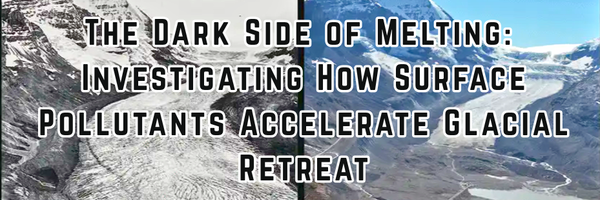
The dark side of Melting: Investigating how Surface Pollutants Accelerate Glacial Retreat
Amaryn Gordon, Christina Gavrilova
Branton School
Grade 7
Presentation
Problem
The problem we are researching is the way glaciers are melting faster in the rocky mountains, one of the reason beings is climate change, specifically coming from human activities, and we most want to focus on mine shafts. This is a big problem because the glaciers in the mountains produce the water that feeds the bow river and most of the freshwater that flows through alberta and bits of saskatchewan, which human rely on this water. also the glaciers would have been the freshwater supply of calgary for many years to come but because of the changes to the environment we cant be sure anymore.
Method
- Take one plate
- Layed out 3 as close as possible to identical ice cubes on one plate
- Sprinkled a thin layer of ground black pepper one ice cube
- Sprinkled thin layer of salt on ice cube number 2
- Kept the third ice cube clean
- Put the plate under one desk lamp
- Recorded in timelapse
- Watch timelapse
- Take any notes in changes and actions of ice
Research
Our research part focuses on our glaciers, how they melt and their importance. In our research we also included a big impact in human activities, and mainly focus on mine shafts and oil rigs and how their dust layers on top of the glaciers, which is what we’re experimenting. We also researched the main human activity factors that cause climate change like mine shafts, burning fossil fuels (greenhouse gasses), industrial and vehicle pollution, and how each works. And in the research conclusion we suggested an idea how to reduce the amount of dust from the mining pits.
Data
- The first obvious sign of movement was 6:30 minutes and it was the ice topped with pepper shifting
- At 9:42 you can clearly see the salt eroding at the ice.
- The pepper cube is clearly melting very quick at 12:27
- The regular cube shifted at 12:50
- Pepper cube shifted forward due to melting lots at the back at 14:20
- The salt cube is now getting skinnier as the salt erodes through it 16:30
- The salt is notable shrinking in at 20:00
- Regular one is melting slowly and crontrolably 20:21
- The regular and pepper shifted together at 23:45
- The salt has created a spikey pattern on the top of the ice as it melts through almost like whore frost
- All ice cubes shifted as they are now all touching at the ends
- All ice cubes are about the same size but the pepper one is slightly smaller at 28:15
- All of the ice cubes are thin and small at 34:00
- The salt melted at 43 mins but the pepper was not far behind
- The pepper melted at 46:00
- In one other experiment the pepper was the fastest
- Regular one is still strong
- Regular melted at 55:00
- The salt melted 22% faster than the regular
- The pepper melted 17% faster than the regular
- The lamp height was 12.5cm away from the ice
Conclusion
What we observed during the first experiment was that the ice topped with black pepper melted first proving our hypothesis about the albedo effect. The regular ice and the salt topped ice melted at about the same time because the salt was the same shade as the ice so not much was different between them. In our second experiment the salted ice cube melted faster and then the pepper 3 minutes later, proving that even if the pollutants are white, that doesn't mean they’ll stop the melting. In conclusion the fastest melted ice cube in our first was the one covered in the black pepper, while the salted covered cube melted about the same speed as the clean one. During our second try the one covered in salt was the first and the pepper one melted very soon after! So now let's stop this cycle of surface pollutants and factors and try moving on to more sustainable resources like solar, wind, hydro and any other new energy. And find solutions on how we can decrease the amount of dust and particles topping on our glaciers!
Citations
- Government of Alberta population data 1927
- Government of Alberta 2010 official population list
- Earth Data Nasa Albedo
- National snow and ice data center
- Parks Canada
- Government of Canada
- Iberdrola
Acknowledgement
We would like give a big thanks to our parents because they have helped us so much with materials for our experiment and inspiration for our research, we would also like to thank our school science fair organizer for helping us along the way and a big thanks to cysf for giving us opportunity to explore science, learn about different ways to do experiments and a place to show our work and learn what could be done better or what we did well. We are so excited to be able to present this to the university of Calgary and hear feedback from the judges!