

Rot or Not
Masha Gupta
Glamorgan School
Grade 7
Presentation
No video provided
Hypothesis
If organic waste is decomposed in the presence of oxygen, then the rate of decomposition will be significantly higher than in oxygen limited conditions, because aerobic microorganisms use oxygen to produce more energy and break down organic matter more efficiently.
Research
Aerobic vs. Anaerobic Decomposition Aerobic decomposition (with oxygen)
- Fast (due to the aerobic microbes that decompose the compost faster when oxygen is present)
- Produces heat
- Produces carbon dioxide and water
- Smells mild or earthy (not stinky)
- Happens in open air or oxygen‑rich environments
- Prevents large eruptions of methane because the landfills decompose quicker
Anaerobic decomposition (without oxygen)
- Slow because the oxygen does not properly reach the packed compost
- Produces methane, hydrogen sulfide, and organic acids
- Smells rotten or sulfur‑like
-
Happens in sealed jars, swamps, landfills or sealed together which is what most garbage facilities
-
Compostable waste is most commonly tightly sealed together making it impossible to reach oxygen and slows down the decomposition process
- compostable waste is most rapidly decomposed within the presence of oxygen, leading the decomposition process to slow down when in anaerobic conditions
- My experiment is testing the rate of decomposition in both aerobic and anaerobic conditions to see which version decomposes faster
- The reason this experiment is held is to lower the rate of methane production and increase the rate of landfill decomposition concluding the subtraction of the depletion of the Ozone layer,global warming, air quality degradation and many other petrifying subjects
- My research answers that allowing oxygen to flow through landfills will ensure faster decomposition,less global problems and a healthy earth
Organic Waste Decomposition
- Oxygen helps microbes (the cell inside compost that decomposes it) make lots of energy, so they can grow and break down food much faster.
- With oxygen, microbes create strong enzymes that quickly break apart the food’s cells.
- Mold needs oxygen to grow, so it spreads fast in the oxygen jar and speeds up rotting.
- Without oxygen, microbes make toxic chemicals (like acids and methane) that slow everything down
- Most of the fastest, most efficient decomposers are aerobic microbes, meaning they require oxygen to survive.
-
Organic waste comes from plants, food scraps, and other once-living materials Organic waste naturally breaks down over time Decomposition is carried out by microorganisms like bacteria and fungi Microorganisms need energy to survive and break down waste Oxygen can affect how fast decomposition happens Aerobic decomposition happens when oxygen is present Aerobic bacteria use oxygen to break down organic material It produces carbon dioxide, water
Calgary produces a large amount of organic waste, and much of it ends up in landfills where oxygen is limited, causing waste to decompose slowly and produce harmful gases like methane. There is a lack of widespread public understanding about how oxygen-rich decomposition methods (such as composting) can significantly speed up decomposition and reduce environmental harm compared to landfill conditions.
Variables
Independent variable: The independent variable is the amount of oxygen available to each jar. One jar is tightly sealed blocking oxygen from entering and one is loosely opened allowing air flow. Dependant variable: The dependant variable is the rate of decomposition in each jar. This will be observed by mold growth appearance or mass over time Controlled variable: The controlled variables include the type and amount of organic waves,the size of the jar sand the environmental conditions such as temperatures light and location, these factors are kept to ensure a fair test
Procedure
- Chop up 6 banana peels, 12 grapes and 6 potato peels into 2x1cm pieces
- Add each quantity of compost into each jar ( 1 chopped banana,1 potato skin and 2 chopped grapes into each jar)
- Poke holes in 3 of the jars lids a place a balloon on top of them to collect methane
- Let the remaining three jars rest without a lid
- Wrap each jar in translucent grid paper
- Count how many grids the mold covers every 3 days
- Measure the amount of compost that shrinks every 3 days
Observations
Analysis
Conclusion
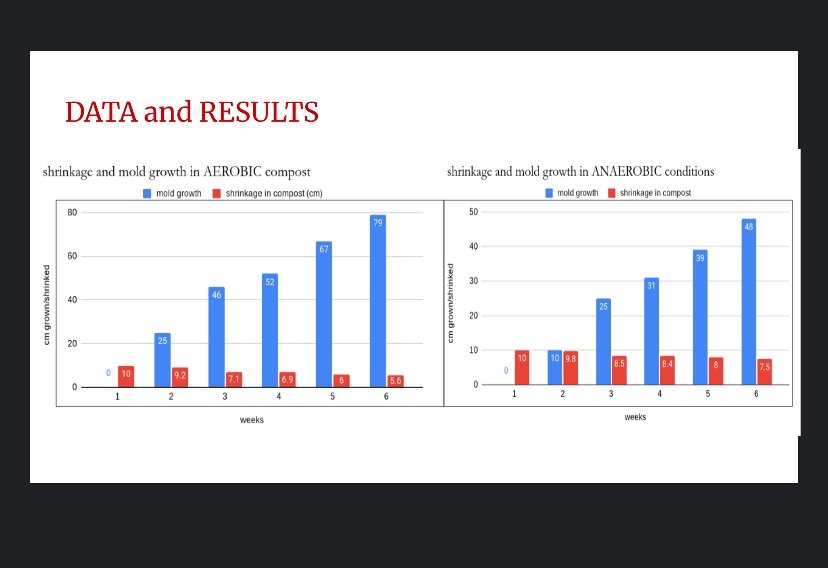
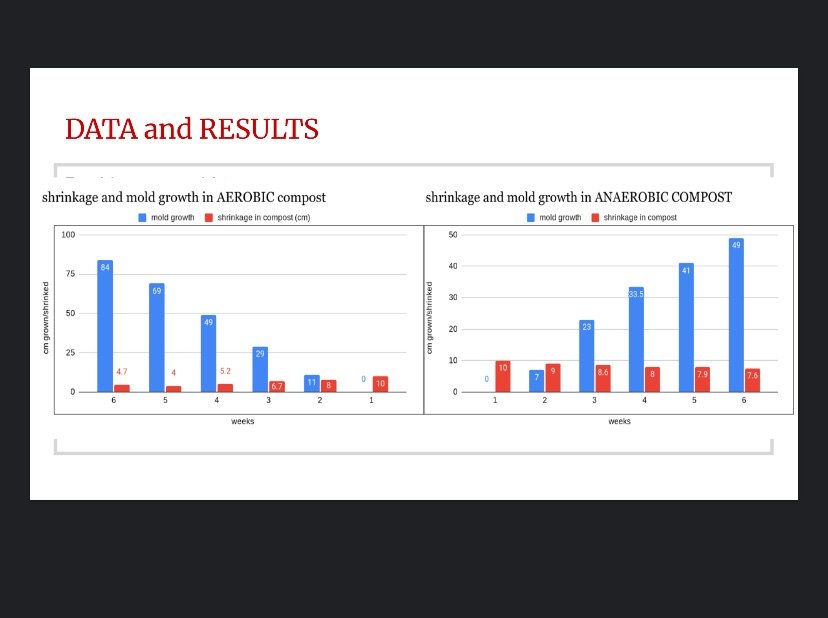
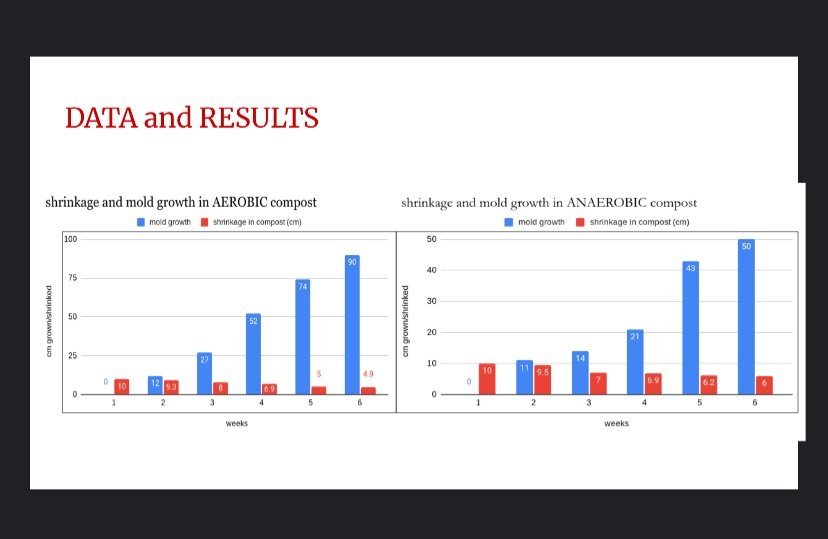
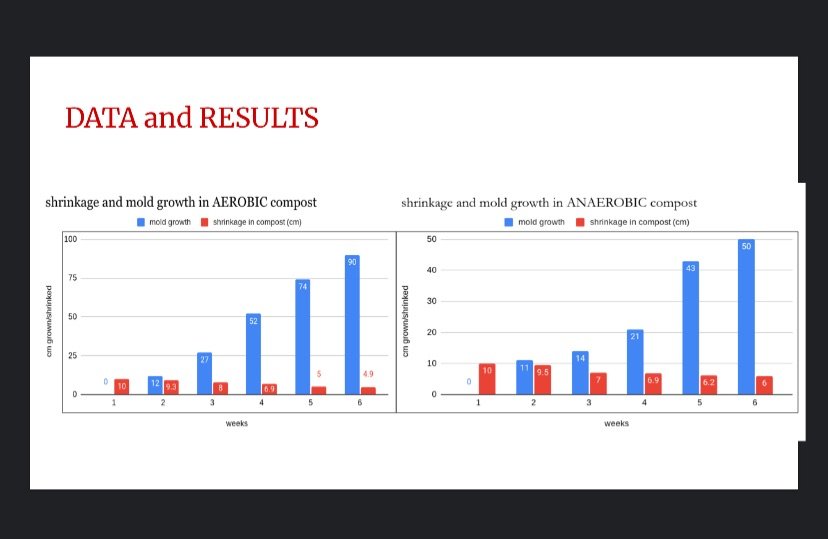
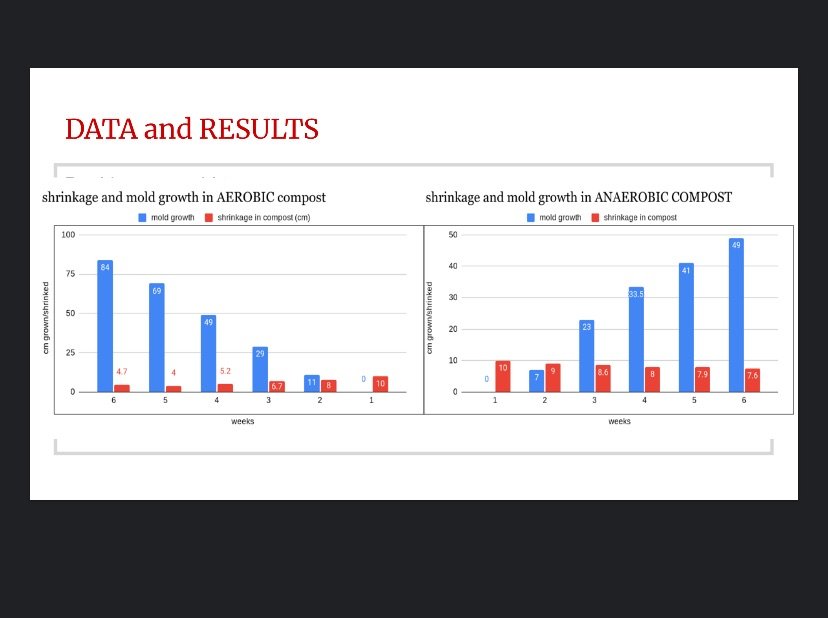
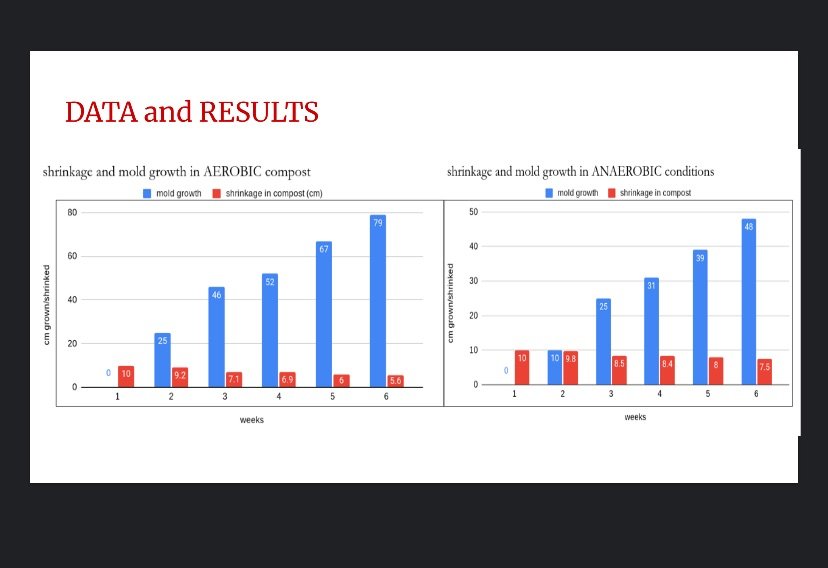
The results support my hypothesis that aerobic compost decomposes faster than anaerobic compost. The graphs show greater mold growth and more shrinkage in the aerobic samples, which are clear signs of faster decomposition. In contrast, the anaerobic compost had significantly less mold growth and less shrinkage, indicating slower breakdown due to limited oxygen. This shows that oxygen increases microbial activity and speeds up decomposition. To compost effectively, materials should be kept loose rather than tightly packed so air can circulate. Turning compost regularly helps maintain oxygen levels and promotes faster, more efficient decomposition.
Application
- Test different organic materials (fruit scraps, leaves, grass clippings) to see if decomposition rates change.
- Measure additional factors such as temperature, pH levels, and odor to better compare aerobic and anaerobic compost.
- Extend the experiment over a longer period of time to observe long-term effects.
- Find the bacterial growth
- Investigate greenhouse gas production (like methane in anaerobic compost) to study environmental impact.
Application is how we can reduce waste and reduce carbon foot print
Sources Of Error
- Test different organic materials (fruit scraps, leaves, grass clippings) to see if decomposition rates change.
- Measure additional factors such as temperature, pH levels, and odor to better compare aerobic and anaerobic compost.
- Extend the experiment over a longer period of time to observe long-term effects.
- Find the bacterial growth
- Investigate greenhouse gas production (like methane in anaerobic compost) to study environmental impact.
Citations
- GoodRx. (n.d.). How accurate are “best by” dates and other expiration date labels? GoodRx. https://www.goodrx.com/well-being/diet-nutrition/when-best-by-dates-packaged-foods-matter-most
- https://th.bing.com/th/id/R.3e2cc0e3924b010feaed937acd902a78?rik=PLtec%2bNq9OEUcw&riu=http%3a%2f%2fgetdrawings.com%2fcliparts%2fscared-clipart-36.jpg&ehk=6RNTf5emhDZdPUenRAFdsvBrgKZ8%2fIEokI1OtbrT5tw%3d&risl=&pid=ImgRaw&r=0. (n.d.).
- M Blevins. (2010, April 7). What causes the growth of bread mold and how to prevent it?. Biology Wise. https://biologywise.com/bread-mold-growth White Mold: Is it dangerous & how to remove it?. Mold Busters. (2024, March 22).
- Online.ucpress.edu. (n.d.). https://online.ucpress.edu/abt/article/59/4/220/15678/Fun-Microbiology-How-to-Measure-Growth-of-a-Fungus
- Tardi, C. (n.d.). What does expiration date mean for food and prescriptions drugs?. Investopedia. https://www.investopedia.com/terms/e/expiration-date.asp
- https://www.bustmold.com/resources/about-mold/types-of-mold/white-mold/#What%20Is%20White%20Mold?
Acknowledgement
https://docs.google.com/presentation/d/1iohVcfe6d26VAuocgaGSeioPYSOb0YbOkFjjcQmzgQA/edit?usp=sharing I would like to thank my parents and all teachers and staff who guided me through this project.