
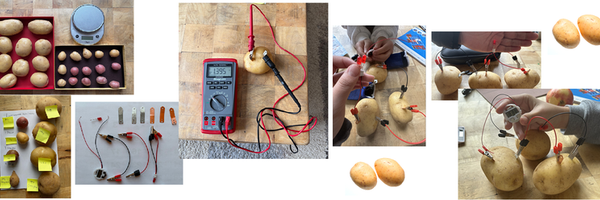
Potato Battery
Alison Chen, Anny Xu
Louis Riel School
Grade 6
Presentation
Hypothesis
If the potato used for the battery generation experiment is large and the state is raw, there will be more electricity generated, because there are no chemical changes compared to the other states of potatoes, and a larger potato would generate more energy, because, like normal batteries, the larger a battery is, the more electricity it generates.
Research
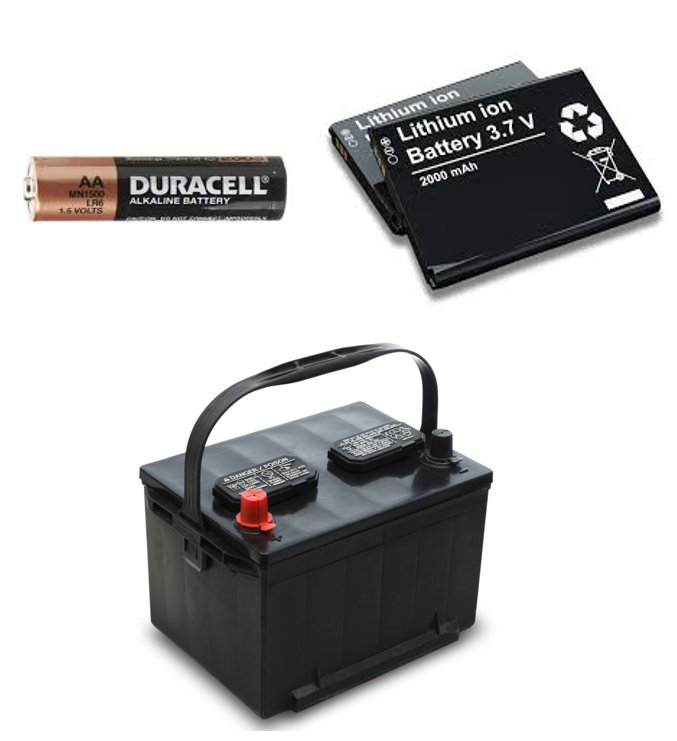
Research Question 1: What is a battery?
- According to Energy Education and the U.S. Department of Energy, a battery is a container for electrical energy.
- Its function depends on a chemical reaction, which typically occurs between two pieces of metal, called electrodes, and a liquid, called an electrolyte.
- The liquid electrolyte is the medium for ion transport, or the bridge, of a battery, while the electrodes are the positive and negative terminals that conduct electricity.
- There are many types of batteries, while an electrochemical battery has four key components, including the electrolyte, the anode (negative electrode), the cathode (positive electrode), and the separator (which separates positive and negative electrodes).
Research Question 2: What is a potato made of?
- A potato has parts similar to the liquid electrolyte that is needed for a battery, comprising one of its four basic components (Source: Potatoes 101: Nutrition Facts and Health Effects).
- According to the National Center for Biotechnology Information and Healthline, a potato is made of 77- 80% water, with the remaining matter composed mainly of carbohydrates (primarily starch), protein, fibre, vitamins (like Vitamin C and B6), and minerals (such as potassium and phosphorus).
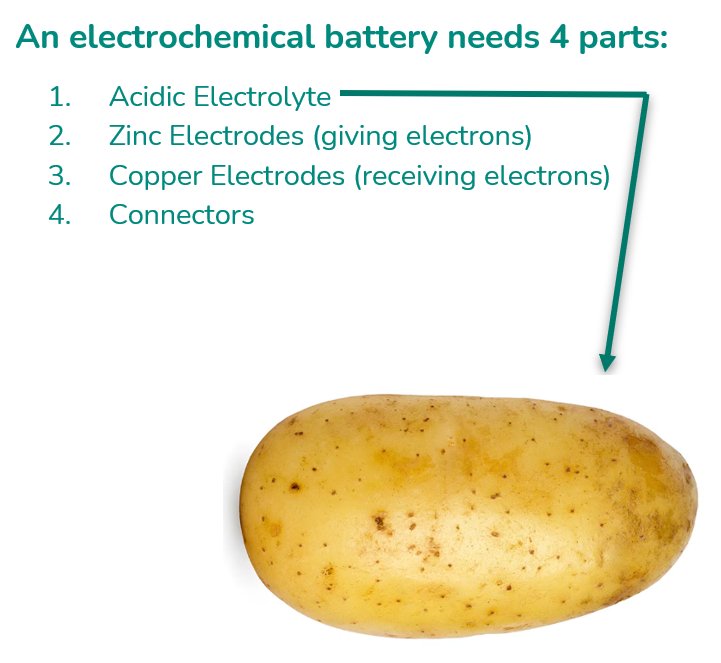
- A potato can generate electricity because the minerals and phosphoric acid act as an electrolyte, which most batteries need to work.
Research Question 3: What is needed to turn a potato into a battery?
- With a potato providing the acidic electrolyte for the battery, we need to prepare additional materials to create a closed circuit, as suggested by Energy Education.
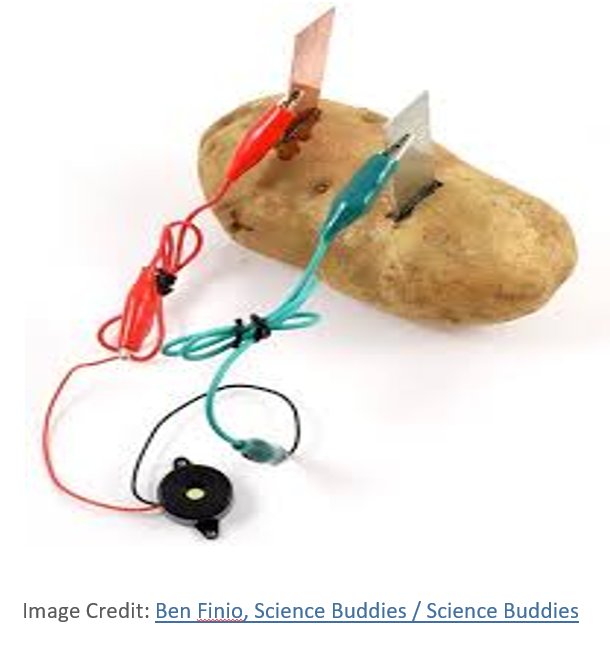
- Zinc and copper are needed as the positive and negative terminals, because they work well together to make electrons move, and that movement makes electricity. According to the U.S. Department of Energy, zinc likes to give away tiny particles called electrons, while copper is a good receiver of those electrons. As a result, when electrons move from zinc to copper through the acidic electrolyte in potatoes, they create electricity.
- Wires and alligator clips are needed to form a complete path or a closed circuit for the current to flow between the positive and negative terminals.
Research Question 4: How long will the battery last?
A potato battery can last a few hours to a few weeks, depending on the metals and the potato, but it will eventually run out of power like any other battery, according to Teach Engineering.
- Zinc used up: While the battery is working, the zinc electrode reacts with the acids in the potato and is dissolved during the electrochemical process. When it is eventually used up, it can no longer send electrons, and the battery will stop working.
- Metals clogged up: Over time, hydrogen gas forms around the copper electrode and oxide rust forms on the zinc electrode. The gas bubbles and rust will block the flow of electricity like barriers.
- Potato dried out: When the water in the potato dries out, or when the potato rots and the phosphoric acid stops functioning, the battery will also stop working because it can no longer transport electrons as the electrolyte.
Variables
Independent Variables
The state and size of the potato
- State: Steamed, Frozen–thawed, Raw, Dehydrated
- Size: Large, Small
Dependent Variables
The amount of electricity produced (voltage and current)
Controlled Variables
- The weight of potatoes
- The same wires
- The same metal electrodes (Zinc and Copper)
- The same room temperature
- The same measuring tools, e.g. the multimeter
- The distance between the two metal electrodes inserted into the potatoes
- Depth of metal electrodes inserted into the potatoes
Procedure
Procedure
- Prepare 8 potatoes, with 4 large ones and 4 small ones; potatoes in each weight cohort should have similar weights
- Divide 8 potatoes into 4 groups, with 1 large and 1 small in each group
- Keep potatoes in group 1 in their normal and raw status at room temperature of 21 °C
- Freeze and thaw potatoes in group 2 (freezing at -18 °C for 3 hours and thawing at 21 °C for 3 hours)
- Steam potatoes in group 3 (steaming for 45 minutes and letting them cool at room temperature for 2 hours to 21 °C)
- Dehydrate potatoes in group 4 (dehydrating in an air fryer at 195 °F for 4 hours)
- For group 1 potatoes, insert one zinc electrode and one copper electrode into each potato, using a ruler to keep the electrodes at the same distance and depth for both potatoes
- Connect the electrodes to a multimeter using wires and clips
- Measure and record the open circuit voltage (V) for each potato
- Measure and record the electric current (microampere or µA) for each potato
- Repeat the experiment for each potato in group 1 three times by changing the location of the metal electrodes (keeping distance and depth consistent)
- Repeat steps 7-11 for potatoes in groups 2 – 4, respectively
Project Materials
- 1 zinc item (like a galvanized nail)
- 1 copper item (like a copper wire or coin)
- 2 wires with clips
- Multimeter (to measure voltage)
- Potatoes (with different weights)
- Scale
- Ruler
- Knife (optional)
- Sandpaper (optional)
- LED or small clock (optional)
Preparation for Experiments
Prepare 8 potatoes in 4 groups

| Weight of Potatoes in Experiment | ||
|---|---|---|
| Small Potato (Grams) | Large Potato (Grams) | |
| Group 1 | Normal Status, raw | |
| 34 g | 212 g | |
| Group 2 | Frozen and Thawed | |
| Before | 34 g | 190 g |
| After | 34 g | 190 g |
| Group 3 | Steamed | |
| Before | 34g | 208g |
| After | 33g | 205g |
| Group 4 | Dehydrated | |
| Before | 34g | 194g |
| After | 22g | 148g |
Observations
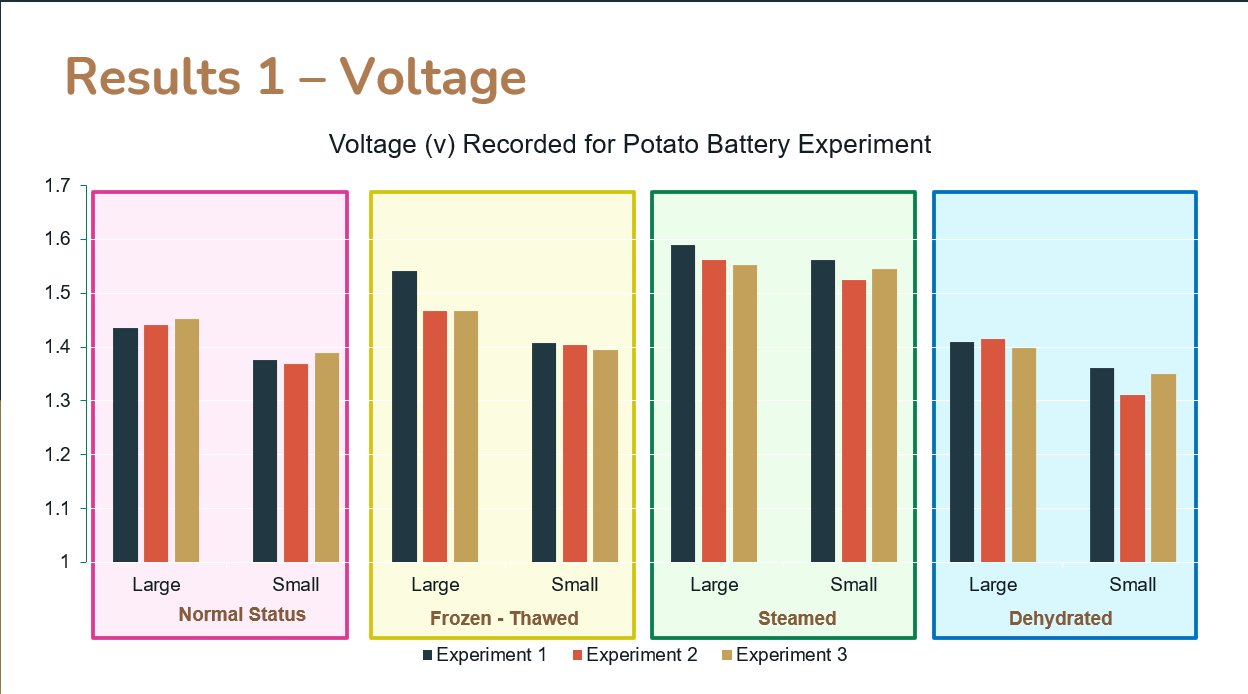
Observations - 1. Voltage
Voltage (V) Recorded for Potato Battery Experiment
| States | Normal | Normal | Frozed-thawed | Frozen-thawed | Steamed | Steamed | Dehydrated | Dehydrated |
|---|---|---|---|---|---|---|---|---|
| Sizes | Large | Small | Large | Small | Large | Small | Large | Small |
| Experiment 1 | 1.436 | 1.376 | 1.542 | 1.408 | 1.589 | 1.561 | 1.409 | 1.362 |
| Experiment 2 | 1.441 | 1.368 | 1.467 | 1.404 | 1.562 | 1.524 | 1.415 | 1.312 |
| Experiment 3 | 1.452 | 1.389 | 1.468 | 1.394 | 1.553 | 1.546 | 1.398 | 1.351 |
| Average | 1.443 | 1.378 | 1.492 | 1.402 | 1.568 | 1.544 | 1.407 | 1.342 |
Observations - 2. Current
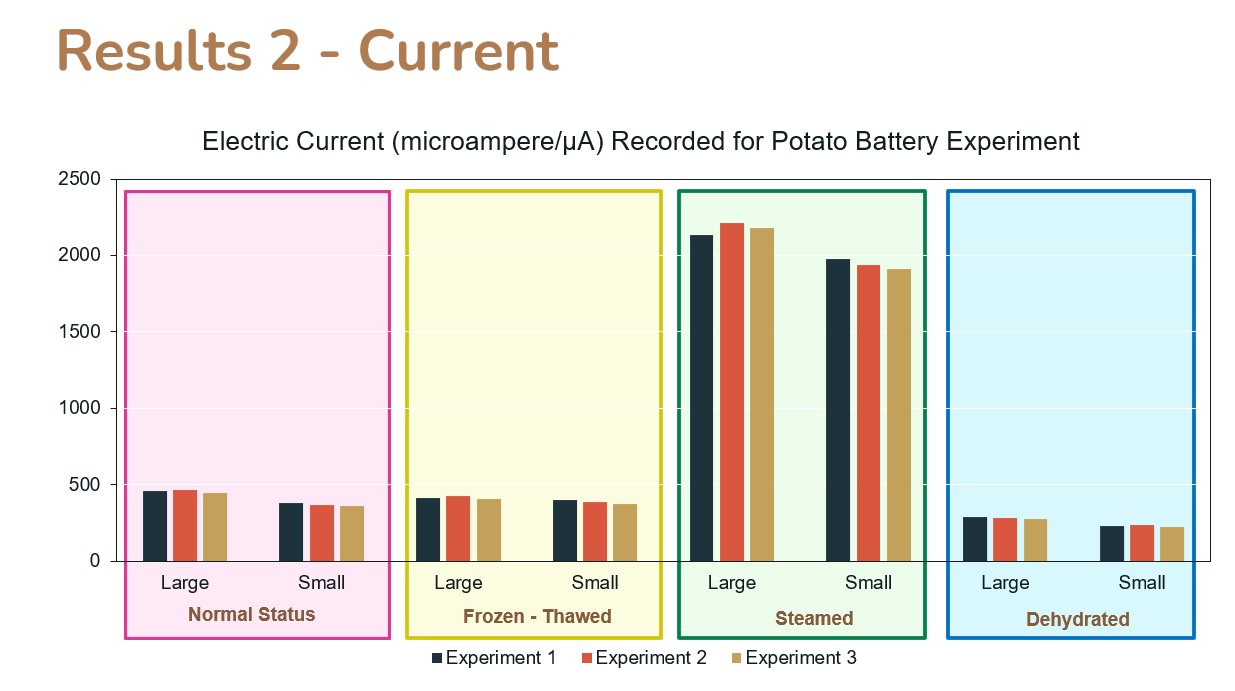
Electric Current (microampere/µA) Recorded for Potato Battery Experiment
| States | Normal | Normal | Frozen-thawed | Frozen-thawed | Steamed | Steamed | Dehydrated | Dehydrated |
|---|---|---|---|---|---|---|---|---|
| Sizes | Large | Small | Large | Small | Large | Small | Large | Small |
| Experiment 1 | 461 | 382 | 413 | 399 | 2132 | 1980 | 286 | 228 |
| Experiment 2 | 465 | 365 | 427 | 389 | 2215 | 1939 | 280 | 235 |
| Experiment 3 | 445 | 357 | 409 | 374 | 2182 | 1911 | 278 | 224 |
| Average | 457 | 368 | 416 | 387 | 2176 | 1943 | 281 | 229 |
Observations - 3. Summary
- Potato size affects the voltage generated out of it, with larger potatoes producing higher voltage than smaller potatoes. Except when potatoes are steamed, the large and small ones produce similar voltage.
- Potato size also affects current, with larger potatoes producing higher current than smaller ones.
- Steamed potatoes produce the highest current, while dehydrated potatoes produce the lowest.
- Voltage remains relatively stable across 4 groups, showing that it depends mainly on electrode size rather than the status of potatoes.
- Current changes more significantly with different statuses of potatoes, showing that it depends more on moisture content and cell structure for electric current generation.
- Frozen–thawed potatoes showed unstable current, changing over time on the multimeter.
Analysis
Revisiting our hypothesis
- The first half of our hypothesis is right: The size of potatoes impacts the voltage and current generated by the potatoes, with larger ones generating more than smaller ones.
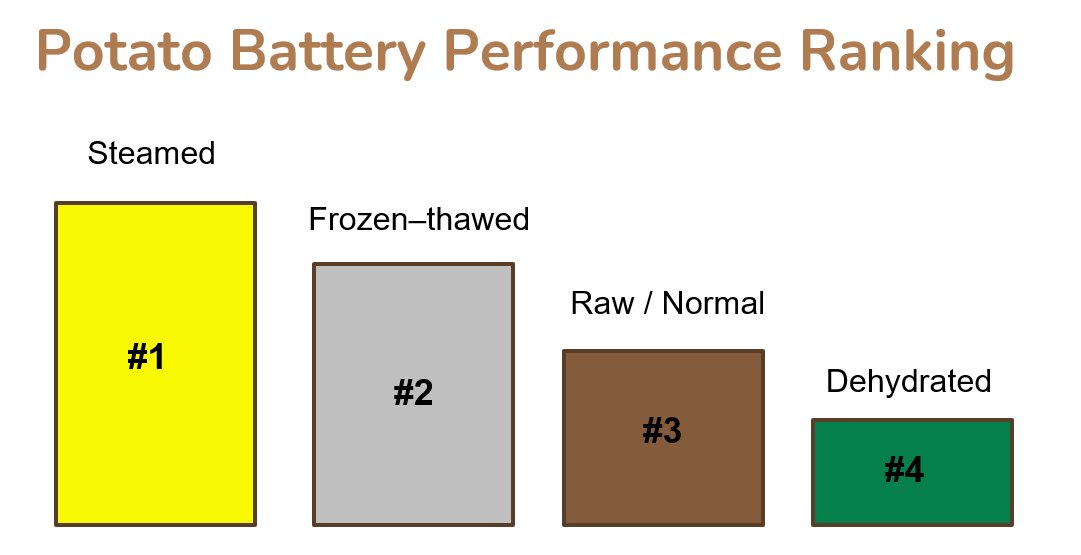
- But the second part of our hypothesis is wrong: We expected the raw potatoes would generate more electricity than potatoes in other states, but it turned out that steamed potatoes would generate the most electricity, then frozen and thawed ones, and then raw potatoes. They only generate more electricity than dehydrated potatoes.
Analyzing the results - Potato Size
Why do larger potatoes generate more current and slightly higher voltage?
- They contain more water and dissolved ions.
- They have lower internal resistance.
- A larger volume allows more charge to flow at the same time.
- Voltage stays similar because voltage depends mainly on the difference between the two electrode metals, not the potato size.
Analyzing the results - Potato State
1. Why do steamed potatoes generate the most electricity?
- Heat breaks down cell walls, releasing electrolytes
- Ions can move more freely
- Internal resistance is reduced
- Water content remains high
Steamed potatoes do not “generate” the most electricity; they allow electrons to move most effectively, because steaming breaks down cell walls more completely.
2. Why do frozen-thawed potatoes generate more electricity than raw ones?
- Freezing and thawing break cell walls
- Ions released into potato tissue
- Internal resistance is reduced
Frozen-thawed potatoes also act as a more effective electrolyte than raw ones.
3. Why do raw potatoes generate less electricity than the other two groups?
- Intact cell walls, trapping electrolytes inside cells
- Higher internal resistance
- Fewer free ions available
- Less effective electrolyte movement pathways
4. Why do dehydrated potatoes generate the least electricity compared to other groups?
- Reduced ion movement due to less water
- Less electrochemical reaction
- Internal resistance is increased
- Electrical current cannot flow easily without water
Conclusion
- Potatoes can generate electricity, and their size and status can impact the amount of electricity generated. Larger potatoes generate higher current than smaller ones due to lower internal resistance, while voltage depends mainly on the electrode metals.
- The status of potatoes impacts the amount of electricity generated in the order: Steamed > Frozen–thawed > Raw > Dehydrated
- Water content and cell structure affect electricity generation: treatments such as steaming, freezing and thawing improve ion movement and increase current, while dehydration reduces ion movement and decreases current.
Application
Application – What can it be used for?
Potato batteries can power small, low-power electric devices. It works better to connect multiple potatoes in series, such as LED lights and small digital clocks.

Application: How much power does a potato battery have?
- According to our research, the output of a large potato in its normal state is 1.443V (voltage) and 457µA (current).
Power = voltage × current = 1.443v × 457×10−6A = 0.000659451W
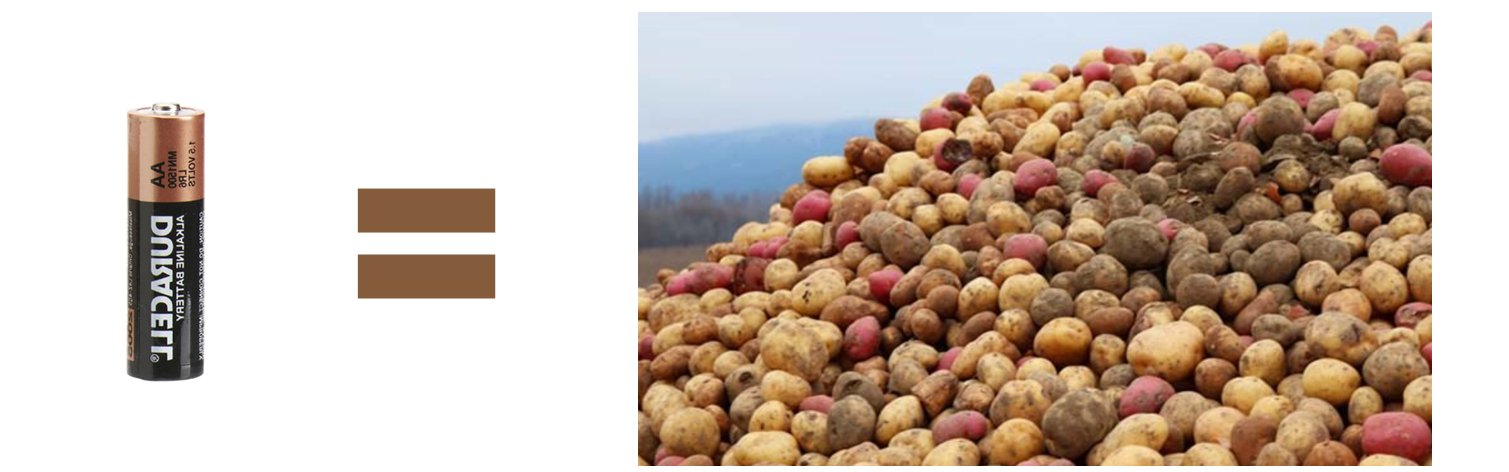
- In comparison, an AA battery has the power of about 1 Watt.
- To provide the power of one AA battery, we need (1 ÷ 0.000659451) = 1516 large potatoes
Application: Can potatoes power up Calgary?
How much power does Calgary need every month?
- An average Calgarian family uses 600 kWh per month, according to ENMAX
- There are about 500,000 households in Calgary
- Calgarians need 500,000 × 600 kWh = 300,000,000 kWh every month
How many potatoes are needed to power up Calgary for one month?
- (300,000,000 kWh × 30 days × 24 hours/day) ÷ (0.000000659451 kW) = 327,545,185,313,237,829 potatoes
- Over 327 thousand trillion potatoes are needed to power up Calgary monthly!
- More than the world’s total production of about 2 trillion potatoes per year.
No, potatoes cannot power up Calgary.
Future Research Questions
- Will different sizes of electrodes (zinc, copper) or different metals other than zinc and copper affect the battery performance?
- Does the way we grow the potatoes affect the battery performance? Will certain fertilizers or the planting process improve the power output?
- Can other crops, vegetables, or fruits be turned into a battery? How about sweet yams, squash, apples, oranges, or lemons? Will they generate more electricity?
- What factors make certain electrolytes more effective than others?
- Some countries (e.g. Brazil) use corn as biofuel to generate electricity. Can potatoes be used in a similar way as biofuel?
Sources Of Error
- Differences in potato size. Even though we tried our best to use potatoes of similar size and weight, we were unable to find 4 large potatoes with exactly the same weight.
- Difference in potato type. The large and small potatoes bought for the experiments are from different brands and types, which may result in different textures.
- Inconsistency in zinc and copper placement. We used a ruler to keep the distance between the zinc and copper electrodes and the depth of insertion the same. But there may still be slight inconsistencies due to the angle of insertion.
- Corrosion on zinc and copper. The zinc and copper items became corroded after multiple experiments. They may have become less effective compared to the first few experiments.
- Unstable current. Frozen–thawed potatoes showed unstable current. The recorded results may have errors due to the changes on the multimeter.
- Different recording times. Potato batteries lose voltage over time because electrochemical reactions slow down during the process. Results recorded at different times may be inconsistent.
- Different treatment results. Potatoes of different sizes were treated for the same amount of time. Large and small potatoes may not have been equally steamed, frozen, or dehydrated due to differences in mass, leading to unequal internal conditions.
Citations
- Science Buddies: "How to turn a potato into a battery" (https://www.sciencebuddies.org/science-fair-projects/project-ideas/Energy_p010/energy-power/potato-battery?ytid=GWIzEp2FZJE&ytsrc=description)
- Potato Power! (https://stemgeneration.org/potato-power/)
- Battery (https://energyeducation.ca/encyclopedia/Battery#:~:text=A%20battery%20is%20a%20device,extremely%20important%20in%20everyday%20life.)
- DOE Explains...Batteries (https://www.energy.gov/science/doe-explainsbatteries)
- Potatoes 101: Nutrition Facts and Health Effects (https://www.healthline.com/nutrition/foods/potatoes)
- Starchy Carbohydrates in a Healthy Diet: The Role of the Humble Potato (https://pmc.ncbi.nlm.nih.gov/articles/PMC6267054/)
- Impact of freezing rate on electrical conductivity of produce (https://pmc.ncbi.nlm.nih.gov/articles/PMC3843770/#:~:text=Results%20and%20discussion,higher%20values%20of%20electrical%20conductivity.)
- How Many Volts Does a Potato Produce? (https://biologyinsights.com/how-many-volts-does-a-potato-produce/)
- Potato power: the spuds that could light the world (https://www.bbc.com/future/article/20131112-potato-power-to-light-the-world)
- Hands-on Activity: Potato Power (https://www.teachengineering.org/activities/view/cub_energy2_lesson04_activity2)
- ENMAX: Real-time system demand (https://www.enmax.com/generation-and-wires/real-time-system-demand)
- Data about Calgary's population (https://www.calgary.ca/research/population-profile.html)
Acknowledgement
We would like to acknowledge our parents, for purchasing the research equipment and materials (potatoes), helping with the preparation by steaming the potatoes, taking photos, and helping us better understand how electricity works. We would also like to acknowledge our teachers, Ms. Shauna Murphy, Ms. Jill Metcalfe, and Mr. Braden Kubitz, for teaching us how to conduct science research step by step and for providing recommendations. Finally, we would like to thank Ms. Karen L. Davis, our teacher coordinator at the Louis Riel School of Calgary Youth Science Fair, for answering our questions about CYSF and for supporting this project.